Writing Class 3-5 Writing Short Reports
Warm-Up for Writing Short Reports

The famous scientist Albert Einstein once said, "I have no special talent. I am only passionately curious." Einstein understood that curiosity was the key to understanding the world.
Your curiosity can take you a long way, just like it did for Einstein. So never stop asking questions about the things that interest you. In this unit, you'll get a chance to question and learn about a holiday that sparks your curiosity and then write a short report about it.
What Is a Report?
Listen to “What Is A Report?”
A report shares true details about a topic. In a short report, you choose a topic you are curious about, find information about it, and share the most important details in a paragraph or two.
The lessons in this unit will help you write a short report about a holiday. Make sure you choose a holiday that you really care about, because you will need to learn more about it.
Thinking by Freewriting
To do your best writing about a holiday, you need to think about special memories associated with holidays. Freewriting can help. Freewriting means writing nonstop for 3-5 minutes about a topic. When you freewrite, you let ideas flow from your mind onto the paper. You don't stop to make corrections or second-guess yourself. You just keep writing! Here’s what a sample of what freewriting looks like.
Which holiday is my favorite? Hmmmmmmm Thanksgiving is awesome cuz of food and fun family time. I watch the Cowboys with my uncles even though I dont like sports that much. they make me giggle when they yell at the TV! Earth Day is another good one. It's not like thanksgiving or New Years we don't get off school or anything like that. Mom takes Ginger and me to the park. We bring these huuuuge trash bags and pick up garbage. One time a snake was hiding under a Doritos wrapper. Yikes!!! Mom points out different things on the nature trails. She knows so much about plants and trees. Earth Day reminds me of the fun I have with my family when we are outdoors like when we go camping and hiking and swimming. I guess Earth Day means a lot to me!
Freewrite about holidays.
Write freely about some of your holiday memories. If you are having trouble getting started, use one of the sentence starters below. Don’t worry about getting everything perfect. Just keep writing, even if the only thing you can say is "I can't think of anything to write."
- The best holiday I ever had was ________ because _________ . . .
- I’ll never forget the holiday when . . .
- My favorite holiday traditions are . . .
- The craziest thing that happened on a holiday was . . .
Reading Short Reports
Before you write your own short report, you can read an example from another student. It can help you understand the task ahead of you. Pay close attention to the types of details the writer uses, and click on the side notes to identify all the key parts.
Reading a Short Report
A short report shares important information to help readers understand a topic. The focus statement introduces the topic and says something special about it. The middle sentences give important details about the topic. The ending sentence sums up why the topic is important.
Sample Short Report
Listen to “What Is Earth Day?”
What Is Earth Day?
Focus StatementEarth Day is a holiday for protecting and caring for our planet. It is celebrated each year on April 22. The holiday was started in the United States in 1970 by a group of leaders and politicians who wanted to do more to protect the earth. Middle SentencesPeople around the world celebrate Earth Day by doing activities that support the environment. Some examples include cleaning parks and rivers, planting flowers and trees, and picking up trash in outdoor spaces. My mom takes my sister and me to the park every Earth Day to pick up litter and walk the nature trails. There is never a shortage of garbage to get rid of. Ending SentenceI like Earth Day because it reminds me of how important it is to care for the planet we call home.
React to the short report.
Answer the questions about the paragraph. Make a copy of this Google doc or download a Word template.
- What is the topic of the report?
- What is special about the topic?
- What is an example of a fact shared by the writer in the middle sentences?
- Does the writer share any surprising information? Give an example.
- What final thought does the report leave you with?

Prewriting for Short Reports
To write a good report, you need to choose a topic that interests you. Then you will research facts about the topic. These prewriting activities will prepare you to write a first draft.
Prewriting to Choose a Topic
Your first prewriting step is to choose a topic for your report. Make sure the topic is something you want to learn more about.
Explore writing topics.
Your short report in this unit will focus on a holiday. Explore the list of holidays below. Choose three holidays that you would most want to write about. If your favorite holiday is not included in the list, write it on one of the blank spaces.
Presidents' Day
Thanksgiving
Martin Luther King Day
Columbus Day
Memorial Day
Independence Day
Veterans Day
New Year's Day
Casimir Pulaski Day
Choose your topic.
Review the three holidays you selected in the activity above. Choose the holiday you most want to explore in your short report. In a sentence or two, explain why you chose this holiday. Make a copy of this Google doc or download a Word template.
- What is my writing topic?
- Why did I choose this topic?
Prewriting to Gather Details
Asking the 5 W's questions—who? what? when? where? why?—can help you gather the basic information about any topic. Answering the 5 W's about your holiday will ensure your report presents key information for your readers.
Answer the 5 W's questions.
Search for answers to the 5 W’s questions about your writing topic. You can find answers in books, Web sites, online videos, and encyclopedias. Make a copy of this Google doc or download a Word template.
Holiday Name:
- Who celebrates the holiday?
- What does the holiday celebrate or remember?
- When is the holiday?
- Where is the holiday celebrated?
- Why or how did it become a holiday?

Writing a Short Report
Once you finish prewriting, you are ready to start writing your report. This lesson's activities will help you write a strong beginning, middle, and ending. You'll also read another student's short report to see how to bring all of the parts together.
Writing the Beginning Part
Your report should begin with a focus statement. The focus names the topic and gives a specific thought about what makes it special.
- Specific topic: Casimir Pulaski Day
- Thought or feeling: Celebrates the birth of a Revolutionary War hero from Poland
Here’s the basic formula for creating a focus statement.
Topic + specific thought or feeling = focus statement
Casimir Pulaski Day celebrates the birth of a Revolutionary War hero from Poland.
Write your focus statement.
Answer the questions that follow and use your answers to create a focus statement for your report. Make a copy of this Google doc or download a Word template.
- What holiday will you write about? (topic)
- What does the holiday celebrate or remember? (specific thought)
- Write a single sentence that combines your answers to questions 1 and 2. (focus statement)
Writing the Middle Part
The middle part should explain important information about the holiday. The following activity will help you organize the information.
Write middle sentences.
For your middle part, write sentences that give more information about your topic. Use this part to answer the 5 W’s questions about your topic. You may need to do more research during this step. Make a copy of this Google doc or download a Word template.
- Write a sentence that shares the date of the holiday.
- Write a sentence or two about when or why it became a holiday.
- Write a sentence or two about things people do to celebrate the holiday.
- Write sentences about any other important details about the holiday.
- Combine your sentences to create the middle part of your report.
Writing the Ending Part
The ending part should put a personal touch on your report by sharing your feelings about the holiday.
Write your ending part.
Write a sentence or two for each ending strategy. Then choose one sentence to use, or combine the two ideas to create your ending part. Make a copy of this Google doc or download a Word template.
- Sum up what makes the topic special.
- Tell why you like the topic.
- Write your ending part.
Casimir Pulaski Day is not very well known.
I like Casimir Pulaski Day because my great-grandparents are from Poland. I get to eat pierogies and learn about my heritage every first Monday in March.
Reading a Sample Short Report
Read a draft.
Note how the writer put the parts together.
Listen to “What Is Casimir Pulaski Day?”
What Is Casimir Pulaski Day?
Focus StatementCasimir Pulaski Day celebrates the birth of a Revolutionary War hero from Poland. Pulaski led the cavalry for George Washington’s army. The state of Illinois created Casimir Pulaski Day in 1985 out of respect for Pulaski and Polish culture. Middle PartThe holiday happens on the first Monday of March in Illinois and on March 4 in Wisconsin. Polish-American neighborhoods honor Pulaski with parades, dances, and other events. Kids in Illinois even get off school for the holiday.
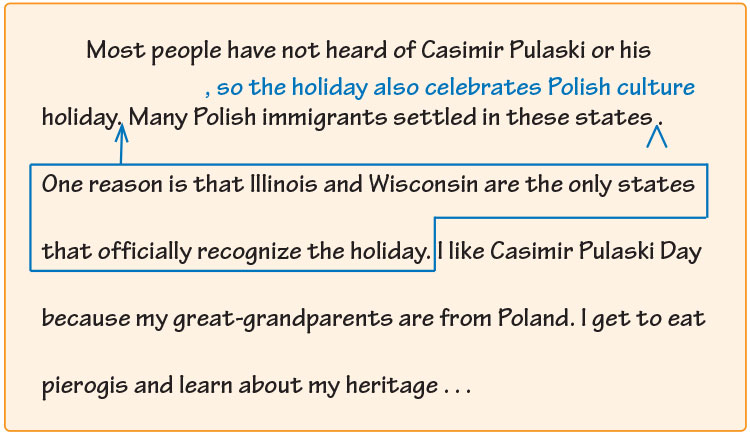
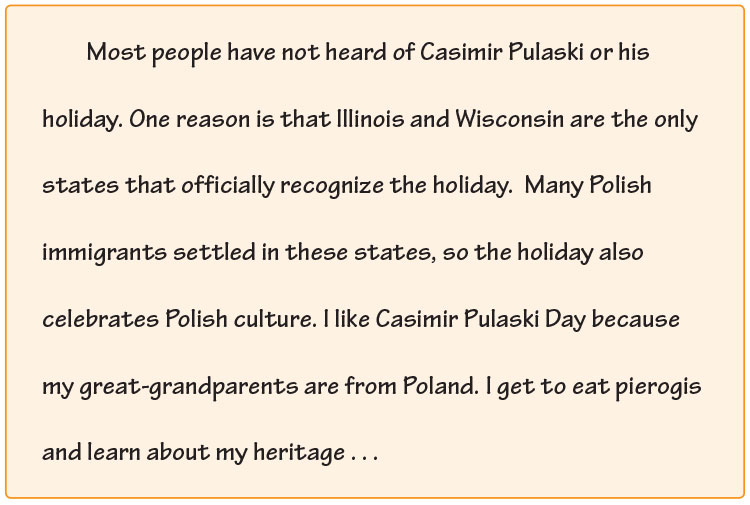
Most people have not heard of Casimir Pulaski or his holiday. One reason is that Illinois and Wisconsin are the only states that officially recognize the holiday. Many Polish immigrants settled in these states, so the holiday also serves as a celebration of Polish culture. Ending PartI like Casimir Pulaski Day because my great-grandparents are from Poland. I get to eat pierogies and learn about my heritage every first Monday in March.

Revising Short Reports
Once you draft your report, take a break. Afterward, you can read it with fresh eyes. Then you should revise your draft, making changes to improve it. These activities will help.
Revising to Add a Surprising Fact
You can make your short report more memorable by adding a surprising fact about the holiday. To do so, you may need to do some more research at the library or on a computer. Search books, Web sites, or videos.
- Unnecessary fact: The weather in the Midwest is often cold and raining during Casimir Pulaski Day.
- Surprising fact: Illinois and Wisconsin are the only two states that officially recognize Casimir Pulaski Day.
Add a surprising detail.
Do some research to discover another surprising fact about your holiday. Search for the best spot to add the fact to your report. If you find unnecessary details in your report, remove or replace them.
Revising to Reorder Details
When details are out of order, they sound choppy and confusing. Sometimes changing the order of sentences can make your writing easier to understand.
- Details out of order: One reason is that Illinois and Wisconsin are the only states that officially recognize the holiday. Most people have not heard of Casimir Pulaski or his holiday.
- Reordered for clarity: Most people have not heard of Casimir Pulaski or his holiday. One reason is that Illinois and Wisconsin are the only states that officially recognize the holiday.
Reorder sentences for clarity.
Reorder the sample groups of sentences so that they make better sense. (One example is provided for you.) Then check the order of sentences in your own report. Make a copy of this Google doc or download a Word template.
- Finally, we end the celebration with dessert. First, we snack on appetizers. Then we eat the main course.
- Most hawks live 10 to 15 years, but some live to be 30 years. Experts say hawks live a long time, but not longer than humans.
- Then add toppings. Finally, bake the pizza. First, make the crust.
- There are many reasons to celebrate Veterans Day. Another reason is to thank living veterans. The most important reason is to honor fallen veterans.
First, we snack on appetizers. Then we eat the main course. Finally, we end the celebration with dessert.
Revising with a Peer Response
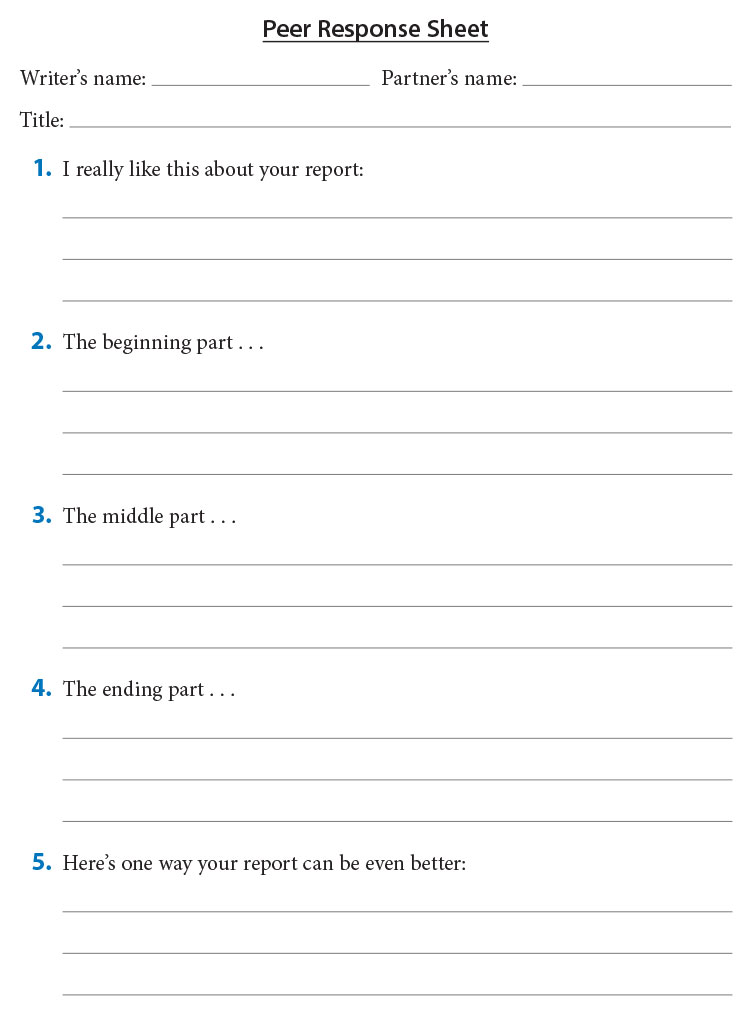
Share your writing.
Have a trusted classmate read your short report and complete the following form. Make a copy of this Google doc or download a Word template.
Revising in Action
When you revise, you add, delete, rewrite, and rearrange your writing to make it clearer. Here are some revisions to “What Is Caimir Pulaski Day?”
Paragraph Before Revising
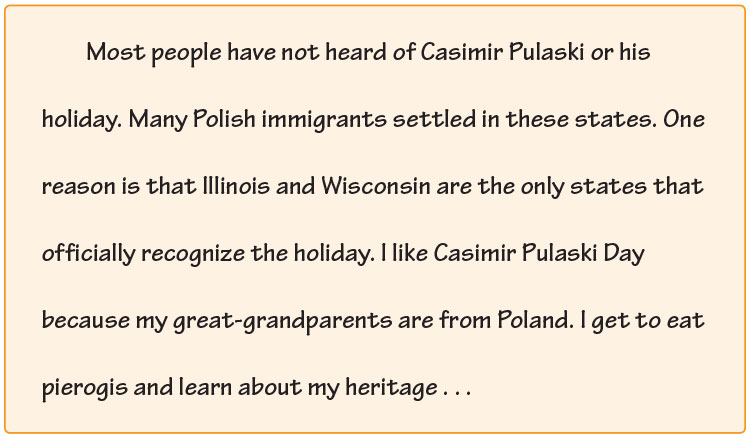
Details are added and reordered.
Paragraph After Revising
Revise with a checklist.
Read each line. When you can answer each question with yes, check it off. Make a copy of this Google doc or download a Word template.
Developing Your Ideas
- Is my topic interesting and specific?
- Does my focus statement include a topic and a specific thought about it?
- Does my report answer the main questions about my topic? Who? What? When? Where? Why?
- Do I include a surprising fact about my topic?
Structuring Your Ideas
- Do I start with my focus statement?
- Does the middle part include important details to explain my topic and support my focus statement?
- Does the ending share my feelings about the topic?

Editing Short Reports
After revising your report, you need to edit it to correct any remaining errors. You'll look closely at punctuation, capitalization, grammar, usage, and spelling. The following activities will help you edit your short report.
Editing to Fix Run-On Sentences
A run-on sentence is two sentences that run together. You can fix a run-on by placing end punctuation after the first sentence, or by connecting the two sentences with a comma and a connecting word (and, but, or).
Run-on sentence:
Corrected with end punctuation and capitalization:
Corrected with a comma and a connecting word:
The original Thanksgiving happened in 1621 it didn’t become a national holiday for another 202 years!
The original Thanksgiving happened in 1621. It didn’t become a national holiday for another 202 years!
The original Thanksgiving happened in 1621, but it didn’t become a national holiday for another 202 years!
Fix run-on sentences.
Fix the run-on sentences that follow. Fix at least two of the run-ons with a comma and a connecting word (and, but, or). Two examples are provided. Make a copy of this Google doc or download a Word template.
- Storm clouds approached our picnic we took cover in Dad’s truck.
Storm clouds approached our picnic. We took cover in Dad’s truck.
- The rain pounded the windshield we stayed dry.
The rain pounded the windshield, but we stayed dry.
- Dad told us stories about his childhood they were funny.
- Brianna couldn’t stop laughing I couldn’t stop laughing, either.
- The rain stopped we continued our picnic.
- We could have flown kites we decided to go swimming instead.
- It didn’t matter that the rain chilled the lake water nothing was stopping us from swimming and splashing around.
- We packed up the truck at the end of the day it was such fun day.
Editing Capitalization
The basic rules for using capital letters are simple: Capitalize the first letter of a sentence and all proper nouns. Names of days, months, holidays, teams, people, and geographic places are proper nouns. Also capitalize words used as names ("I told Mom" just like "I told Sharon" but "I told my mom" since you wouldn't write "I told my Sharon").
It was a Saturday baseball game at the end of May. My brother and I got permission from Mom to go to the game.
Capitalize proper nouns.
Capitalize the proper nouns in the following sentences. The first one is done for you. Make a copy of this Google doc or download a Word template.
- Last memorial day, my uncle took my brother and me to see the st. louis cardinals.
Last Memorial Day, my uncle took my brother and me to see the St. Louis Cardinals.
- The game was at busch stadium in st. louis.
- The cardinals played the pittsburgh pirates.
- My uncle said there was another game on tuesday.
- My brother said he didn't think mom would let us go; she wanted us to visit springfield, illinois.
- Maybe we'll get to go to another baseball game on independence day.
Editing in Action
When you edit, you check to make sure your report is correct.
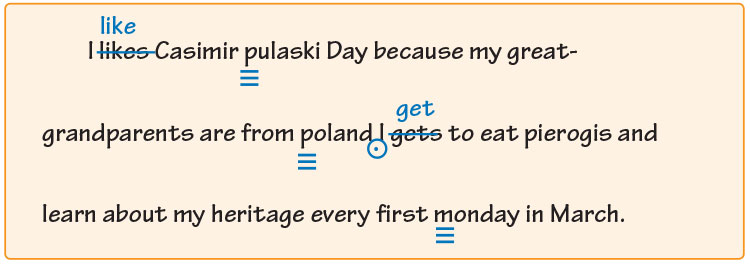
Paragraph Before Edits
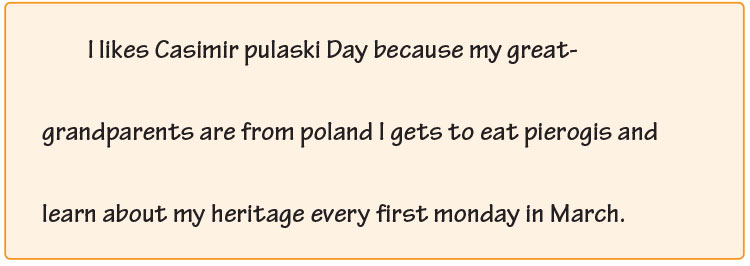
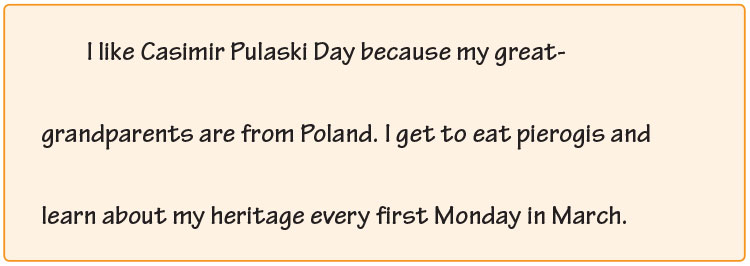
The writer fixes agreement errors, missing capital letters, and a run-on sentence.
Paragraph After Edits
Edit with a checklist.
Read each line. When you can answer each question with a “yes,” check it off. Make a copy of this Google doc or download a Word template.
Checking Grammar and Usage
- Have I used correct end punctuation after all of my sentences?
- Do my sentences have a subject and a verb?
- Do my subjects and verbs agree in number? (Bears eat, not bears eats.)
- Are sentences complete (no fragments or run-ons)?
Checking Capitalization, Punctuation, and Spelling
- Are first words in sentences capitalized?
- Are all proper nouns capitalized (names, months, holidays)?
- Have I used the right words (too instead of two)?
- Are words correctly spelled?

Publishing Short Reports
When you publish your report, you share a final copy with others. First, you need to make a clean final copy of your work. Then you should find ways to share what you have written with your classmates, teacher, family, and friends.
Publishing a Final Copy
Create a final copy of your short report.
Include your editing changes and read over your work a final time. (If you are working on a computer, spell check your work.)
Reflecting on Your Writing
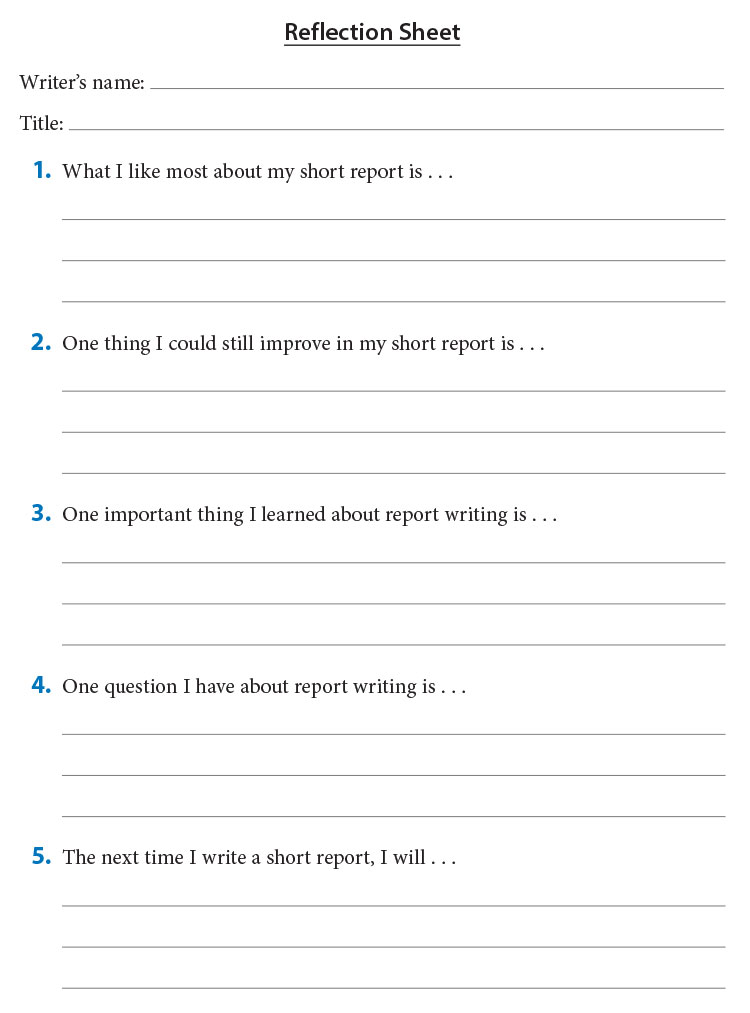
Reflect on your writing.
Complete the following form to think about what you learned. Make a copy of this Google doc or download a Word template.
Comments
Post a Comment