Writing Class 3-5 Writing Process Essays
Warm-Up for Process Essays
A process essay leads readers through a series of steps for getting something done. This lesson will help you think about different processes and which ones you might explain in an essay.
What Is a Process?
Listen to "What Is a Process?"
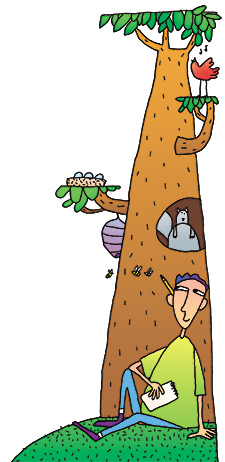
A process is a series of steps for getting something done. For a bird, building a nest is a process. For a bee or a squirrel, gathering food is a process. And for a student, writing a process essay is, itself, a process.
What processes do you know how to do? What processes could you explain to others?
When you write a process essay, you explain how to do something or how something works. Each paragraph in your essay focuses on a step in the process. The sentences follow time order, leading the reader from start to finish.
Process writing helps you get the job done!
Thinking About a Process
Most things don’t happen all at once. They take steps to finish. Even something as simple as shooting a free-throw:
- Stand at the free-throw line.
- Get the ball from the ref.
- Focus on the basket.
- Line up the shot.
- Shoot the ball.
- If you make the first shot, repeat the process.
You can organize the steps of a process by making a numbered list like the one above.
Time Line
You can also make a time line to put steps in time order. Start each line with a time-order word, and give the step.
Choose a process you can do.
Write down something you know how to do.
Organize the steps.
Create a numbered list or a time line. Make a copy of this Google doc or download a Word template.
Numbered List
Time Line
Reading a Process Paragraph and Essay
Before you explain a process, you'll want to see how others did so. This lesson shows you a process paragraph and a process essay, explaining each part. As you read them, think about how the writers put ideas together and how you might explain ideas in your process writing.
Reading a Process Paragraph
A process paragraph has three main parts. The topic sentence states the process. The body sentences describe the steps. The ending sentence wraps up the process. This paragraph describes the process of building a tree house.
Listen to "Tree House Summer."
Sample Paragraph
Tree-House Summer
Topic SentenceLast summer, my friends and I built a tree house in my back yard. We started by designing the tree house. Body SentencesThen we listed materials we needed and found a store that sold building supplies. We took our list and the money we had saved and went shopping. We loaded everything into my dad’s van and headed back. The first thing we had to do was build a frame for the floor of the house. (My mom helped with that.) Next we used a rope to raise all the wood up into the tree. We then carefully nailed the boards to the frame, and we soon had a floor. After that, we added walls and a roof. Ending SentencesWe now had a great place to hang out for the rest of the summer!
Respond to the paragraph.
Answer the following questions about the paragraph. Make a copy of this Google doc or download a Word template.
- What process does the paragraph describe?
- What words does the writer use to show time order?
Reading a Process Essay
A process essay has three main parts. The beginning paragraph hooks the reader’s interest and provides a focus statement. The middle paragraphs provide the steps of the process. The ending paragraph sums up the process in a thoughtful way.
In this essay, the writer uses commands to tell the reader just how to do the process. Headings and a list make the ideas clear.
Listen to "How to Build a Tree House."
Sample Essay
How to Build a Tree House
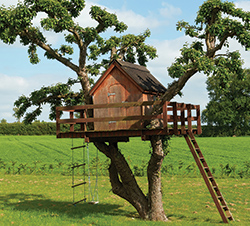
Beginning ParagraphHave you ever been up in a tree house? A tree house is a kids’ world in the sky. Last summer, Dad and I built a tree house in our back yard. With some lumber and the right tree, you can build your own tree house.
Step 1: Find the Right Tree.
Middle ParagraphsStart by looking for a tree for your tree house. It should be on property that you own. The tree should be big and strong, without a lot of dead branches. Also look for a tree that has branches arranged so that they could hold up a tree house. Get permission before you build anything.
HeadingsStep 2: Plan Your Tree House
Then, plan what kind of tree house you want. Will it have one floor or more? Will it have railings or walls? What kind of roof do you want? Once you get a plan, list the materials you need. Remember tools like a hammer, a drill, and a saw. Ask an adult to take you to a store to buy what you need.
Step 3: Build Your Tree House.
Finally, you are ready to build your tree house. Get an adult to help you, and be safe!
- ListBuild the floor. Make a square of strong wood like 2 X 6’s. Put more beams in rows 12 inches apart. Then add floorboards and attach the floor to the tree.
- Build walls or railings. Build them on the ground and lift them with ropes to attach them, or build them in the tree. Connect the walls in corners.
- Build the roof. A flat roof is easiest to build, but a peaked roof sheds rain better. You can put tar paper and shingles on to finish it.
Ending ParagraphWith a little work, you can build your own tree house. My dad said, "The best part is that we did it together." Become a builder and design your own kids’ world. See you in the trees!
Respond to the essay.
Work with a partner to answer these questions. Make a copy of this Google doc or download a Word template.
- How does the essay get your attention in the lead sentence?
- What sentence gives the essay a focus?
- What does time order mean?
- What words in the essay show time order?
- What final thought does the essay leave you with?

Prewriting for Process Essays
Prewriting is your first step in writing a process essay. These prewriting activities will help you select a topic to write about, create a focus statement, and gather and organize your details before you begin a first draft.
Prewriting to Focus Your Ideas
Plan your writing.
Use this sheet to plan your process essay. Make a copy of this Google doc or download a Word template.
- List three things that you know how to do really well.
- Which of these three processes would you like to explain in an essay?
- What tools and materials do you need for this process?
- What steps would you list for doing this process?
First,
Second,
Then,
Next,
Finally,
- What special thought or feeling do you have about this process?
Prewriting to Gather Details
Gather different types of details.
Gather information about your process. Find a detail for each example that follows. Make a copy of this Google doc or download a Word template.
- Facts are ideas that can be proven to be true.
Hamsters are the most popular rodent pets in the U.S.
- Definitions tell what a word means.
A gerbil is a rodent that looks like a large gray mouse.
- Examples show or illustrate a specific type of something.
A plastic hamster cage can have tubes attached for exercise.
- Sensory details focus on seeing, hearing, smelling, tasting, and touching.
Teddy bear hamsters have fluffy coats in gold, brown, and white.
- Quotations let people involved in the process speak about it.
Mom said, "If you get a pet, you have to take care of it."
Write a lead.
Read each lead-writing strategy and example and write your own. Make a copy of this Google doc or download a Word template.
- Ask a question about the process.
How would you like to have a living teddy bear?
- Say something interesting about the process:
A hamster may look like a teddy bear, but it is a living creature.
- Tell a little story about the process:
My hamster is my friend but is also my responsibility.
Write your focus statement.
Read about focus statements. Then write your own focus statement. Make a copy of this Google doc or download a Word template.
Your beginning paragraph should end with a focus statement. The focus statement names the process and gives a thought about it.
By following these steps, you also can have your own living teddy bear!
- Name the process.
- Give a specific thought.
- Write a focus statement.

Writing a Process Essay
Once you finish prewriting, you are ready to create the first draft of your ideas. These writing activities will help you create a strong beginning, middle, and ending for your process essay. You'll also read another student's essay to see how all of the parts came together.
Writing the Beginning Paragraph
Write your beginning paragraph.
Write your lead sentence and move to your focus statement. Make a copy of this Google doc or download a Word template.
Lead Sentence
Detail Sentences
Focus Statement
Writing the Middle Paragraphs
Write topic sentences.
For each middle paragraph, write a topic sentence that names the step. Make a copy of this Google doc or download a Word template.
- Write a topic sentence for step 1:
First of all, have your parent take you to buy a hamster.
- Write a topic sentence for step 2:
Next, you need to get a cage for your hamster.
- Write a topic sentence for step 3:
Afterward, you need to take care of your pet.
- Write topic sentences for any other steps:
You can even build mazes to help your pet get exercise!
Write middle paragraphs.
Write your topic sentences. Add detail sentences to support them. Use time-order transitions to connect your ideas. Make a copy of this Google doc or download a Word template.
Time-Order Transitions
first
next
then
afterward
to start
secondly
continue by
finally
last year
a week later
next month
by the end
before
when
during
after
Middle Paragraph 1
Topic Sentence
Detail Sentences
Middle Paragraph 2
Topic Sentence
Detail Sentences
Middle Paragraph 3
Topic Sentence
Detail Sentences
Middle Paragraph 4
Topic Sentence
Detail Sentences
Middle Paragraph 5
Topic Sentence
Detail Sentences
Writing the Ending Paragraph
Write your ending paragraph.
Try these ending strategies. Then combine some into an ending paragraph. Make a copy of this Google doc or download a Word template.
- Restate your focus.
Soon, you’ll find out that your little teddy bear is a lot like you.
- Tell readers to do something.
Treat your hamster to sunflower seeds, but not too many!
- Give a last thought.
As you learn more about your little friend, you become an even better big friend.
Read a sample.
Note how the writer put the parts together.
Listen to "Living Teddy Bears."
Read a Sample Process Draft
Living Teddy Bears
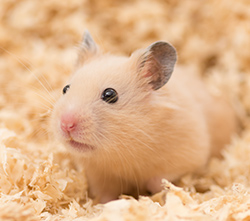
LeadHow would you like to have a living teddy bear? You can if you adopt a teddy bear hamster. Remember, though, that your hamster isn’t a stuffed animal but a living creature. Focus StatementBy following these steps, you can have your own living teddy bear!
Topic SentencesFirst of all, have your parent take you to buy a hamster. If you get a male hamster, you won’t end up with babies. Find a hamster that likes to be held and won’t bite. Give your hamster a great name. Mine is “Fuzzy Wuzzy.”
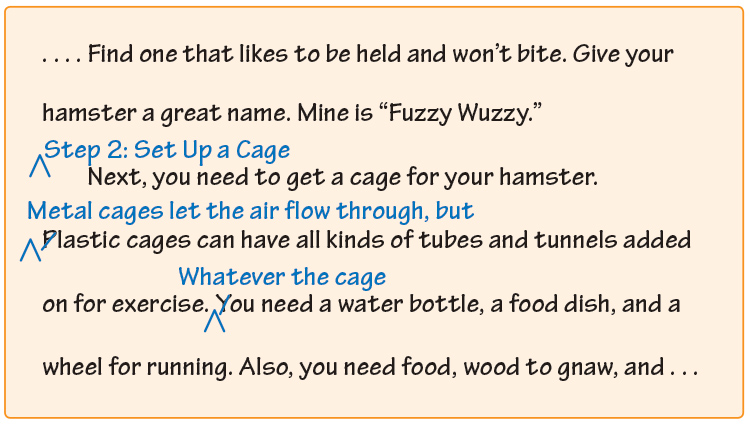
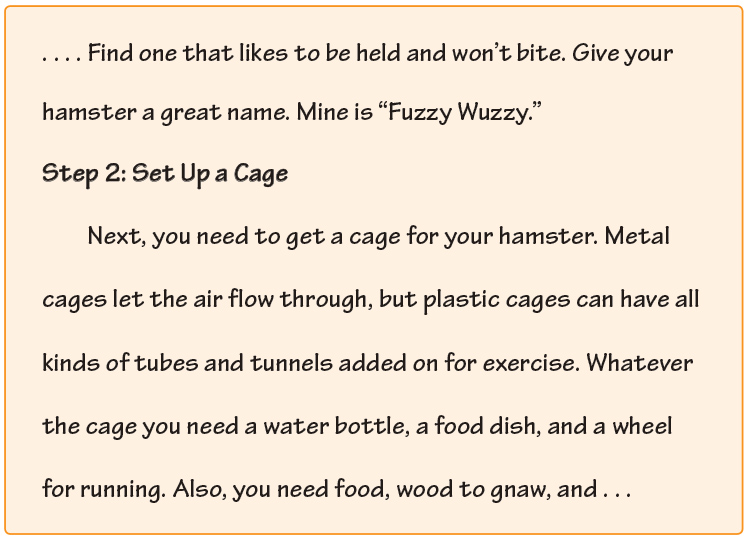
Next, you need to get a cage for your hamster. Detail SentencesMetal cages let the air flow through, but plastic cages can have all kinds of tubes and tunnels added on for exercise. Whatever the cage, you need a water bottle, a food dish, and a wheel for running. Also, you need food, wood to gnaw, and cedar bedding. Set up the cage in a safe, warm place away from cats.
TransitionsAfterward, you need to take care of your pet. Provide fresh food every day and water whenever the bottle gets low. Clean the cage once every week or so. Remember also to hold your hamster. Help your pet learn to trust you. You can also build mazes out of cardboard tubes and Pringles cans, so your pet has new, fun places to explore.
Ending ParagraphSoon, you’ll find out that your little teddy bear is a lot like you. You like treats like ice cream, and hamsters like treats like sunflower seeds, but not too many! You don’t like to get disturbed while you sleep, and neither do hamsters, though they like to sleep in the day. As you learn more about your little friend, you’ll become an even better big friend.

Revising Process Essays
Once you finish a first draft of your process essay, set it aside for awhile. When you return to it, you can see it anew. That's what revising means—seeing your work with new eyes. When you revise, you look at your essay from your reader's perspective to make sure you have included all of the important ideas and placed them in the best structure. These activities will help you revise.
Revising to Elaborate Details
To explain something, you need to elaborate. When you elaborate, you use different types of details to explain an idea.
Step 2: Get a cage
Next, you need to get a cage for your hamster.
Detail 1: Metal cages
Metal cages let the air flow through.
Detail 2: Plastic cages
Plastic cages can have all kinds of tubes for exercise.
Detail 3: Cage features
You need a water bottle, food dish, and wheel for running.
Elaborate details.
Use the following activity to come up with new details for your essay. Make a copy of this Google doc or download a Word template.
- Write down a step that is not as clear as it could be.
- Write a new detail that could help explain this step.
- Write another new detail that could help explain this step.
- Write a third new detail that could help explain this step.
- Review these details. Add some to your essay if they help you explain.
Revising to Add Headings and a Title
Write headings for your essay.
Follow these instructions to write a heading for each step. Then add the headings to your essay, before each middle paragraph. Make a copy of this Google doc or download a Word template.
- Write a heading on its own line before each step (middle paragraph).
- Make each heading bold.
- Capitalize the first and last words and all other words except short prepositions and a, an, and, but, or, nor, for, so, and yet.
Step 1: Shop for a Hamster
- Write a heading for step 1.
- Write a heading for step 2:
- Write a heading for step 3:
- Write headings for any other steps:
Write a title.
Try each strategy. Then add one title to your essay. Make a copy of this Google doc or download a Word template.
- Name the process.
How to Care for a Hamster
- Use an expression.
Fuzzy Wuzzy Wasn’t a Bear
- Be creative.
Living Teddy Bears
Revising with a Peer Response
Share your writing.
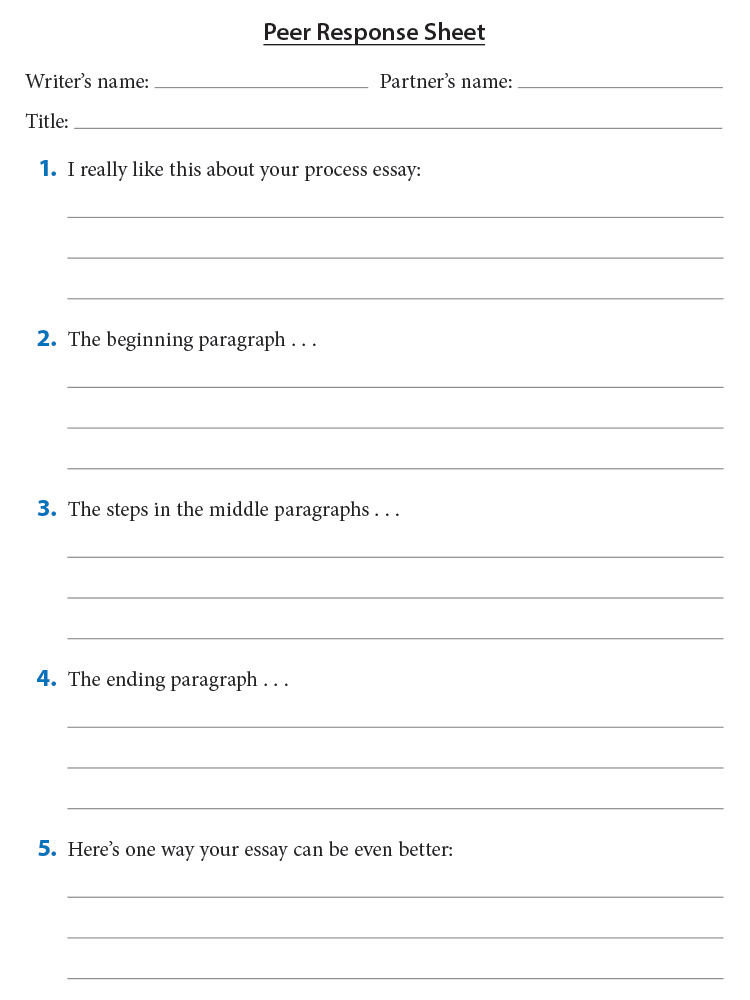
Have a trusted classmate read your essay and complete the form. Make a copy of this Google doc or download a Word template.
Revising in Action
When you revise, you add, delete, rewrite, and rearrange your writing to make it clearer. Here are revisions to the "Living Teddy Bears" essay.
Paragraph Before Revisions
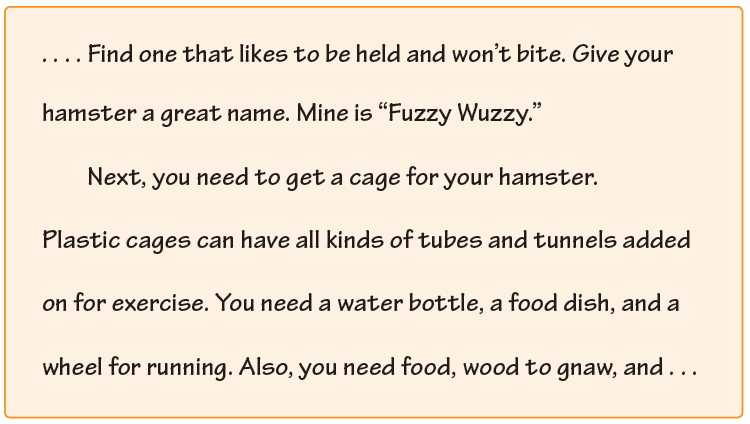
A heading, new details, and a transition are added.
Paragraph After Revisions
Revise with a checklist.
Read each line. When you can answer each question with a yes, check it off. Make a copy of this Google doc or download a Word template.
Developing Your Ideas
- Does the essay clearly explain an interesting process?
- Do facts, definitions, details, and examples help develop ideas?
- Does the voice effectively teach the reader how to do the process?
Structuring Your Ideas
- Does a lead hook the reader at the beginning?
- Does the beginning paragraph have a clear focus statement?
- Do middle paragraphs have topic sentences that name steps?
- Do transition words connect ideas effectively?
- Does an ending paragraph sum up the process?

Editing Process Essays
After making big changes to improve your process essay, you need to make little changes (editing) to correct any remaining errors. You'll look for problems with sentences, punctuation, capitalization, grammar, usage, and spelling. The following activities will help you edit your writing.
Editing Command Sentences
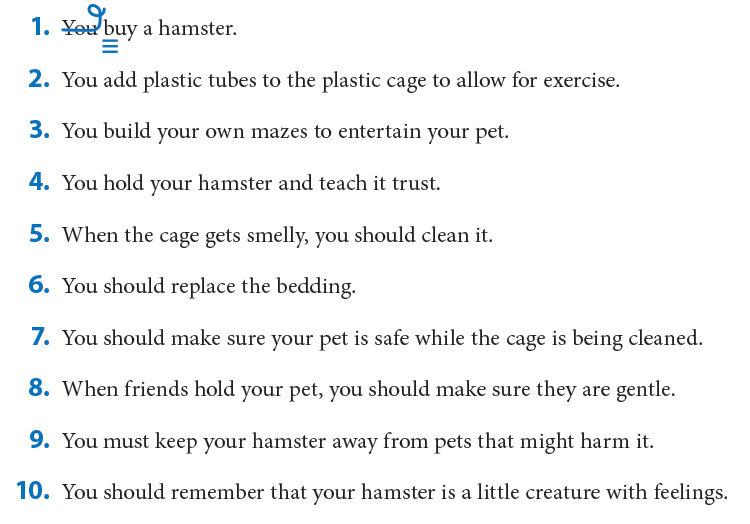
Commands usually start with verbs.
Clean the cage. Change the bedding. Fill the bottle.
What about a subject? Commands have implied subjects: you.
(You) Clean the cage. (You) Change the bedding. (You) Fill the bottle.
Watch the video "Command Sentences."
Change statements to commands.
Change statements to commands.
In the following statements, cross out “you” and helping verbs to create commands. Change capitalization as needed. The first one has been done for you. (Make a copy of this Google doc or download a Word template.)
Create commands.
In your essay, make some regular sentences into commands if they make your ideas clearer.
Editing for the Right Word
Some words sound the same but have different meanings and spellings.
Hold your hamster until you’re comfortable with it.
- Your is “owned by you”
- You’re is a contraction of “you are”
They’re nervous at first until they trust their owners.
- They’re is a contraction of “they are”
- Their is “owned by them”
It’s important for a hamster to gnaw wood to keep its teeth healthy.
- It’s is a contraction of “it is”
- Its is “owned by it”
When these word have apostrophes (’), they are contractions. When they don’t, they show ownership.
Choose the right word.
Circle the correct word in parentheses. The first one has been done for you. (Make a copy of this Google doc or download a Word template.)
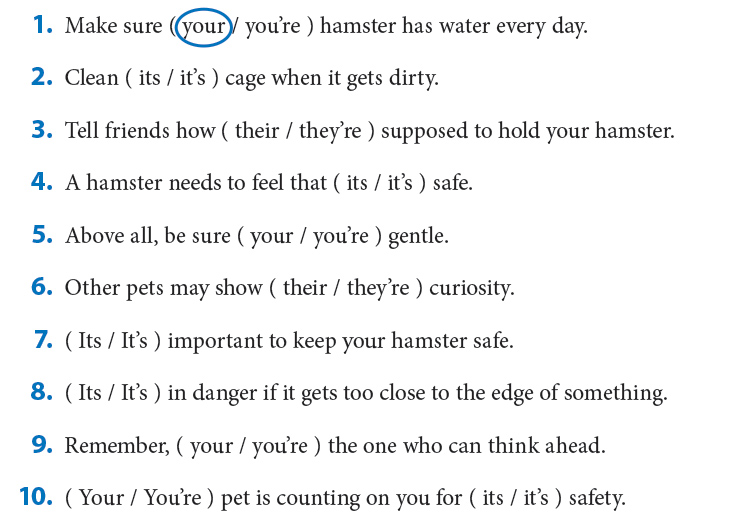
Edit for the right word.
Read your essay, paying attention to every time you use your/you’re, their/they’re, or its/it’s. Make sure you have used the correct form.
Editing in Action
When you edit, you check to make sure your essay is correct.
Paragraph Before Edits
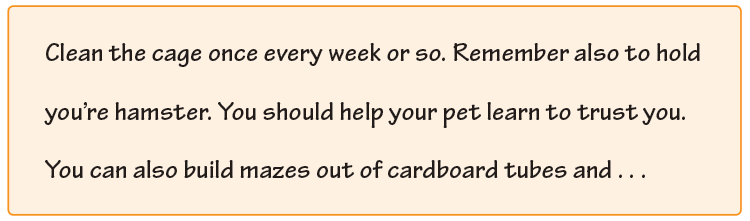
A usage error is fixed and a command sentence is created.
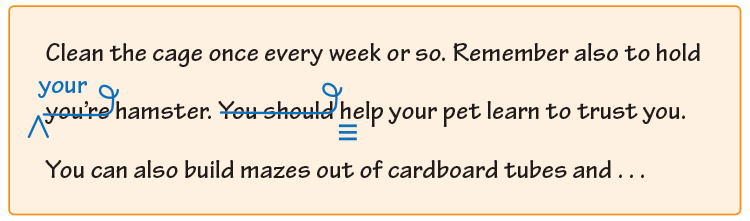
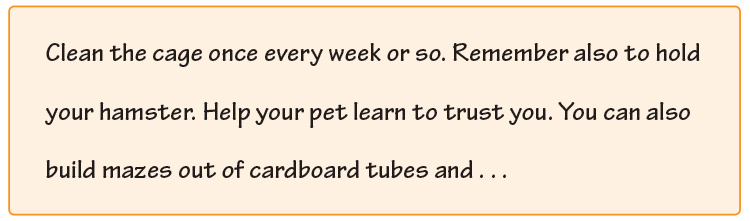
Paragraph After Edits
Edit with a checklist.
Read each line. When you can answer each question with a yes, check it off. (Make a copy of this Google doc or download a Word template.)
Checking Grammar and Usage
- Do command sentences help explain the process?
- Are words used correctly (your/you’re, their/they’re, its/it’s)?
- Are may, might, must, and other helping verbs used correctly?
- Are prepositional phrases used well?
- Are sentences complete (no fragments or run-ons)?
Checking Capitalization, Punctuation, and Spelling
- Are the first words in sentences capitalized?
- Are proper names of people, places, and things capitalized?
- Do commas and quotation marks set off quotations?
- Do compound sentences have commas before and, but, or or?
- Are words correctly spelled?

Publishing Process Essays
When you publish your process essay, you make it public, sharing it with others. First, you need to make a clean final copy of your work. Then you should find ways to share what you have written with classmates, your teacher, your family, and your friends.
Publishing a Final Copy
Create a final copy of your writing.
Include your revising and editing changes and read over your work a final time. (If you are working on a computer, spell-check your work.) Make a copy of this Google doc or download a Word template.
Reflecting on Your Writing
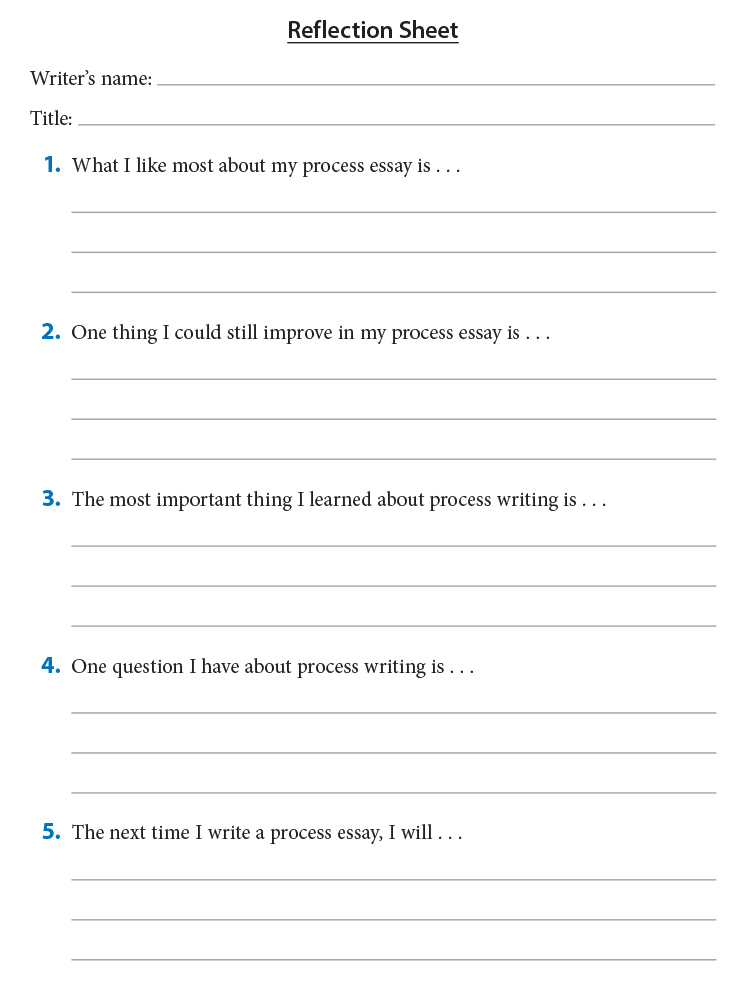
Reflect on your writing.
Complete the following form to think about what you learned. Make a copy of this Google doc or download a Word template.
Comments
Post a Comment