Writing Class 3-5 Writing Paragraphs
Warm-Up for Writing Paragraphs
Paragraphs are the building blocks of great writing. This unit will show you how to create paragraphs for three different purposes: to tell a story, to explain a topic, and to influence readers.
What Is a Paragraph?
Listen to "What Is a Paragraph?"
A paragraph is a group of sentences about one topic. Usually, the first sentence names the topic, and the other sentences give more details about it. In a well-written paragraph, sentences follow a clear order so that readers can quickly understand the topic.
Think of a paragraph as a telescope: It focuses on one specific idea and magnifies it so that people can see it more clearly.
Learning to write good paragraphs is essential to becoming a good writer. This unit will give you a chance to improve your paragraph-writing skills.
Thinking About Paragraphs
Well-organized paragraphs have clear beginning, middle, and ending parts. The following information will help you learn about the key parts.
The Topic Sentence
The topic sentence tells the reader what the paragraph is about. A good topic sentence does two things: (1) it names an interesting topic, and (2) it provides a specific thought or feeling about the topic.
interesting topic + thought or feeling = topic sentence
The trees all around us (interesting topic) give us much more than just shade (specific thought).
The Body
Body sentences include specific details readers need to understand the topic. The following sentences include plenty of specific details.
. . . Trees add beauty to the landscape and give shelter to wildlife. Different types of trees provide wood, paper, food, medicines, and many other useful products. Tree roots prevent soil erosion and help store water. Though it is something you cannot see, the most important thing trees do is help clean the air. Trees absorb carbon dioxide and produce oxygen, and people need oxygen to breathe. . . .
The Ending Sentence
The ending sentence sums up the paragraph. A good ending sentence leaves readers with an interesting final thought.
People can thank trees for a lot more than shade on a hot day! (restates the topic sentence)
Respond to the paragraph.
Answer the question about the paragraph. Then follow the instructions to write your own topic sentence and supporting details about trees. Make a copy of this Google doc or download a Word template.
- What detail gives the strongest support for the topic sentence?
- What is your favorite thing about trees?
- Write a sentence that names your topic (trees), and tells your favorite thing about them.
- What facts, examples, anecdotes, and other details could you give to support your topic sentence? List them below.
Writing Strong Beginnings and Endings
An effective paragraph begins with a clear topic sentence and ends with a strong closing point. These activities will help you practice writing these important parts.
Writing Topic Sentences
The topic sentence tells the reader what the paragraph is about. It names the topic and gives a thought or feeling about it. Most of the time, it is the first sentence of the paragraph.
Sample Topic Sentence
The new indoor skateboard park challenges even the best skateboarders.
- Specific topic: The new indoor skateboard park
- Thought or feeling: Challenges even the best skateboarders
Read topic sentences.
Write the topic and thought or feeling for each sentence. Make a copy of this Google doc or download a Word template.
- My brother’s room is the messiest room on the planet.
Topic:
Thought or feeling:
- Keeping a well-organized backpack is one of the keys to a good day at school.
Topic:
Thought or feeling:
Write a topic sentence.
Read the paragraph that follows. Then write a topic sentence. Make a copy of this Google doc or download a Word template.
The first thing you see when you walk into the observatory is a giant telescope. To get to the telescope, you need to climb stairs to a wooden platform. By standing on the platform, you can stretch your head high enough to look through the lens. What you see is amazing—Mars, Jupiter, Saturn, the Orion Nebula. Not only do you see stars and planets but other galaxies. A trip to the observatory helps you see the universe!
Topic sentence:
Writing Ending Sentences
An effective ending sentence sums up what you have said or provides the reader with a strong thought or feeling.
Sample Ending Sentence
That’s why the skate park draws riders from around town and the state.
- Specific topic: The skate park
- Final thought or feeling: Draws riders from around town and the state
Write ending sentences.
For each paragraph, write an ending sentence that sums up the paragraph or gives a strong thought or feeling. Make a copy of this Google doc or download a Word template.
Our new playground equipment is the best I’ve ever seen. The tire swings are huge, and you can sit or stand on them, which makes them even cooler. The climbing walls are all different sizes, so you can choose the one that’s right for you. And the landing area is soft and bouncy, so when you fall, it’s part of the fun. But the best part of all is the lookout tower. It’s three stories high and is connected by a whole bunch of ladders and tubes.
Ending sentence:
The school cafeteria is my favorite place in our school. That’s partly because I love the food they serve there, but that’s just one thing. I also like it because we can hang out and talk about all kinds of things, and no one tells us to be quiet. We can find out what time our next soccer practice is and what everyone is going to be doing after school. Sometimes, we even talk about school things, like what we need to do to finish our group projects.
Ending sentence:
Understanding Narrative Paragraphs
In a narrative paragraph, you tell a story about a personal experience. You try to pull your readers into the story and keep them wondering what will happen next. Be sure to include specific details to make your experience come to life.
Read a narrative paragraph.
Note how the author catches your interest in the topic sentence, describes the event, creates suspense, and closes the paragraph.
Listen to "Climbing Contest"
Topic SentenceLast Tuesday, I invited Danny, Julio, Renatta, and Mishiko to ride over to climb my favorite oak tree. We’ve all climbed the tree together before, but this time we decided to see who could climb the highest. Julio and Renatta climbed a little bit higher than usual, and I climbed almost to the end of one huge limb. Body SentencesMishiko climbed even higher than I did, but Danny won our little contest. Unfortunately, he didn’t realize how high he had climbed, until he looked down. He froze. He clung to the limb he was on and was afraid to climb down. What if he had to stay up in the tree all night? Renatta took off on her bike to tell her mom. Her mom called the fire department, and before long, an engine—with sirens blasting—arrived to rescue Danny. Ending SentenceIt was very exciting, but we also learned a lesson about climbing contests.
Respond to the narrative paragraph.
Answer the questions below to think about the important information that all narrative paragraphs need to include. Make a copy of this Google doc or download a Word template.
- Who was involved in this event?
- Where did it take place?
- When did it take place?
- What happened?
- Why did it take place?

Prewriting for a Narrative Paragraph
When you write a narrative paragraph, your goal is to share an interesting event or important experience. Start by gathering details about the experience.
Gather details.
Think about something interesting that happened to you recently. Answer these questions to gather details. Make a copy of this Google doc or download a Word template.
- Who was with you?
- What happened?
- When and where did it happen?
- What did you see, hear, smell, taste, or touch?
Create a time line.
Put the events in time order. You can use a time line to write what happened first, then, next, and finally. Make a copy of this Google doc or download a Word template.
Time Line
First | |
Then | |
Next | |
Finally |

Writing a Narrative Paragraph
After you gather details about your experience, you are ready to write your first draft.
Write a narrative paragraph.
Create a topic sentence that names the experience and gives a special thought or feeling about it. Write body sentences that describe events in time order. Create an ending sentence that wraps up the story. Make a copy of this Google doc or download a Word template.
Understanding Explanatory Paragraphs
Your main purpose in an explanatory paragraph is to give information about a subject. You may give directions, present ideas, or explain how to do something. An explanatory paragraph uses transitions such as first, then, after, and finally.
Read an explanatory paragraph.
Read the following paragraph. Note how the first sentence introduces the topic, the body sentences include details with time transitions, and the ending sentence wraps up the explanation.
Listen to "Building Our Tree House"
Topic SentenceLast summer, my friends and I built a tree house in our back yard. Our first step was to agree on a design for the tree house. Then we made a list of materials we needed and located a store that sold building supplies. We took our list and the money we had saved and went shopping. Body SentencesWe loaded everything into my dad’s van and headed back. The first thing we had to do was build a frame for the floor of the house. (My mom helped with that.) Then we used a rope to raise all the wood up into the tree. TransitionsAfterward, we nailed the floorboards to the frame, and we soon had a floor. After that, we added walls and a roof. It took us all afternoon, but it was worth it. Ending SentenceWe now had a great place to hang out for the rest of the summer.
Respond to the explanatory paragraph.
Answer the questions below to think about the explanatory paragraph. Make a copy of this Google doc or download a Word template.
- What pattern of organization does the writer use?
- Why is this an effective pattern for explaining an event?
- What is your favorite detail from this paragraph? Why?
- After reading this paragraph, would you like to build your own tree house? Why or why not?

Prewriting for an Explanatory Paragraph
An explanatory paragraph helps you explain something. The topic needs to be a fairly simple one. You should be able to explain it in five or six sentences. Start by gathering details about your topic.
Think of a topic.
Think of how to do something—a process that you can explain in a paragraph. Answer these questions to consider topics. Make a copy of this Google doc or download a Word template.
- What can you teach others to do?
- What can you explain to someone else?
Create a flow chart.
Choose a process to explain. Then fill each box with a step, in order. Make a copy of this Google doc or download a Word template.
Flow Chart
First,
Then,
Next,
Finally,
Writing an Explanatory Paragraph
After you have gathered details about your topic, you are ready to begin writing your first draft.
Write a topic sentence.
Write a sentence that names the process you will explain and gets the attention of the reader. Write body sentences giving steps in time order. Create an ending sentence that sums up the process. Make a copy of this Google doc or download a Word template.
Understanding Persuasive Paragraphs
In a persuasive paragraph, you give your opinion on a subject and try to get your reader to agree with you. To do this, you need to give facts and other reasons to support your opinion. Otherwise, you won’t persuade your readers.
Read a persuasive paragraph.
Note the opinion that the writer is presenting and supporting. Pay special attention to the reasons the writer gives for the opinion.
Listen to "Perfect Tree House Place"
Opinion StatementKids need a place to call their own, and a tree house is the perfect place. For instance, a tree house gives my friends and me a chance to get away from the pressures of school, homework, and little brothers or sisters. We can just hang out and be ourselves. Body SentencesWe can also decorate our tree house any way we want. In addition, a tree house is a good place for thinking, playing music, looking at the sky, or just being with friends. ReasonsSure, if we didn’t have this kind of place, we’d find other ways to keep busy. We’d go to the mall, text our friends, play video games, or just watch TV.Ending SentenceBut doesn’t a tree house sound like a better place for kids to spend their time?
Respond to a persuasive paragraph.
Answer the following questions about the persuasive paragraph. Make a copy of this Google doc or download a Word template.
- What opinion does the writer express?
- What reason do you think provides the strongest support?
- Why does the writer include information about other activities than being in a tree house?
- Why does the writer end the paragraph with a question?
Prewriting for a Persuasive Paragraph
A persuasive paragraph expresses your opinion about a topic and gives reasons to convince others to agree with you. What strong opinions do you have? Which could you support in a paragraph to persuade others?
Think of a topic.
Answer these questions to think of an opinion you can write about. Make a copy of this Google doc or download a Word template.
- What is the best part about school?
- Who has been your favorite teacher? Why?
- What is a big problem at your school?
- What one school rule would you like to change?
Gather supporting reasons.
Choose an opinion from above. Write down supporting reasons. Make a copy of this Google doc or download a Word template.
Reason Chart
What is your opinion?
Why is your opinion correct?
What is another reason?
What is a third reason?
Writing a Persuasive Paragraph
After you have chosen a topic and reasons to support it, you are ready to begin writing the first draft.
Write an opinion statement.
Write an opinion statement, which names your opinion and gets the attention of the reader. Write body sentences to give reasons that support your opinion. Create an ending sentence that sums up your opinion. Make a copy of this Google doc or download a Word template.

Revising Paragraphs
Once you draft a paragraph, take a break and come back to it to see it freshly. When you revise, you check your writing for its ideas and structure. These activities will help you revise.
Revising for Structure
Your first job in revising is to check the overall structure of your paragraph. Choose one of the paragraphs you have written and check each part below.
Check your topic sentence or opinion statement.
Answer these questions about your first sentence. Apply any changes that will improve your first sentence. Make a copy of this Google doc or download a Word template.
- How could my first sentence more clearly identify my topic?
- How could I capture my reader’s attention in the first sentence?
Check your body sentences.
Answer these questions about your body sentences. Apply any changes that will improve them.
- What new idea would strengthen my support?
- What idea could be deleted to create better focus?
- What idea could I rewrite to make clearer?
Check your ending sentence.
Answer this question and apply any changes.
- How could I make my ending sentence more interesting?
Revising to Elaborate Details
Your body sentences need to include a variety of details that elaborate on the first sentence. Choose a paragraph you have written and use this activity to think of a variety of new details for it.
Elaborate details.
For each type of detail, think of an example that works with your paragraph. Consider adding new details to your paragraph. Make a copy of this Google doc or download a Word template.
- Facts are ideas that can be proven to be true.
Pete Nelson has made a living building tree houses for adults.
- Definitions tell what a word means.
A suspension bridge is held up by ropes or cables.
- Examples show a specific type of something.
A bridge can connect one tree house to another.
- Sensory details focus on seeing, hearing, smelling, tasting, and touching.
During hot summer days, tree houses get shady breezes.
- Quotations let people involved speak about the process.
Dad said, "The tree house will be your own little home."
Revising for Organization
When you revise your paragraph, make sure you have placed details in the best order. Use transition words and phrases to help connect your ideas.
Time Order
Time order places details in the order in which they happened. Time order works well in narratives or paragraphs about a process.
. . . The first thing we had to do was build a frame for the floor of the house. Then we used a rope to raise all the wood up into the tree. Afterward, we nailed the boards to the frame, and soon we had a floor. . .
Transitions that show time
about
after
at
before
during
first
second
third
until
meanwhile
today
tomorrow
yesterday
next
soon
later
finally
then
as soon as
when
Check time order.
Organize details in time order in your narrative or explanatory (process) paragraph. Use transitions to connect your ideas.
Order of Location
Order of location usually goes from left to right, from top to bottom, or from near to far. Descriptive paragraphs often use this pattern.
. . . The tree’s trunk is so wide I can’t reach my arms around it! Its bark forms funny patterns as it crawls up toward the sky. . . .
Transitions that show location
above
across
against
along
among
around
behind
below
beneath
beside
between
by
down
in back of
in front of
inside
into
near
off
on top of
outside
over
throughout
toward
up
Order of Importance
Order of importance moves from most important to least or the other way around. Persuasive paragraphs often use this pattern.
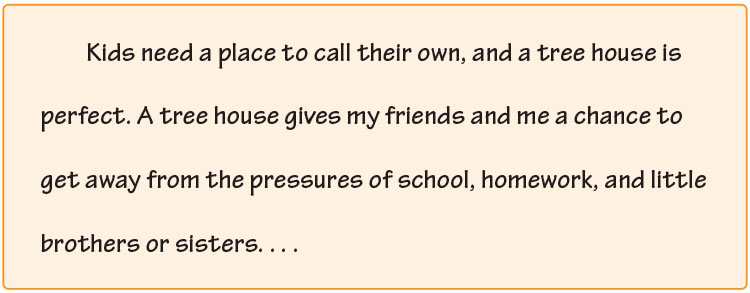
. . . Kids need a place to call their own, and a tree house is perfect. For instance, a tree house gives my friends and me a chance to get away from the pressures of school, homework, and little brothers or sisters. . . . .
Transitions that show importance:
obviously
therefore
because
as a result
for instance
for example
for that reason
clearly
again
and
next
finally
as well
along with
in addition
in conclusion
Check order of importance.
Organize details in order of importance in your persuasive paragraph. Use transitions to connect your ideas.
Comparison-Contrast Order
When writing focuses on the similarities and differences between two topics, it uses comparison-contrast order. Sometimes writing will focus on similarities first and differences after. Sometimes it will focus on one subject completely and then the other. Sometimes it will compare and contrast them point by point.
. . . Most pine trees have a straight central trunk, while most deciduous trees have branches that spread outward from the center. It’s easier to find space for a tree house in a broad-leaf tree. Also, pines have soft wood and sticky sap, whereas deciduous have hard wood and watery sap. . . . .
Transitions that compare
in the same way
similarly
likewise
like
as
also
too
and
Transitions that contrast
on the other hand
even though
otherwise
however
but
while
although
whereas
Revising in Action
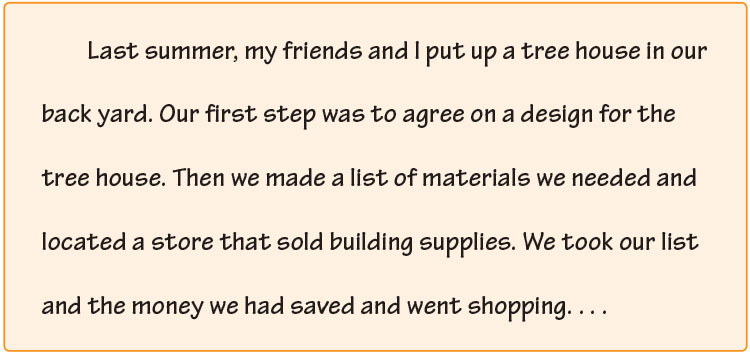
When you revise, you add, delete, rewrite, and rearrange your writing to make it clearer. Here are revisions to the tree-house explanatory paragraph.
Paragraph Before Edits
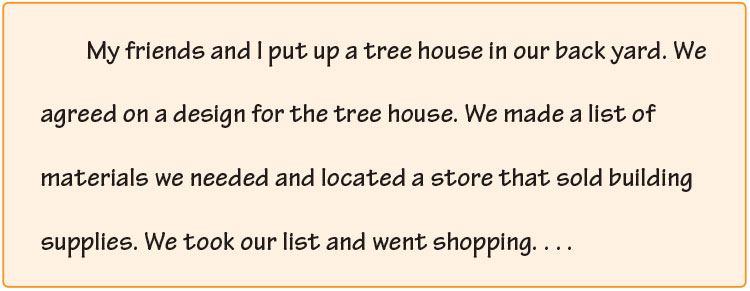
Transitions and a detail were added.
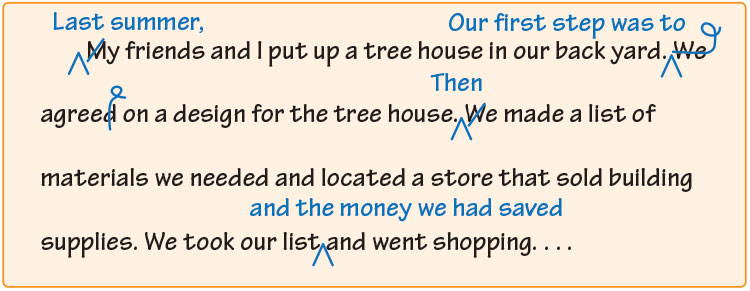
Paragraph After Edits
Revise with a checklist.
Read each line in the checklist. When you can answer each question with a yes, check it off. Make a copy of this Google doc or download a Word template.
Developing Your Ideas
- Do I clearly name my topic?
- Do I develop my topic with facts, definitions, details, and examples?
- Does the voice show my interest in the topic?
Structuring Your Ideas
- Does a topic sentence begin my paragraph?
- Do body sentences support my topic sentence?
- Does an ending sentence sum up the paragraph and leave the reader with an interesting final thought?
- Do transition words connect my ideas effectively?

Editing Paragraphs
After making big changes to improve a paragraph, you need to make little changes (editing) to correct any remaining errors. You'll look for problems with sentences, punctuation, capitalization, grammar, usage, and spelling. The following activities will help you edit your writing.
Editing for Sentences
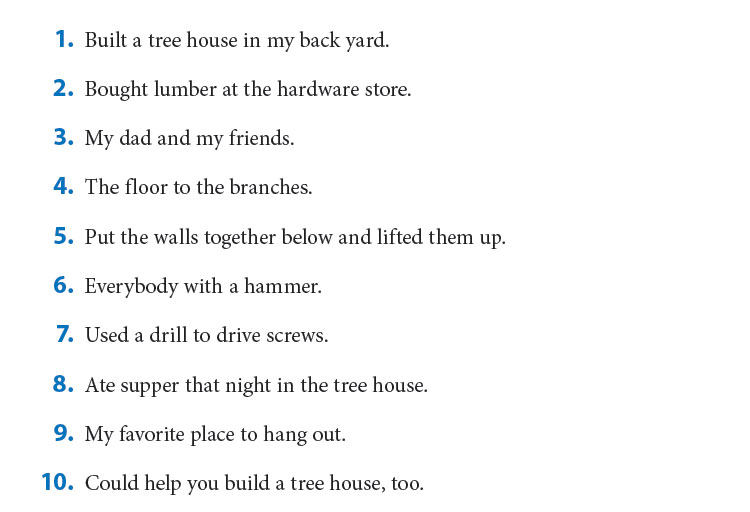
Every sentence needs a subject and a verb. The subject is the person, place, thing, or idea that the sentence is about. The verb tells something about the subject.

If a group of words does not have a subject or a verb, it is a fragment.

To fix a fragment, add the part that is missing—subject, verb, or both.

Fix fragments.
For each fragment, add what is missing: subject, verb, or both. Change punctuation and capitalization as needed. Make a copy of this Google doc or download a Word template.
Editing for Correctness
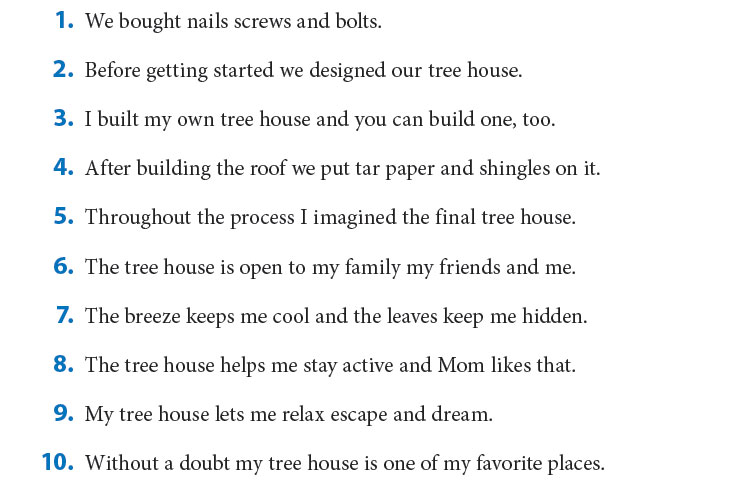
Commas are the most often used and misused punctuation marks. When you edit your paragraph, use commas in the following ways:
- Place a comma after each item in a series (except the last one).
- Place a comma after three or more introductory words.
- Place a comma before and, but, or or when you are joining two sentences together into a compound sentence.
You will need a hammer, a saw, and a drill.
After building the floor, we built the walls.
I built the wall on the ground, and Dad lifted it into the tree.
Fix commas.
Insert commas where needed in each sentence. Make a copy of this Google doc or download a Word template.
Editing in Action
When you edit, you check to make sure your paragraph is correct.
Paragraph Before Edits
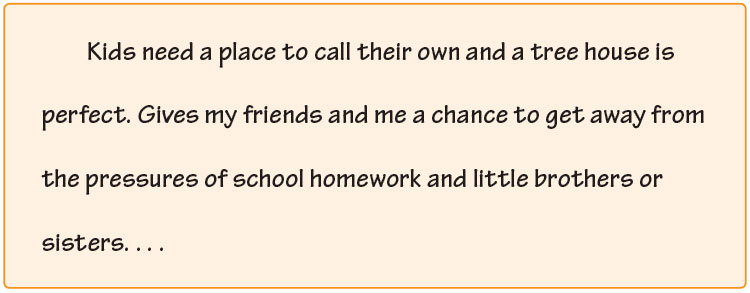
Commas were added and a fragment was fixed.
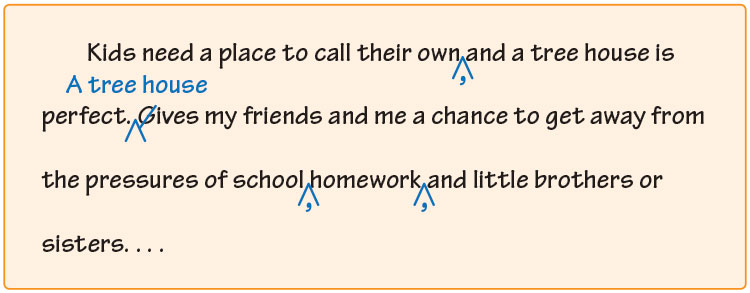
Paragraph After Edits
Edit with a checklist.
Read each line in the checklist. When you can answer each question with a yes, check it off. Make a copy of this Google doc or download a Word template.
Checking Grammar and Usage
- Are sentences complete (no fragments)?
- Are words used correctly (your/you’re, their/they’re, its/it’s)?
Checking Capitalization, Punctuation, and Spelling
- Do compound sentences have commas before and, but, or or?
- Do series have commas after each item except the last?
- Do commas follow introductory word groups of four or more words?
- Are the first words in sentences capitalized?
- Are the proper names of people, places, and things capitalized?
- Do commas and quotation marks set off quotations?
- Is every word spelled correctly?

Publishing Paragraphs
When you publish your paragraph, you make it public, sharing it with others. First, you need to make a clean final copy of your work. Then you should find ways to share what you have written with classmates, your teacher, your family, and your friends.
Publishing a Final Copy
Create a final copy of your paragraph.
Include your revising and editing changes and read over your work a final time. (If you are working on a computer, spell-check your work.) Make a copy of this Google doc or download a Word template.
Reflecting on Your Writing
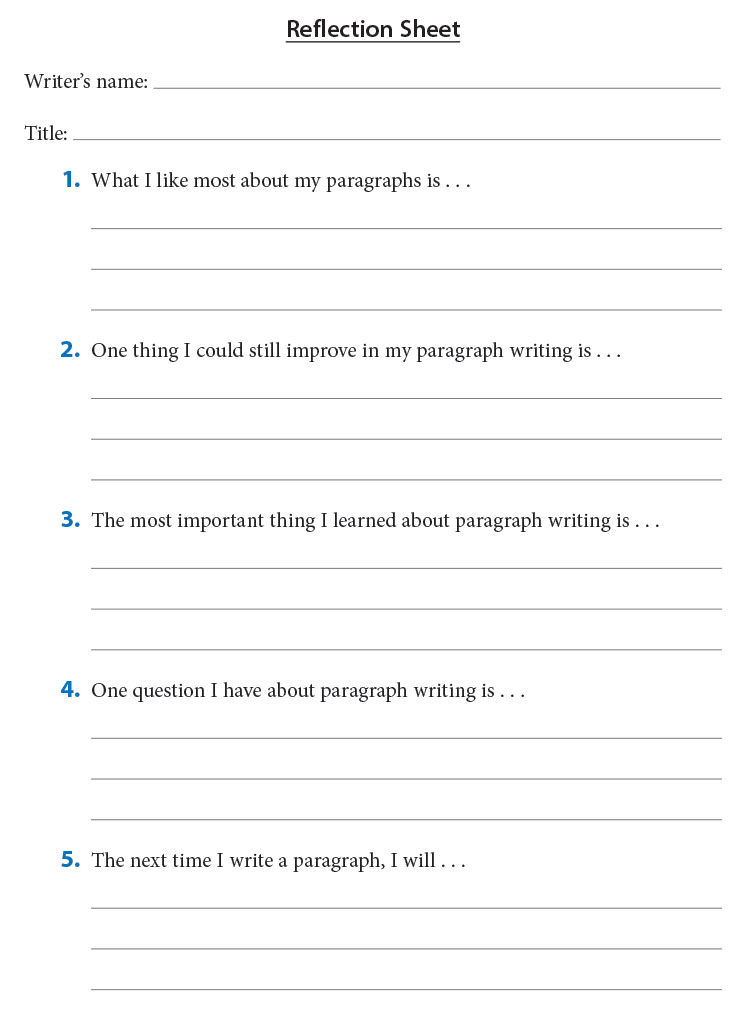
Reflect on your writing.
Complete the following form to think about what you learned. Make a copy of this Google doc or download a Word template.
Comments
Post a Comment