Writing Class 3-5 Writing Opinion Letters
Warm-Up for Writing Opinion Letters

Have you ever wished something was different about your school? Perhaps, you think the playground equipment is unsafe or too crowded. Or that there should be a new food option offered at the cafeteria. Or maybe you have ideas for new field trips.
As a younger person, you might feel like you need to keep those ideas to yourself. After all, adults seem to control all the decision-making in your school and community. But you're not powerless, because you can write, and the written word holds the power for change. This unit explores one effective way to express your ideas and influence change in your school and community—by writing an opinion letter.
What Is an Opinion?
Listen to "What Is an Opinion?"
An opinion shares a belief or feeling. It is different from a fact. Here is an opinion: Students at Lincoln School need a kickball league. Here is a fact: Lincoln School lunch recess runs from noon to 12:35 p.m.
What opinions do you have about school? What would you like to change about the school day? What opinions do you have about your neighborhood or city, and why?
When you write an opinion letter, you express an opinion in the hopes of getting readers to agree with you and even take action. Your letter should explain reasons that strongly support your opinion.
An opinion letter helps you think carefully about important ideas, develop a strong argument, and even change the world for the better.
Using Facts and Opinions
You share opinions all the time: Math is the best subject. Baseball is really boring. Do you have strong reasons and facts to support your opinions? If you do, then your opinions are strong because they are based on good information. Note the opinions and reasons of the following students:
Opinion:
Math is the best subject.
Reasons:
I get good grades in math.
I get to work ahead.
Math is like solving a puzzle.
Opinion:
Baseball is really boring.
Reasons:
I usually play in the outfield.
The ball never comes to me.
It takes forever to get to bat.
Support or oppose an opinion.
Choose one of the two opinions listed below. Circle or underline whether you agree or disagree with it. Then list one reason for your choice. Make a copy of this Google doc or download a Word template.
- Math is the best subject. agree disagree
- Baseball is boring. agree disagree
Write opinions.
Read the sample opinion about food. Then write one of your own.
Granola bars are my favorite school snack.
Support opinions with reasons.
Read the sample reason for the sample opinion. Then write two or three strong reasons to support your opinion from the previous activity. Make a copy of this Google doc or download a Word template.
Granola bars are crunchy.
Reason 1:
Reason 2:
Reason 3:
Share your work with a classmate.
After you’ve shared your work, answer this question.
Which opinion of your classmates’ has the strongest reasons? Why?
Reading an Opinion Email and Letter
Before you express an opinion in writing, you'll want to see how others did so. This lesson shows you an opinion email and an opinion letter. Schools and businesses all over the world communicate using these types of correspondence. As you read them, think about how the writer put ideas together and how you could express your own opinion and reasons to support it.
Reading an Opinion Email
One way to share your opinion is by sending an email. The email header identifies the receiver and subject of the email. The message itself contains the information—and the opinion—that you are sharing.
Sample Email
Listen to "Sample Email"
Header: Receiver and SubjectTo: RZold@mckinleyschool.edu
Subject: Afternoon Recess
Dear Principal Zold:
Beginning: OpinionMy name is Crishawn Wells, and I am a fourth grader at McKinley. I am writing to you because I feel we need an afternoon recess.
Middle: ReasonsOn some days, we do mostly seatwork all afternoon. After awhile, we get really antsy and have a hard time doing our work.
This is why we need the afternoon recess. It would refresh us and help us concentrate on our subjects.
Ending: Call to ActionI hope you consider my request.
Thank you,
Crishawn Wells
Respond to the email.
Answer these questions about the email message. Make a copy of this Google doc or download a Word template.
- Who is the audience for this message?
- What opinion is shared?
- What main reason supports this opinion?
Reading an Opinion Letter
An opinion letter is a type of business letter. It is written to make a request or to ask for a change. The beginning paragraph of the letter introduces the writer and states the opinion. The middle paragraphs give reasons to support the opinion. The ending paragraph restates the opinion and sometimes asks for a change to be made.
Sample Letter
This sample letter, like the email, deals with afternoon recess. However, it explores more reasons to support the opinion, which makes the opinion more convincing to the reader. You will also see that a business letter follows a certain form. (You will learn about this form later on.)
Listen to "Sample Letter"
Room 105
McKinley School
March 15, 2018
Mr. Richard Zold, Principal
McKinley School
Superior, WI 54880
SalutationDear Mr. Zold:
Beginning: Writer and OpinionMy name is Crishawn Wells, and I am a fourth grader in Ms. Cole’s class. I really like McKinley School, and Ms. Cole is my favorite teacher ever. She really helps us learn. I am writing because I feel we should have an afternoon recess.
Middle: Supporting ReasonsFirst of all, we get really antsy after a lot of sitting around. On some days, we stay in our classroom for the whole afternoon. When we start squirming, Ms. Cole has us stand up and do the hokey-pokey. She says we need to refresh our brains.
Second, we don’t have a lot of time to play with friends. Lunch recess is really short and the playground gets crowded. So it is hard to play and make friends. An afternoon recess would help.
Finally, we just need the exercise. Kids need to run around and play games. It isn’t healthy to sit for so long.
Ending: Call for ChangeThank you for reading my letter. I know you want the best for us. I hope you will think about adding an afternoon recess.
Sincerely,
Crishawn Wells
Respond to the letter.
Answer these questions about the opinion letter. Make a copy of this Google doc or download a Word template.
- What sentence in the beginning part states the opinion?
- What other information is given in the beginning? (Name two things.)
- What are the three reasons that support the opinion? (Hint: Look at the topic sentences of the three middle paragraphs.)
- What transitions or connecting words introduce each middle paragraph?
- What sentence in the ending part asks for a change to be made?

Prewriting for Opinion Letters
Prewriting is your first step in writing an opinion letter. These activities will help you select a topic, develop an opinion, gather reasons to support your opinion, and understand the key parts of business letters.
Prewriting to Select a Topic
To write a convincing opinion letter, you have to choose a topic that you feel strongly about. Your passion for the topic (or lack thereof) will show in your letter.
Brainstorm topics.
Answer each of the following questions in one or two different ways. Make a copy of this Google doc or download a Word template.
- What would make your school better?
an afternoon recess
- What would make your classroom better?
more computers
- What problems in your school need to be solved?
overcrowded playground at lunch
- What would make your community or neighborhood better for kids?
ice skating rinks in the parks
- What problems in your community or neighborhood need to be solved?
not enough streetlights
Choose a topic for your opinion letter.
Select a topic that is really important to you.
Prewriting to Develop Your Opinion
An opinion statement should identify a topic and state your feeling about it. Phrases and words like “I think,” “I believe,” “I feel,” “we need,” and “should” are often used when writing opinion statements.
Here is a formula that you can follow to write an opinion statement.
Write your opinion statement.
Use the formula to develop your own opinion statement. (If needed, try more than one version.) Make a copy of this Google doc or download a Word template.
- Write your topic:
- Write a strong feeling you have about the topic:
- Combine your answers to questions 1 and 2 to create your opinion statement. (Feel free to change the wording to make it clearer.)
- Write your opinion statement in a different way (optional):
Prewriting to Gather Reasons
A strong opinion should be supported by effective reasons. (Reasons answer the question “Why?”)
Opinion Statement:
I believe we should have an afternoon recess.
Reasons:
We get antsy after working in our seats for too long.
We don’t have a lot of time to play with friends.
We just need the exercise.
Support opinions with reasons.
Write your opinion statement and state three strong reasons to support it. Make a copy of this Google doc or download a Word template.
Opinion Statement:
Reason 1:
Reason 2:
Reason 3:
Prewriting to Order Your Reasons
The reasons in opinion letters are usually organized by order of importance. This means that the most important reason is stated first and the least important reason is stated last. (Or a writer can work the other way around.) In the sample letter about afternoon recess, the writer starts with his most important reason and ends with his least important reason.
Order reasons and add details.
List your reasons by order of importance. Under each reason, list details that you could use to explain or support your reasoning. Make a copy of this Google doc or download a Word template.
Reason 1:
Details:
Reason 2:
Details:
Reason 3:
Details:
Prewriting to Understand the Parts of Business Letters
Because an opinion letter is a type of business letter, you need to include these parts in this order.
- Heading The heading includes your address and the date you wrote the letter. Write the heading in the upper left-hand corner.
- Inside Address The inside address gives the reader’s name and address.
- Salutation The salutation is a polite way to say hello. Start with the word “Dear” and give the person’s name. Put a colon (:) after the person’s name.
- Body The body is the main part of the letter. It includes the beginning, middle, and ending.
- Complimentary closing The complimentary closing is a polite way to say good-bye. “Sincerely” is often used. Place a comma after the closing.
- Signature The signature is the final part of the letter. Write it beneath the closing. (If you are using a computer, leave four spaces after the closing, then type your name. Write your signature between the closing and your typed name.)
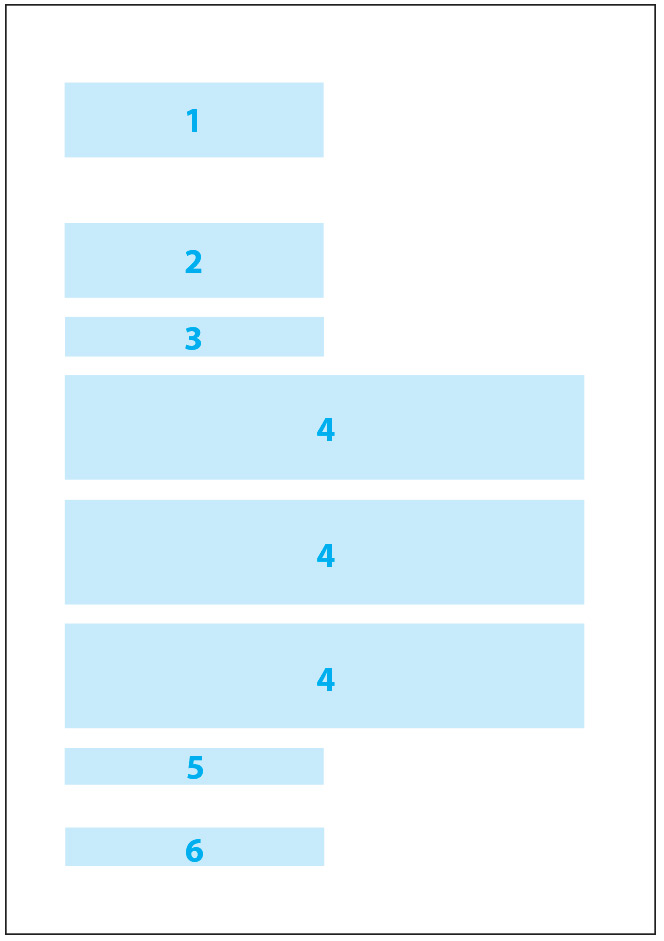
Label the parts of a business letter.
Write the correct term in each blank: body, closing, heading, signature, inside address, salutation. Make a copy of this Google doc or download a Word template.
Room 203
Parkview Middle School
Marshfield, MI 43000
May 1, 2018
Ms. Valerie Lynch
Science Teacher
Parkview Middle School
Marshfield, MI 43000
Dear Ms. Lynch:
My name is Sarah Taylor, and I am a fourth grader at Dyer School. The students in Ms. Larson’s class really like science. We feel Dyer School needs a science fair again.
First, we have done a lot of science projects this year. With our new science program, we are always building or testing something. My classmates would like to show their work to other people.
Second, science is really important. Ms. Larson always shares stories about science and how we need to understand science. A science fair would show that we value science.
Third, a science fair could help the school. If people in the community come to the fair, they will see all the good things we are doing. They might help us raise money for some new science equipment.
Thank you for reading my letter. We hope that you will bring back the science fair.
Sincerely,
Sarah Taylor

Writing an Opinion Letter
Great job completing your prewriting activities! Now you're ready to write the first draft of your letter. These writing activities will help you create the key parts of your opinion letter, including a strong beginning, middle, and ending.
Writing the Heading, Inside Address, and Salutation
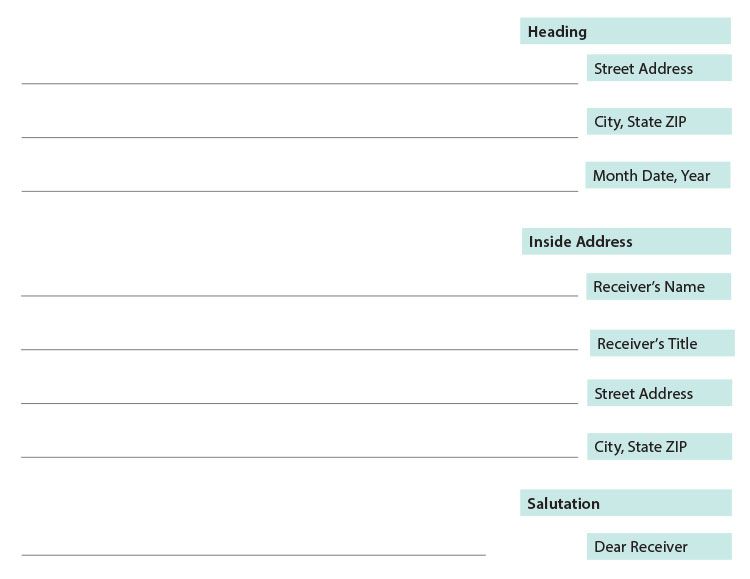
At the top of your opinion letter, you create a heading that includes your address and the date. Then you skip a line to write the inside address, which names the person to whom you are writing, gives the person’s job title, and provides the person’s address. Afterward, you greet the reader using “Dear,” a title (Mr., Ms., or Mrs.), and the person’s last name. Note: Use Mr. for adult men and Ms. for adult women. If the woman is married and prefers the title Mrs., use it instead.
Add a heading, inside address, and salutation.
Write the top parts of your letter. Make a copy of this Google doc or download a Word template.
Writing the Beginning Paragraph
In the beginning paragraph of your letter, you should do the following:
- Identify yourself.
- Give a few details leading up to your opinion.
- Provide your opinion statement.
My name is Crishawn Wells, and I am a fourth grader in Ms. Cole’s class.
I really like McKinley School, and Ms. Cole is my favorite teacher ever. She really helps us learn.
I am writing because I believe we need an afternoon recess.
Write your beginning paragraph.
Follow the strategies from above to create your beginning paragraph.
Beginning Paragraph
Writing the Middle Paragraphs
In the middle paragraphs, you should support the opinion with your reasons. Write a separate paragraph for each reason.
- For each middle paragraph, state your reason first. (This will be the topic sentence for the paragraph.)
- Then include details that help explain the reason.
We get really antsy after a lot of seatwork.
On some days, we stay in our classroom for the whole afternoon. When we start squirming, Ms. Cole has us stand and do the hokey-pokey. She says we need to refresh our brains.
Write your middle paragraphs.
Review the middle paragraph strategies from above. Then write a topic sentence that states the first reason to support your opinion. Add examples, facts, observations, and definitions to support the reason. Then begin a new paragraph for the second reason, and so on.
Middle Paragraphs
Writing the Ending Paragraph
The ending is important because it includes your final point about your opinion. Use these strategies in your ending paragraph. (Use at least two.)
- Thank the reader.
- Make a positive comment.
- Ask the reader to consider your idea.
Thank you for reading my letter.
I know you want the best for us.
I hope you will think about adding an afternoon recess.
Write the ending paragraph.
Combine some or all of the strategies from above to create your ending paragraph.
Ending Paragraph
Add a complimentary close and signature.
Skip a line after the final paragraph. Then write “Sincerely,” or “Best wishes,” and sign your name.

Revising Opinion Letters
Once you finish a first draft of your opinion letter, put it down for awhile. Then return to it, and look for ways to improve it. That's what the revising step is all about. When you revise, you look at your letter from your reader's perspective to make sure your writing is clear and convincing. These activities will help you revise.
Revising to Use the Right Voice
Your writing voice is the way you express your ideas. For example, in a message to a classmate, you would probably use a friendly voice:
Susie,
Can you come over tonight? We can draw our maps together.
Jeni
But in a business letter, you would use a serious and polite voice:
My name is Crishawn Wells, and I am a fourth grader in Ms. Cole’s class. I really like McKinley School, and Ms. Cole is my favorite teacher ever. She really helps us learn. I am writing because I feel we need an afternoon recess.
Identify voice.
Read each example below. Then underline or circle the type of voice—friendly or serious—depending on the words that are used. Make a copy of this Google doc or download a Word template.
Voice Example 1
- a. friendly
b. serious
Hey Mike,
We have a soccer match tomorrow, right? Can I get a ride?
Thanks,
Eric
Voice Example 2
- a. friendly
b. serious
Dear Mayor Williams:
My name is Star Wilson, and I live on Island Avenue. My friends and I get home late on Wednesday nights when it is dark. We need more streetlights on Island Avenue.
Check your voice.
Check your letter to make sure you use a serious voice. If you find words that don’t sound serious and polite, change them.
Revising to Use Transitions
Transitions are connecting words that make writing easy to follow. The opinion letter about recess uses these transitions: first of all, next, and finally.
Add transitions to a letter.
Insert helpful transitions into the opinion letter. Choose among the following transitions: most importantly, in addition, lastly. Note: Each should be used once in letter. Make a copy of this Google doc or download a Word template.
Paragraph Before Revising
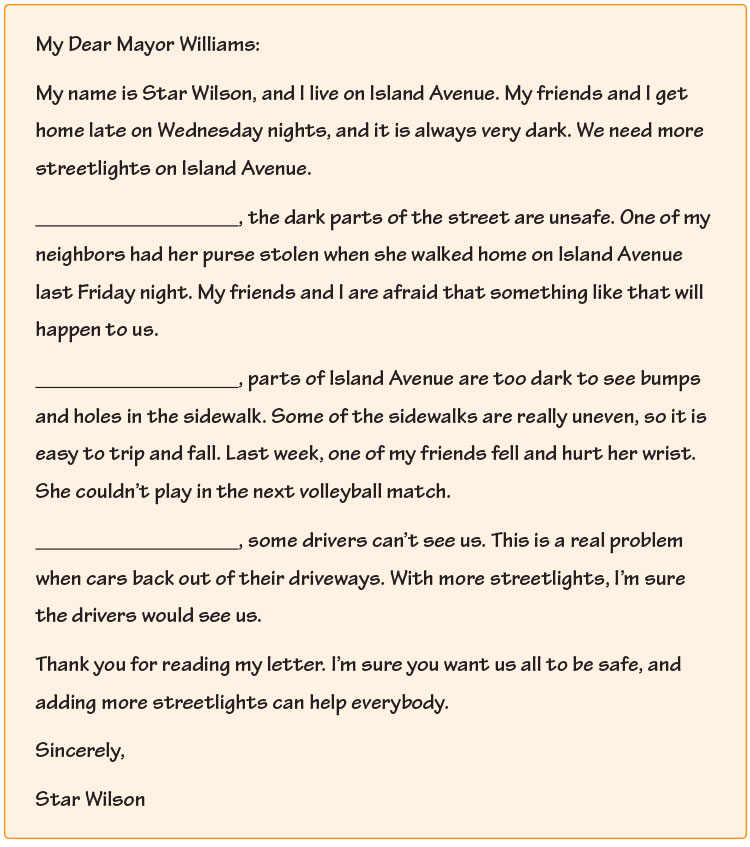
Details are added and reordered.
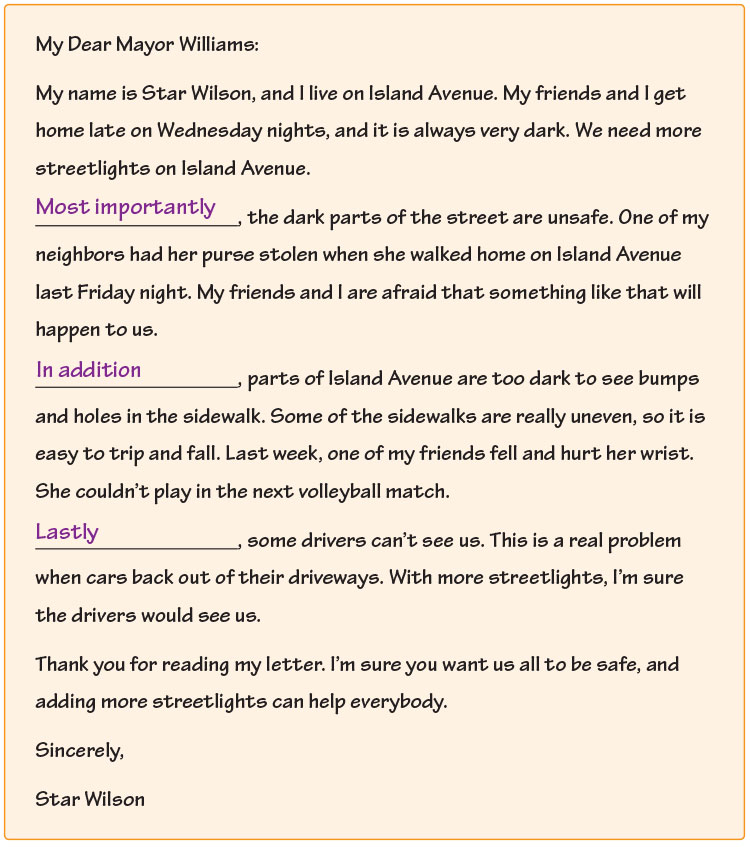
Check your letter for transitions.
Read your first draft closely. Add transitions where needed.
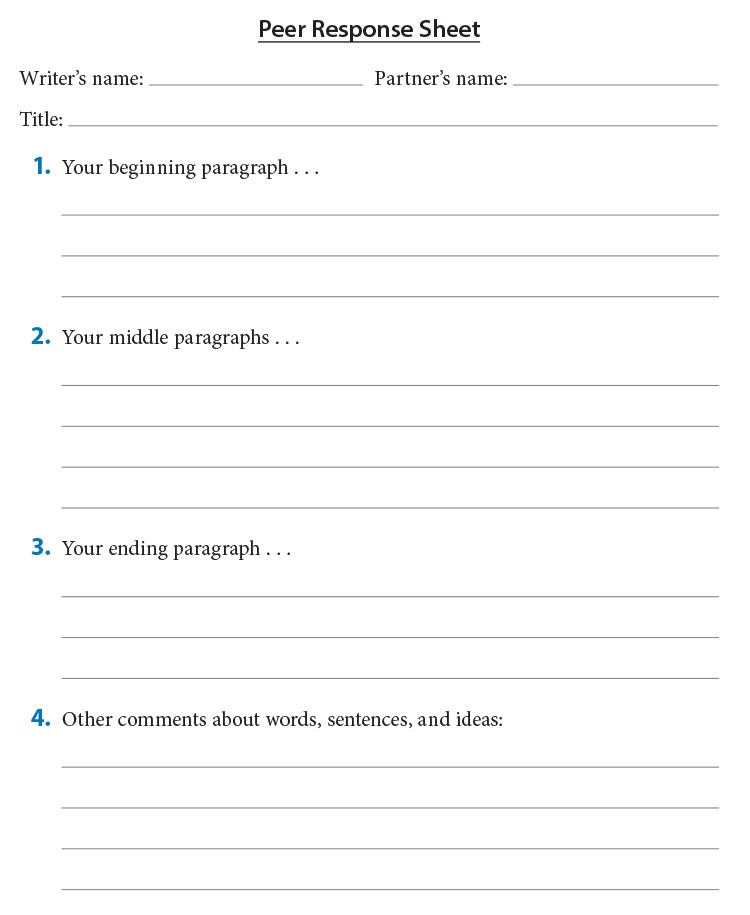
Revising with a Peer Response
Share your writing.
Have a partner read your letter and then respond to it by completing this form. A responder should try to list at least one strong point for each part of your letter and, if at all possible, one thing to improve. Make a copy of this Google doc or download a Word template.
Revising in Action
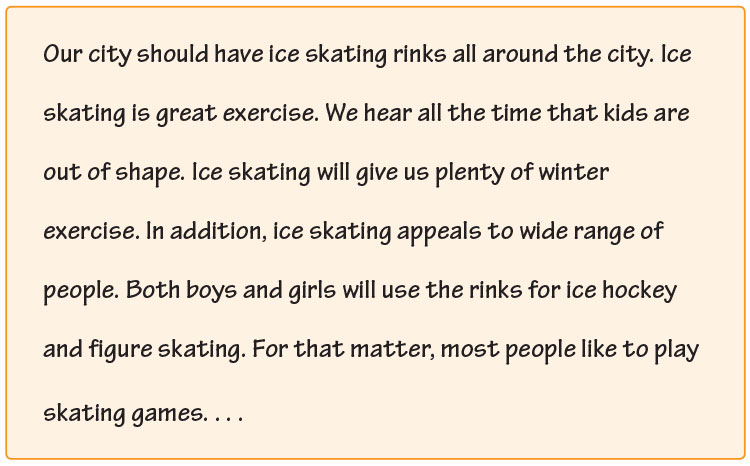
When you revise, you add, take out, rewrite, and rearrange your writing to make it clearer. Here are revisions to one student’s letter.
Paragraph Before Revising
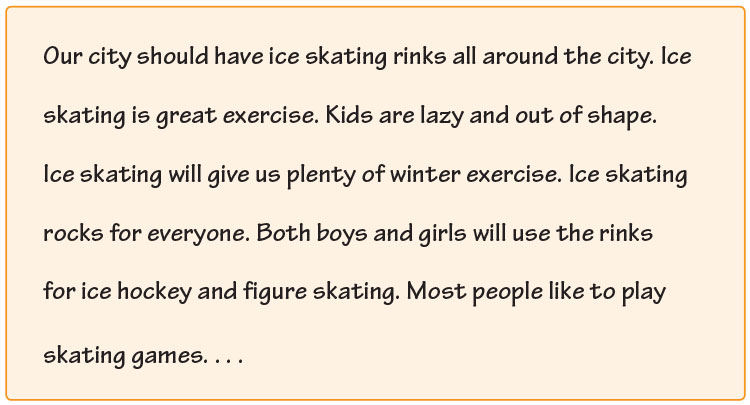
Details are added and reordered.
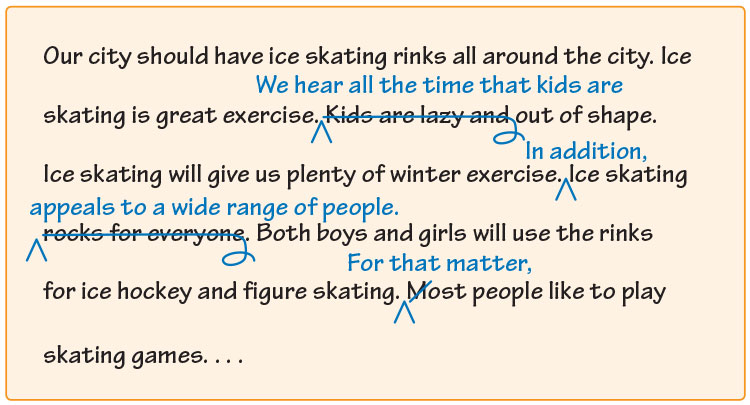
Paragraph After Revising
Revise with a checklist.
Read each line. When you can answer each question with a yes, check it off. Make a copy of this Google doc or download a Word template.
Developing Your Ideas
- Do I state a clear and reasonable opinion?
- Do I support the opinion with strong reasons?
- Do I sound serious and polite in my letter?
Structuring Your Ideas
- Do I introduce myself and state my opinion in the beginning?
- Does each middle paragraph develop a reason?
- Do I organize the middle paragraphs by order of importance?
- Do I thank the reader in the ending and ask the person to act?

Editing Opinion Letters
After you make improvements to the ideas in your letter, you should make sure your spelling, grammar, and punctuation are clear and correct. The activities that follow will help. You'll also use a checklist to finalize your editing.
Editing to Vary Sentences
Writing can sound dull if too many of the sentences are the same length and start in the same way. These three sentences suffer from sounding the same.
Our school needs more computers. Our school has 300 students. Our school has just one computer lab.
These same ideas are much more interesting when the sentences vary in length and in the way they begin. (As you will see, the second and third sentences have been combined.)
McKinley School needs more computers. The 300 students in our school all share just one computer lab.
Vary sentences.
Rewrite each passage so the sentences vary in length and in the way they begin. (Tip: You don’t have to change every sentence.) Make a copy of this Google doc or download a Word template.
- The cooks make two great foods every week. The cooks make tacos on Wednesday. The cooks make pizza on Fridays.
- The dogs in our city need a dog park. The dogs have no place to run. The dogs have no place to play together.
Edit for sentence variety.
Check the variety of sentences in your own letter. Edit those that sound the same.
Editing to Correct Commas
Business letters contain special sections, including the heading, inside address, and closing. Commas have important roles in each of these sections.
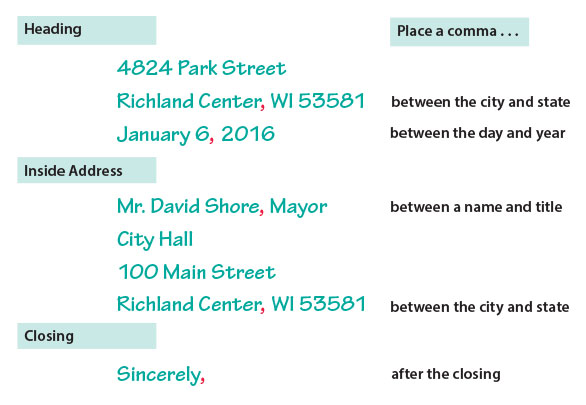
Correct comma use.
Insert commas in the correct spots in the following headings, inside addresses, and closings. Make a copy of this Google doc or download a Word template.
- 7834 Green Blvd.
Albany NY 12204
March 27 2018 - Ms. Alice Watson Advisor
Parkview Press
Parkview Elementary
San Antonio TX 78212 - Sincerely
Michelle Jackson - Mr. Lee Manager
Petland
6574 Benson Dr.
Albany NY 12205 - 625 Oak Avenue
Fort Atkinson WI 53538
October 6 2018
Edit for commas.
Check your heading, inside address, and closing for comma use.
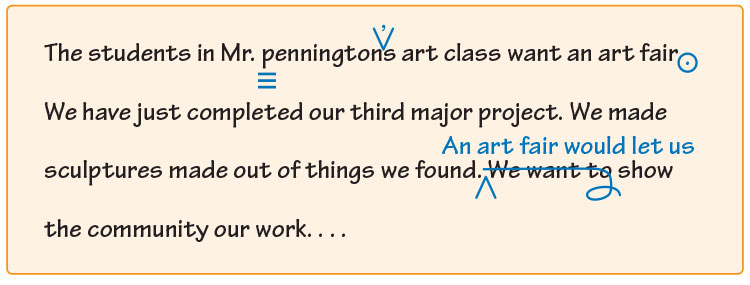
Editing in Action
When you edit, you check your revised letter for spelling, punctuation, capitalization, and usage errors.
Paragraph Before Revising
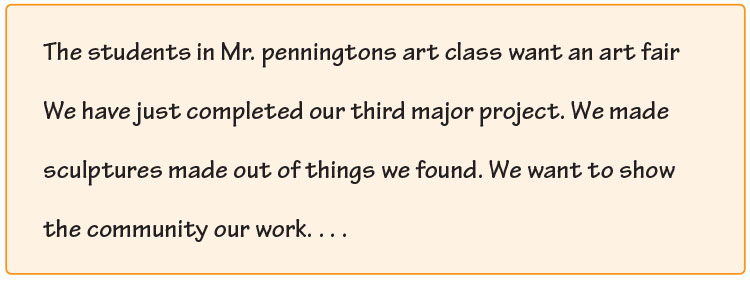
Details are added and reordered.
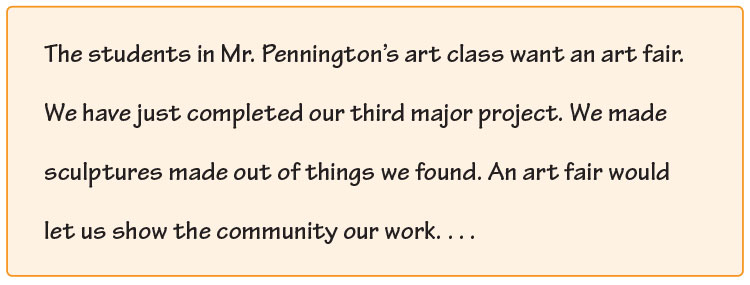
Paragraph After Revising
Edit with a checklist.
Use this checklist as a guide when you check your opinion letter for errors. Make a copy of this Google doc or download a Word template.
Checking Grammar and Usage
- Are the sentences complete (no fragments or run-ons)?
- Do the subjects and verbs agree (he gives, not he give)?
- Are the forms of the subjects correct (Mr. Zold, not Mr. Zold he?)
- Are the forms of the verbs correct (caught, not catched)?
- Are other words used correctly (its/it’s, to/too/two)?
Checking Capitalization, Punctuation, and Spelling
- Is the first word in each sentence capitalized?
- Are the names of people and places capitalized correctly?
- Do sentences end with the correct punctuation marks?
- Are commas used correctly in the heading, inside address, and closing?
- Are words, including the names of people, spelled correctly?

Publishing Opinion Letters
When you publish your letter, you deliver your final copy to the intended reader. First, you need to make a clean final copy of your work. Then you place it in an envelop, and address the envelop. (Ask for help from a parent or teacher if you need assistance.) Finally, deliver the letter by mail or in person.
Publishing a Final Copy
Create a final copy of your opinion letter.
Include your editing changes and read over your work a final time. (If you are working on a computer, spell check your work.)
Reflecting on Your Writing
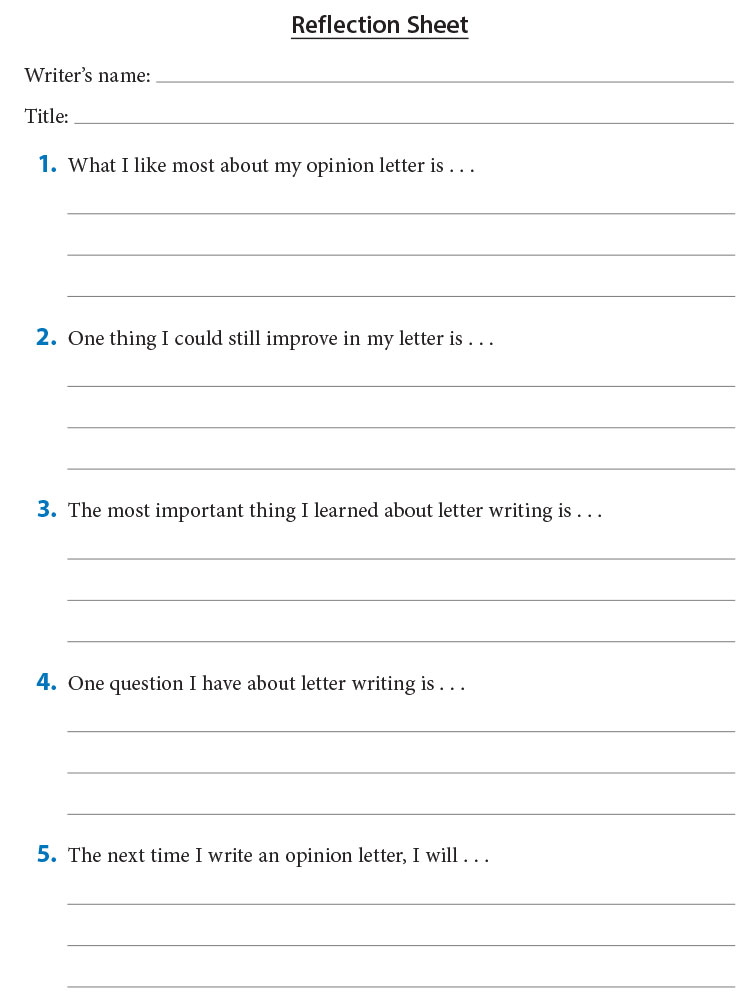
Reflect on your writing.
Complete the following form to think about what you learned. Make a copy of this Google doc or download a Word template.
Comments
Post a Comment