Writing Class 3-5 Writing Fiction Reviews
Warm-Up for Writing Fiction Reviews
One fun way to think about a book is to write a review. In a book review, you tell others what a book is about and help your readers decide if they want to read it next! The activities in this unit will guide you in reviewing a fiction book by focusing on characters, conflict, and theme.
What Is a Fiction Review?
Listen to "What Is a Fiction Review?"
Fiction books are gateways to new worlds. When you open a book and begin reading, you are transported to a new place with interesting characters, conflicts, and adventures. When you finish a good book, you probably know the story well enough to tell others about it.
In a fiction review, you let others know about a book by explaining its important parts and characters without saying too much. After all, you don’t want to spoil the ending!
Thinking About Character Traits
The main character may be the most important part of a fiction book. This person or animal is sometimes called the protagonist. To truly understand what happens in a book, you need to think carefully about the main character.
Creating a Character Profile Page
To get to know a character better, create a profile page that shares important information about the character. Study how one student created a sample profile page to learn about the main character in the book Shiloh.
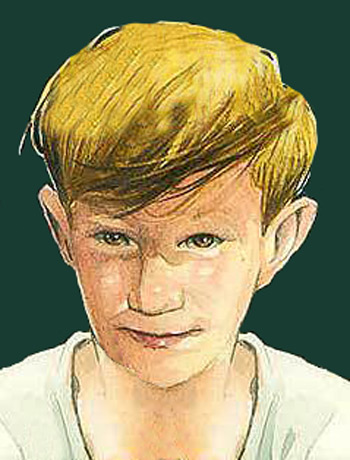
Name:
Marty
Age:
11
Hometown/place:
West Virginia
Likes:
All animals (especially Shiloh), the outdoors, the woods, exploring, his brothers and sisters
Dislikes:
Hurting animals, lying, and dishonest people
Greatest wants/desires:
To make Shiloh his dog, to protect him and keep away from Judd, and to change laws to protect dogs
Greatest fears/obstacles:
Not being able to protect Shiloh, lying to his parents, and knowing that Judd owns and hurts Shiloh; also laws that let people own animals even if they mistreat them
Choose a main character.
Write the main character from your favorite book or from a book you are currently reading.
Create a character profile page.
Fill in the character profile page to get to know the main character. In the box, draw a picture of your character’s face. Make a copy of this Google doc or download a Word template.
Character Profile Page
Name:
Age:
Hometown/place:
Likes:
Dislikes:
Greatest wants/desires:
Greatest fears/obstacles:
Reading Fiction Reviews
Before you write your own review, you should see how other students reviewed fiction. As you read these samples, pay close attention to the types of details included. Consider how you might share similar details in your own review.
Reading a Paragraph Review
A paragraph response to a book has three main parts: The topic sentence introduces the title, author, and main idea. The body sentences introduce the main character, the obstacles faced, and the lessons learned. The ending sentence gives your final opinion of the book.
Sample Paragraph
Listen to "Review of Shiloh"
Review of Shiloh
Topic SentenceShiloh by Phyllis Reynolds Naylor is a story about a boy’s struggle to keep a dog that is not his. Marty Preston lives in West Virginia. One day while exploring, he discovers a beagle. He names the dog Shiloh but learns that the dog belongs to Judd Travers, who is known for mistreating animals. Body SentencesWhen Marty’s dad makes him return Shiloh to Judd, Marty sees Judd kick Shiloh. Then one day Shiloh escapes, and Marty builds him a cage in the woods. Marty struggles to decide how to keep the dog without stealing from a neighbor or lying to his parents. Something happens that forces him to tell the truth. Ending SentencesIf you want to know if he keeps Shiloh, you will have to read the book yourself. I think you’ll like Shiloh as much as I did.
Respond to the paragraph.
Answer the questions about the paragraph. Make a copy of this Google doc or download a Word template.
- Name the title, author, and main character of the book.
- What main obstacle faces the main character?
Reading a Full Book Review
A full book review has three main parts. The beginning paragraph states the book's title and author. It also previews the story in an interesting way. The middle paragraphs tell about the characters, conflict, and theme. The ending paragraph gives the reviewer's opinion of the book.
Sample Book Review
Listen to "Review of Shiloh"
Review of Shiloh
Beginning ParagraphShiloh by Phyllis Reynolds Naylor is an emotional story about a boy who wants to keep a dog that is not his. Marty finds the dog lost in the woods and starts to take care of him. He soon discovers that the dog already has an owner—a mean one. This problem forces Marty to make tough choices between what is right and wrong.
Middle ParagraphsThe main character in Shiloh is Marty Preston. Marty is 11 years old and lives with his family in the hills of West Virginia. CharacterHe loves animals. He won’t even eat the rabbits that his father hunts for dinner. One day he meets a stray beagle in the woods. Marty takes him home and names him Shiloh. However, his dad says Judd Travers owns Shiloh.
Judd is a mean man who mistreats animals. When Marty returns Shiloh to Judd, he sees Judd kick Shiloh. This saddens Marty, and he decides that he needs to buy Shiloh from Judd. The problem is Marty doesn’t have any money. Then Shiloh runs away to Marty, and things get really complicated. Marty knows if his parents find out he has Shiloh, he’ll have to return the dog to Judd. ConflictBut Marty thinks if that happens, Judd will abuse Shiloh even worse.
Marty understands lying is wrong. He once caught Judd cheating the owner of the corner store out of money. But he also wants to protect Shiloh, so he hides Shiloh out of sight beyond his house. He says, “Funny how one lie leads to another, and before you know it your whole life can be a lie.” Eventually something happens that forces Marty to confess. In the end, he has to confront Judd, too.
ThemeThe book Shiloh shows that the difference between right and wrong is not always clear. Marty says, “Nothing is as simple as you guess—not right or wrong, not Judd Travers, not even me or this dog I got here.” When you need to make a choice without a simple right or wrong answer, you have to think it through and act for the greater good. Marty decides Shiloh’s well being was important enough to bend the rules.
Ending ParagraphI like this book because I love dogs, just like Marty. I also like that Shiloh is told from Marty’s point of view, since then I was able to learn his thoughts and feelings along the way. So you might be wondering what happens to Marty and Shiloh in the end. Read the book to find out!
Respond to the full book review.
Work with a partner to answer these questions. Make a copy of this Google doc or download a Word template.
- How does the first paragraph preview what’s to come later in the review?
- Who is the main character in the book, and what do you learn about him?
- What is the main conflict in the book?
- What theme is discussed in the review?
- Does the reviewer like the book? Cite evidence from the review to support your answer.

Prewriting for Fiction Reviews
To write a great review, you need to choose a book you enjoy and spend some time gathering key details from it. These prewriting activities will prepare you to write a first draft.
Prewriting for Topic and Character Details
Your first prewriting step is to choose a work of fiction for your review. Make sure the work is something you like and remember well. You can also read something new—a mystery, an adventure book, a novel, or even a play.
Fill in a topic matrix.
Fill in a topic matrix to think about a book you might want to review. Consider books you really enjoy or that you read recently. Make a copy of this Google doc or download a Word template.
What is the book’s title? | |
Who is the author? | |
What is the book about? | |
What do you like about the book? |
Gather details about the main character.
Answer these questions to get to know the main character better. Make a copy of this Google doc or download a Word template.
- Identify the main character’s name, age, and place (home).
- How does the character feel throughout the story (happy, lonely, disappointed, etc.)?
- How does the character change in the book?
Prewriting for Conflict and Theme Details
Conflict is the main problem or obstacle the main character faces. Theme is a big life lesson that is revealed through the story. Most books have more than one theme.
Explain the conflict.
Answer these questions to review the conflict in your book. Make a copy of this Google doc or download a Word template.
- What does the main character want or need?
- What problems or obstacles prevent the main character from getting what he or she wants?
Identify a theme.
A theme is a big life lesson that relates to everyone. The theme usually isn’t stated outright in a book. You have to infer it from the characters’ actions and words. Ask questions like these. Make a copy of this Google doc or download a Word template.
- What important thing does the main character learn?
- How does that lesson apply to everyone, including me (theme)?

Writing a Fiction Review
Once you finish prewriting, you are ready to create the first draft of your review. These writing activities will help you create strong beginning, middle, and ending parts. You'll also read another student's review to see how all of the parts work together.
Writing the Beginning Paragraph
The purpose of your beginning paragraph is to grab your reader's attention, introduce the title and author of your book, and tell something interesting about it. The paragraph should start with a lead sentence, which gets the reader interested in the book. You can introduce the title and author in the lead or in a new sentence. Then, to close out the paragraph, introduce the big challenge the main character must face in the book. But don't spoil the ending!
Write a lead sentence.
Try out at least two of these strategies for introducing the topic of your review. Read the examples for ideas. Make a copy of this Google doc or download a Word template.
1. Ask a question related to the work.
Have you ever felt like a stranger in your school or community?
2. Talk directly to your readers.
You never know when you will meet someone who will change your life.
3. Provide a suspenseful detail from the story.
Just when Lucy thought she was getting her very own room, a stranger showed up and changed everything.
4. Share a feeling you have about the work.
The Great Wall of Lucy Wu by Wendy Wan-Long Shang changed the way I think about my heritage.
Write your beginning paragraph.
Start with your lead sentence. Follow with one or two sentences that identify the title and author of the book and introduce the biggest challenge facing the main character. Make a copy of this Google doc or download a Word template.
Writing the Middle Paragraphs
In separate middle paragraphs, explain what the main character is like, what conflict he or she faces, and what theme or themes are represented in the story. But don't give away too many details! You don't want to spoil the best parts for your readers.
Write topic sentences.
For each middle paragraph, write a topic sentence that introduces an important part of the story—the main character, the conflict, and the theme. Make a copy of this Google doc or download a Word template.
1. Write a topic sentence that introduces the main character:
Lucy Wu is an 11-year-old living in New York.
2. Write a topic sentence about the conflict:
Lucy’s plan to get her own room goes to dust when Lucy’s father surprises her by bringing Yi-Po back from China.
3. Write a topic sentence about the theme:
The Great Wall of Lucy Wu shows that family heritage is something to have pride in and learn from, even if it is different from the heritage of those around you.
4. Write topic sentences for any other middle paragraphs (optional).
But this is not the end of the story!
Write middle paragraphs.
Write your topic sentences. Add details and examples from the book to explain or add to the topic sentence. Use transitions to connect ideas and information where needed. Make a copy of this Google doc or download a Word template.
Transitions to Add Information
Again
Along with
Also
Another
For example
And
Next
Finally
As well
Along with
In addition
Yet another
Middle Paragraph 1
Middle Paragraph 2
Middle Paragraph 3
Additional Middle Paragraphs
Writing the Final Paragraph
In the final paragraph, share your final feelings about the book and let your readers know who else might like to read it.
Write your ending paragraph.
Try these ending strategies. Then combine them into an ending paragraph. Make a copy of this Google doc or download a Word template.
1. Give your opinion of the book.
The Great Wall of Lucy Wu is an awesome story about coming of age.
2. Tell others why they should read it.
I recommend it to anyone who sometimes feels like a stranger.
3. Call readers to action.
Find out everything that happens by reading this exciting book.
Ending Paragraph
Reading a Sample Draft
Read a sample fiction review.
As you read this draft, notice how the writer put the parts together.
Listen to "The Great Wall of Lucy Wu Review"
The Great Wall of Lucy Wu Review
LeadYou never know when you will meet someone who will change your life. In The Great Wall of Lucy Wu by Wendy Wan-Long Shang, Lucy thinks she is finally going to get her very own bedroom, but her big plans change when a surprise visitor moves in. Beginning ParagraphThe visitor makes Lucy rethink what it means to be Chinese-American.
Lucy Wu is an 11-year-old living in New York. Her parents are both Chinese, and this plays a big role in the story. Being Chinese-American is important to her family, but Lucy is not sure about her Chinese side. She says, “The Chinese part of my life doesn’t make sense sometimes.” But Lucy is excited about starting sixth grade and is even more excited that her sister is going to college, because she gets a bedroom all to herself.
Middle ParagraphsLucy’s plan to get her own room goes to dust when her father surprises her by bringing Yi-Po back from China. Yi-Po is Lucy’s great aunt, and she moves into Lucy’s bedroom. Yi-Po smells like vapor rub and can’t speak English. To make matters worse, sixth grade is not going as planned, either. Lucy finds out she has to attend Chinese school on weekends and might miss basketball practice because of it. Next, a rival classmate writes bad things about her heritage in the bathroom, and Yi-Po embarrasses Lucy in front of friends.
Topic SentencesBut this is not the end of the story! Many exciting things happen that make Lucy reconsider what she thinks of her great aunt and her Chinese heritage. Lucy goes from resentment to respect as she learns about her background.
ThemeThe Great Wall of Lucy Wu shows that family heritage is something to have pride in and to learn from, even if it is different from the heritage of those around you. You just have to have an open mind and give it a chance. In the book, Lucy learns the saying “Don’t be the frog at the bottom of the well.” A frog in a well can see only the walls that are close by but never the great things outside of the well. When Lucy learns to accept her heritage, she gets to see many great new things, too.
Ending ParagraphThe Great Wall of Lucy Wu is an awesome coming-of-age story. I recommend it to anyone who sometimes feels like a stranger at school or in the community. Lucy is smart, funny, athletic, and friendly, and she changes for the better. Read this excellent book to find out everything that happens to her.

Revising Fiction Reviews
Okay, so you've finished your first draft. Great work! What should you do next? First, set it aside for a while. When you return to it, you will be able to read it with fresh eyes. Why is this important? It will help you recognize areas that need improvement. That's the purpose of revising—to make your ideas stronger and easier to follow. The improvement strategies on this page will help you add, cut, and rearrange the writing you've already done.
Revising to Cite Evidence
Citing specific details from the book can help you explain the characters, conflict, and theme. You can make a general idea (purple) stronger or more convincing by adding different types of specific evidence (green).
- Dialogue is something a character says.
- Reasons answer the question why?
- Actions are something a character does.
- Examples provide a specific instance of something.
Marty feels bad about lying to his family. He says, “Funny how one lie leads to another, and before you know it your whole life can be a lie.”
Marty feels sad. He catches Judd kicking Shiloh.
Lucy wants her own space. She builds a wall to split her shared bedroom.
Lucy doesn't feel connected to some Chinese customs. She doesn’t like traditional Chinese food such as octopus and frog.
Cite evidence to support general ideas.
Find and record two general ideas or statements from your book review. Then find evidence from the book to support each idea. Add the evidence to your review. Make a copy of this Google doc or download a Word template.
- General idea:
Specific evidence:
- General idea:
Specific evidence:
Revising Paraphrases and Quotations
Whenever you use ideas from someone else's book in your own writing, you need to paraphrase or quote those ideas. Paraphrasing means writing the idea in your own words. Quoting means using the exact words from the book with quotation marks. Read the passage from The Great Wall of Lucy Wu and the sample paraphrase and quote that follow it.
The Chinese part of my life just doesn’t make sense sometimes. Like there are a bunch of women I call ai yi, which means aunt, and when I was little, I thought my mom had a ton of sisters. But they weren’t my real aunts, they were just my mom’s friends.
Paraphrase
Lucy is confused by some Chinese customs, such as why she refers to her mother’s friends as aunts.
Quote
When you use the exact words from a book, you need to put quotation marks around those words. If the quote is followed by a comma or period, put the punctuation inside the end quotation mark.
In The Great Wall of Lucy Wu, Lucy says, “The Chinese part of my life just doesn’t make sense sometimes.”
Paraphrase and quote.
Practice paraphrasing and quoting using the sample selection. Make a copy of this Google doc or download a Word template.
Glenda of the Giraffe People
by Leslie Fields
Glenda liked to hang around. Literally. Every recess, she hung from the monkey bars until the line of kids barked her down. Then she would hang from the side braces of the swings.
- Paraphrase the passage:
- Quote a line or lines from the passage:
Revising with a Peer Response
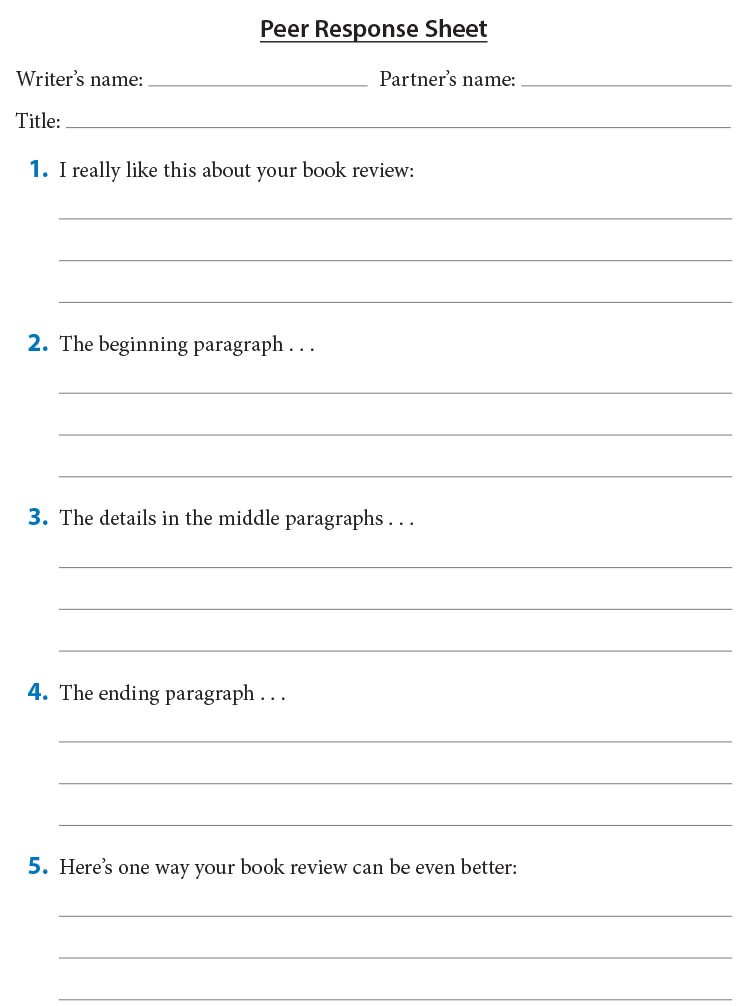
Share your writing.
Have a trusted classmate read your book review and complete this form. Make a copy of this Google doc or download a Word template.
Revising in Action
When you revise, you add, delete, rewrite, and rearrange your writing to make it clearer. Here are some revisions to the book review of The Great Wall of Lucy Wu.
Paragraph Before Revisions
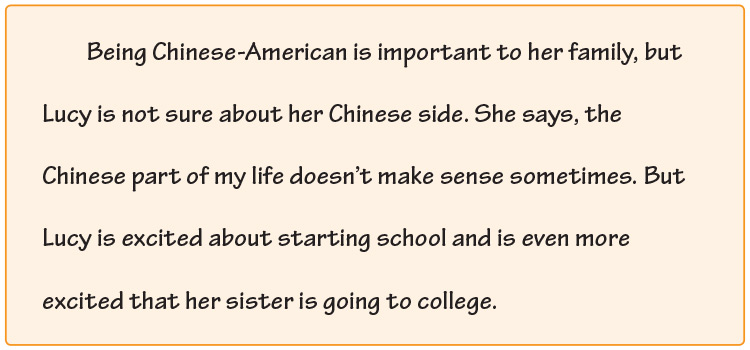
Quotation marks are added to indicate direct words from the book. A general detail is changed to a more specific one, and new evidence is cited to elaborate an idea.

Paragraph After Revisions

Revise with a checklist.
Read each line. When you can answer each question with a yes, check it off. Make a copy of this Google doc or download a Word template.
Developing Your Ideas
- Do I name the book and the author?
- Do I share information about the main character?
- Do I share information about the conflict?
- Do I identify and explain a theme from the book?
- Do I cite evidence to support general ideas?
- Do I paraphrase and quote ideas correctly?
Structuring Your Ideas
- Does a lead sentence name the title and preview the book?
- Does the beginning paragraph preview what the book is about?
- Do middle paragraphs tell about the characters, conflict, and theme?
- Does the ending paragraph give my recommendation?

Editing Fiction Reviews
After revising your fiction review, you need to edit it to correct any remaining errors. You'll look closely at sentences, punctuation, capitalization, grammar, usage, and spelling. The following activities will help you edit your review.
Editing for Present Tense
Writing verbs in the present tense will make your review more lively. The present tense shows that something is happening now or happens regularly. Even though you read the book in the past, you can describe things that happened in the book in the present tense.
Past tense: A classmate wrote hurtful comments about her heritage.
Present tense: A classmate writes hurtful comments about her heritage.
Choose present-tense verbs.
Select the present-tense verb from the options in each sentence. Make a copy of this Google doc or download a Word template.
- Something bad (happens, happened) to the main character.
- Shiloh (cowered, cowers) around people.
- Marty and his family (live, lived) in West Virginia.
- When Shiloh (ran, runs) away, Marty (built, builds) him a cage.
Editing for Active Verbs
Another way to energize your writing is to use the active form of verbs. A verb is active if the subject is doing the action of the verb. A verb is passive if the action of the verb is being done to the subject.
Passive: Hurtful comments about her heritage were written by a classmate.
Active: A classmate writes hurtful comments about her heritage.
Replace passive verbs.
Rewrite the sentences to make the verbs active. Use the present tense of the verb in your sentence. One example is provided. Make a copy of this Google doc or download a Word template.
- A cage for Shiloh is built by Marty.
Marty builds a cage for Shiloh.
- A bad thing is seen by Marty.
- Marty is followed by Shiloh.
Editing Titles for Italics and Capitalization
If you are writing on a computer, you should italicize book titles. Italics is a style of type that is slightly slanted so that it stands out. Italics are also used for titles of plays, magazines, newspapers, television programs, and movies.
Shiloh
The Great Wall of Lucy Wu
James and the Giant Peach
If you are writing by hand, use underlining instead of italics.
Shiloh
The Great Wall of Lucy Wu
James and the Giant Peach
Book titles follow special capitalization rules. Capitalize the first word of a title, the last word, and every word in between except for short prepositions (of, in, to, for), connecting words (and), and articles (a, an, the).
Where the Red Fern Grows
How to Eat Fried Worms
Italicize and capitalize titles.
Rewrite the following sentences to correct the missing italics and capitalization of titles. Make a copy of this Google doc or download a Word template.
- The Diary of a wimpy Kid is both a book and a movie.
- Have you read The secret Zoo?
- In the book island of the Blue Dolphins, Karana is stranded on an island.
- James and the giant peach is my favorite book.
- Another book about a dog is called Old yeller.
- The Incredibles is an exciting movie.
- A spider is the star of the book and movie called Charlotte’s web.
- I like all of the characters in Toy story 3.
- The wednesday wars is written by Gary D. Schmidt.
- National Geographic includes great panoramic pictures.
Editing in Action
When you edit, you check to make sure your review is correct.
Paragraph Before Edits
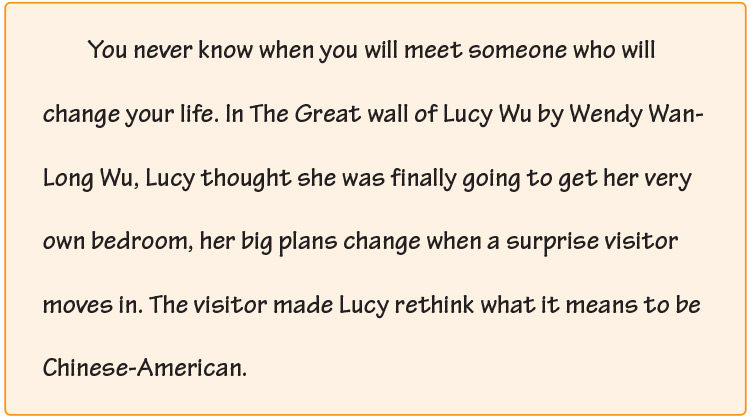
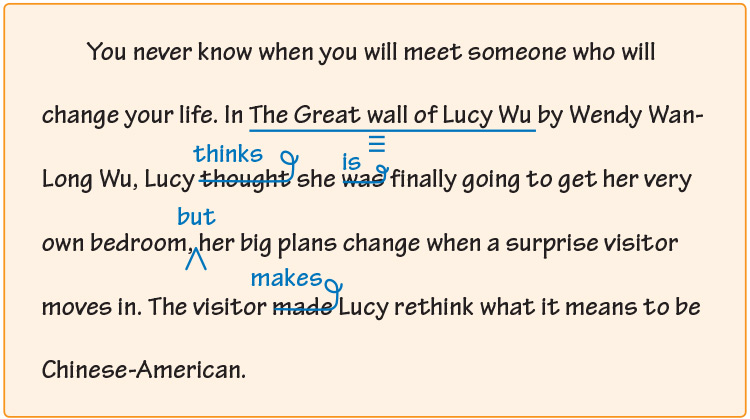
A title is underlined and missing capitalization is fixed. Past tense verbs are changed to present tense, and a comma splice error is fixed.
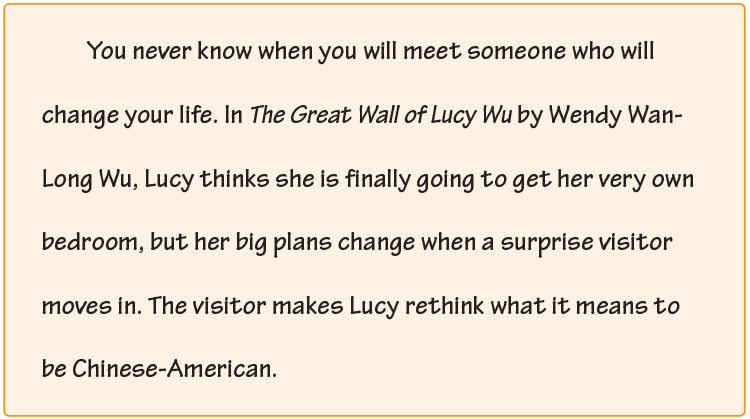
Paragraph After Edits
Edit with a checklist.
Read each line. When you can answer each question with a yes, check it off. Make a copy of this Google doc or download a Word template.
Checking Grammar and Usage
- Do I describe actions from the book in the present tense?
- Do I use active verbs in place of passive verbs? (Yi-Po embarrasses Lucy, not Lucy was embarrassed by Yi-Po.)
- Are words used correctly (your/you’re, their/they’re, its/it’s)?
- Do my subjects and verbs agree in number? (Lucy and Yi-Po were laughing, not Lucy and Yi-Po was laughing.)
- Are sentences complete (no fragments or run-ons)?
Checking Capitalization, Punctuation, and Spelling
- Are the first words in sentences capitalized?
- Are book titles capitalized correctly?
- Are book titles italicized or underlined?
- Do commas and quotation marks set off exact words from the book?
- Are words correctly spelled?

Publishing Fiction Reviews
When you publish your review, you share it with others. First, you need to make a clean final copy of your work. Then you should find ways to share your writing with classmates, your teacher, your family, and your friends.
Publishing a Final Copy
Create a final copy of your review.
Include your revising and editing changes and read over your work a final time. (If you are working on a computer, spell-check your work.)
Reflecting on Your Writing
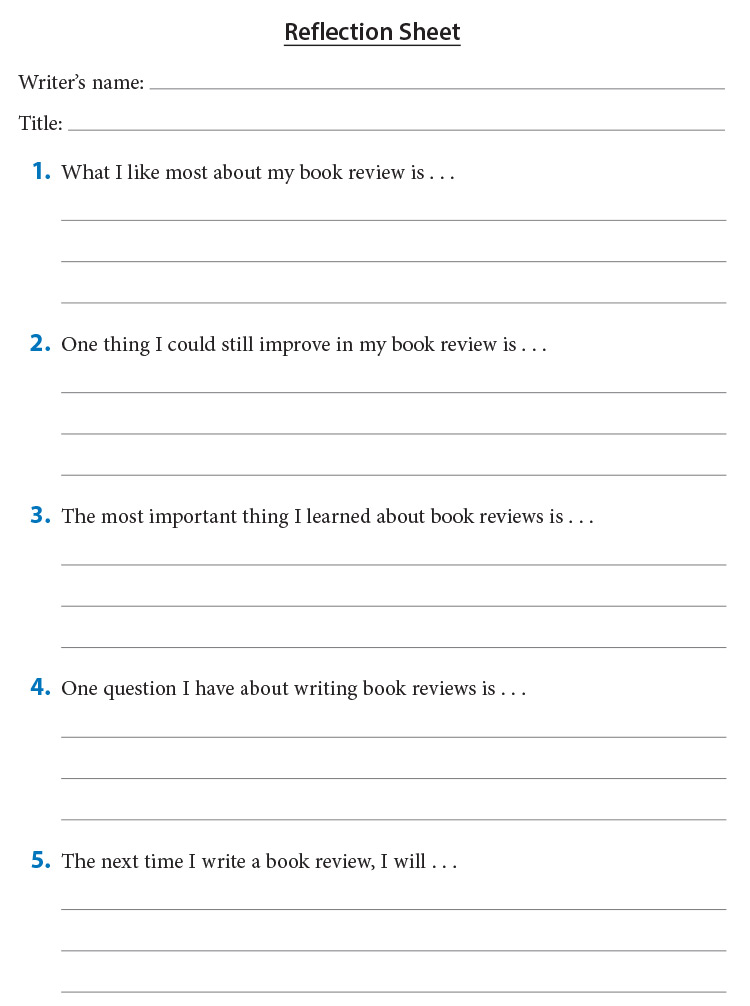
Reflect on your writing.
Complete the following form to think about what you learned. Make a copy of this Google doc or download a Word template.
Comments
Post a Comment