Writing Class 3-5 Writing Essays
Warm-Up for Writing Essays

An essay explores a topic in great detail using multiple paragraphs. This lesson will show you one special way to gather information for your own essay.
What Is an Essay?
You first learn how to write sentences. Then you learn how to write paragraphs. Next, you learn how to write essays. Each new form builds on what you learned before: A group of related sentences forms a paragraph. A group of related paragraphs forms an essay.
An essay gives information about a single topic. The beginning paragraph introduces the topic, the middle paragraphs explain the topic, and the ending paragraph summarizes the main points. Essays explain, describe, or persuade.
In this unit, you will write an essay that explains how a group of third graders answered an interesting question.
Watch the video "Building Essays"
Thinking About Polls
Big companies and organizations take polls to find out what people are thinking. For example, when there is an election, voters will be asked who they are going to vote for and why. Asking these questions helps candidates know how they are doing during their campaign.
Consumers are asked what they like such as thin or thick crust on their pizza. Young TV viewers like you may be asked about their favorite shows. Even principals and teachers use polls to ask their students different questions.
Take a poll.
Answer the following questions about different parts of your life in and out of school. Make a copy of this Google doc or download a Word template.
- What is your favorite sport?
Why?
- What is your favorite holiday?
Why?
- What is the best book you’ve read in class?
Why?
- What is your favorite fruit?
Why?
Compiling the Results
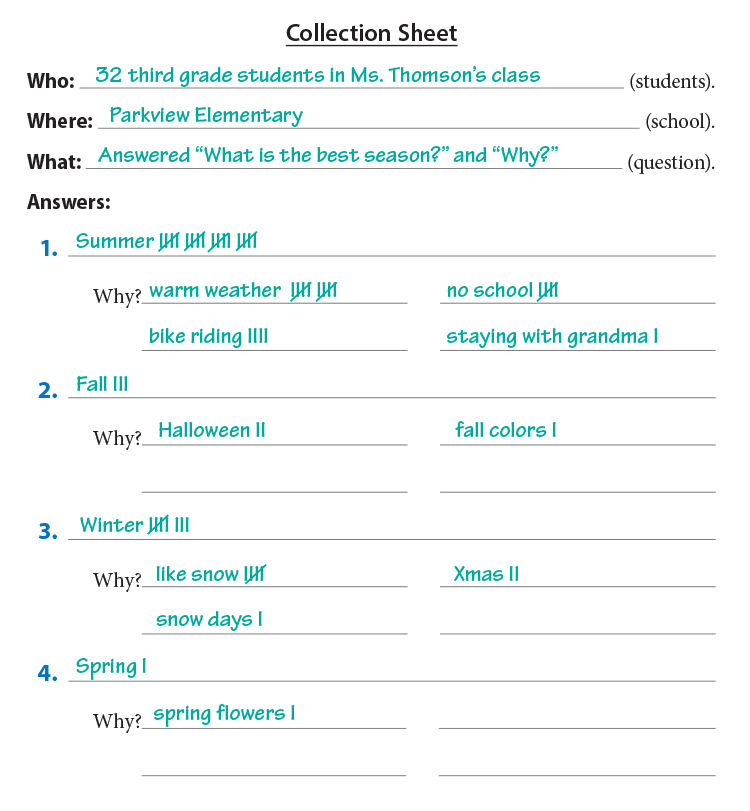
Asking questions is the first part of taking a poll. The next part is compiling the answers. You can use a collection sheet like this to compile answers.
Review a collection sheet.
Read the results of a poll that asked students to name the best season and to give the main reason for their choice.
Use a collection sheet.
Compile the answers to “What is your favorite sport?” and “Why?” Make a copy of this Google doc or download a Word template.
Reading an Informational Paragraph and Essay
Before you write your essay, you'll want to see how others did so. This lesson shows you an informational paragraph and an informational essay, explaining each part. As you read them, think about how the writers put ideas together and how you could describe the results of a classroom poll in your own essay.
Reading an Informational Paragraph
An informational paragraph has three main parts. The topic sentence names the topic. The body sentences explain the topic. The ending sentence gives a final idea about the topic. This paragraph explains the results of the poll about students’ favorite seasons.
Sample Paragraph
Listen to “Summer Wins”
Summer Wins
Topic SentenceMost third graders at Parkview Elementary picked summer as the best season. There are 32 third graders at Parkview, and 20 of them picked summer. Most of these students liked it because of the warm weather and no school. Body SentencesWinter came next with eight third graders voting for it. Playing in the snow and Christmas were the main reasons. Three students picked fall because of Halloween and fall colors. Only one third grader picked spring because of the flowers. Ending SentenceThe seasons are all fun, but every third grader has a favorite.
Respond to the paragraph.
Answer the following questions about the paragraph. Make a copy of this Google doc or download a Word template.
- What is the topic of the paragraph?
- What season was listed first? Why?
- How does the ending sentence remind the reader about the topic?
Reading an Informational Essay
An informational essay gives important facts about a topic. The beginning paragraph hooks the reader and names the topic. The middle paragraphs explain the important information about the topic. The ending paragraph reminds the reader about the topic and gives a final idea. This informational essay explains the results of the poll question about students’ favorite seasons.
Sample Essay
Listen to “Summer Is the Best!”
Summer Is the Best!
Beginning ParagraphHaving different seasons is fun. Kids can do different things in each one like swimming in the summer and sledding in the winter. When third graders at Parkview Elementary picked their best season, summer was the big winner.
Thirty-two third graders in the school answered two questions: What is the best season? Why? Ms. Williams’ third-grade class collected and posted the results.
Middle ParagraphsTwenty third graders picked summer. That is more than half of the students! Ten of these students like the warm weather. Five students like it because there is no school. Four students like it for bike riding, and one student likes it because she gets to stay with her grandma.
Winter came in second, because eight third graders like it the best. Five students like it because they can play in the snow. Two like winter because of Christmas, and one student likes it because of snow days. Snow days mean no school!
Three third graders think fall is the best season. Two students picked it because of Halloween, and one student likes fall because of the colors. Only one third grader picked spring. She likes it for the flowers.
Ending ParagraphEvery third grader has one favorite season, and it is summer for many of them. They probably like something about the other seasons, too. Each one is so different.
Respond to the essay.
Answer these questions about the essay. Make a copy of this Google doc or download a Word template.
- How does the essay begin?
- What sentence in the beginning tells the topic of the essay?
- What information is given in the second paragraph?
- How are the middle paragraphs organized?
- What final idea is stated about this topic?

Prewriting for Essays
Prewriting is your first step in writing an essay. This prewriting activity will help you select a topic to write about and gather important details about the topic before you begin a first draft.
Prewriting to Plan Your Own Essay
Review the results.
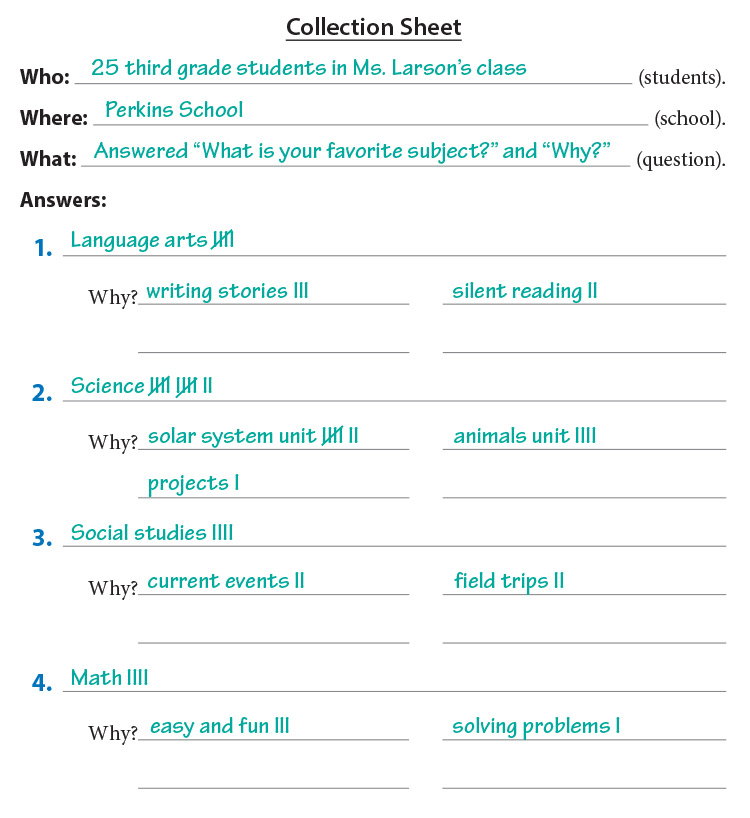
Study the answers to another question. This will be the topic for your own essay.
Analyze the results.
Answer these questions to help you think about the results of the poll. Make a copy of this Google doc or download a Word template.
- What questions did the students answer?
- How many students answered these questions?
- What course was popular with the most students?
- What reasons did they give for this choice?
- What course came in second? Third?
- What, if anything, surprised you about the reasons for these choices?
- How would you answer this question?

Writing Essays
Once you finish prewriting, you are ready to present your poll results in writing. These activities will help you hook the reader's interest at the beginning, explain important information in the middle, and end with a strong final point. You'll also read another student's essay to see how all of the parts came together.
Writing the Beginning Paragraph
In the beginning paragraph, the first sentence is called the lead sentence. The lead should get the reader’s interest about the topic of the essay. The last sentence is the focus statement, which names the main idea of the essay. Any sentences in between give details about the topic.
Write a lead sentence.
Follow the directions below to write two different lead sentences. Then choose the one you like best for your essay. Make a copy of this Google doc or download a Word template.
- Say something interesting about the topic.
Ocean mammals are big and small.
- Ask a question about the topic.
What ocean mammal is your favorite?
Write the focus statement.
State the specific topic of the poll and the main point learned from the answers.
Third graders in Cooper School studied ocean mammals (topic), and they like whales and dolphins the best (main point).
Write the beginning paragraph.
Write your complete beginning paragraph. Start with your lead sentence, follow with one or two detail sentences, and end with your focus statement. (See “Summer Is the Best!” for an example.)
Lead Sentence:
Detail Sentences:
Focus Statement:
Writing the Middle Paragraphs
The middle paragraphs should discuss the answers to the poll question. The first of these paragraphs should give background information. It should state . . .
- how many students answered the question,
- what school they are from, and
- who compiled the results.
Each of the next paragraphs should focus on the different answers.
Develop the middle part of your essay.
Write your middle paragraphs. Make a copy of this Google doc or download a Word template.
Middle Paragraph 1
Background Information
Middle Paragraph 2
Most Popular Answers
Middle Paragraph 3
Second Most Popular Answers
Middle Paragraph 4
Third/Fourth Most Popular Answers
Writing the Ending Paragraph
The last paragraph should restate the focus of your essay. It can also give a final thought about the topic.
There are so many ocean mammals. For students in our school, whales and dolphins are the big favorites (restate the focus). But they all are fun to learn about (final thought).
End your essay.
Write the ending paragraph for your essay. Use the ending above as a guide. Make a copy of this Google doc or download a Word template.
Restated Focus:
Final Thought:
Adding a Title
A strong title makes the reader want to read your essay. It usually says something interesting about the topic.
Mammals in the Deep Ocean
Super Saltwater Animals
Create a title.
Write two or three titles for your essay. Then choose the one you like the best.
Reading a Sample Draft
Read an essay.
As you read this draft, notice how the writer put the parts together.
Listen to “Mammals in the Deep Ocean”
Mammals in the Deep Ocean
LeadOcean mammals are big and small. There are huge whales and small sea otters. Third graders in Cooper School studied ocean Focus Statementmammals, and they like whales and dolphins the best.
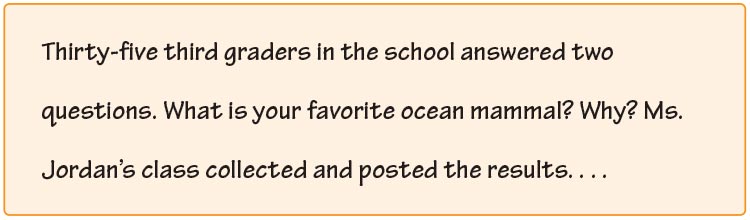
Thirty-five third graders in the school answered two questions. What is your favorite ocean mammal? Why? Ms. Jordan’s class collected and posted the results.
Middle ParagraphsThirteen third graders like whales the best. Seven students like them because they are so big. One student said that the blue whale is the heaviest mammal ever. Five students like whales because they leap out of the water, and one student likes them because they can dive so deep.
Dolphins are the favorite of 12 third graders. Nine students like them because dolphins like to play. Two students say they are so smart, and one student likes to see them swim.
Six students like seals the best. Four students think they are funny when they bark and flop around. One student thinks the pups are really cute, and another student likes to watch them swim in the zoo.
Sea otters were selected by four third graders. They like them because they are goofy. They crack oysters open on rocks on their bellies! One student likes walruses because they are so funny looking.
Ending ParagraphThere are so many ocean mammals. For students in our school, whales and dolphins are the big favorites. But they all are fun to learn about.

Revising Essays
Once you draft your essay, take a break and come back to it to see it freshly. When you revise, you make sure your big ideas are separated into different paragraphs and enough details explain each idea. These activities will help you revise.
Revising to Find Paragraphs
If your writing goes on and on without paragraphs, it can be hard to read. When this happens, you need to separate the writing into paragraphs. Use this three-step process:
- Label the first word with a paragraph sign (¶).
- Name the main idea in the first paragraph.
- Find the first sentence not about this idea and label it. Start a new paragraph.
- Repeat steps 1-3 as you move through your essay.
Watch the video "Finding Paragraphs"
Mark the paragraphs.
Carefully read this part of an essay. The first new paragraph is marked for you. Mark the next new paragraphs and repeat the three-step process. Make a copy of this Google doc or download a Word template.
We have had many great presidents. They have led our country when we were in wars or when people really needed help. Many third graders in Waller School picked Abraham Lincoln as the best president. ¶Twenty-four third graders in our school answered two questions. Who is the best president? Why? Mr. Hayes collected and posted the results. Fifteen students picked Abraham Lincoln as our best president. Twelve of these students picked him because he freed the slaves. Three students said he was a great leader during the Civil War. Six students picked George Washington as our best president. Five of these students picked Washington because he was our first president. One student thought he was great because he fought for our freedom. Three students picked President Obama. Two students said he is our first African-American president. One student said he helped our country get a better economy.
Check your essay.
Be sure that you have started a new paragraph for each new idea in your essay. (You can combine some ideas if they are really short.)
Revising to Add Details
Details help explain a main idea. When writing lacks detail, it may seem incomplete. The details for your essay are included in the answers to the poll question and the reasons for the answers.
Sometimes, it helps to add a detail of your own to emphasize a point or add information. In the following paragraph, the writer added his own detail (in italics).
Main IdeaThirteen third graders like whales the best. Seven students like them because they are so big. One student says that the blue whale is the heaviest mammal ever. DetailsFive students like whales because they leap out of the water, and one student likes them because they can dive so deep.
Add a detail.
Complete this activity to add a new detail in one of your paragraphs. Make a copy of this Google doc or download a Word template.
- Write down the main idea or topic sentence for one middle paragraph.
- Write down the first detail in this paragraph.
- Write down the second detail.
- Write down the third detail (if there is one).
- Add a sentence that tells more about one of the details. (This sentence should emphasize a point or add information.)
Revising with a Peer Response
Share your writing.
Have a trusted classmate read your essay and complete the form. Make a copy of this Google doc or download a Word template.
Revising in Action
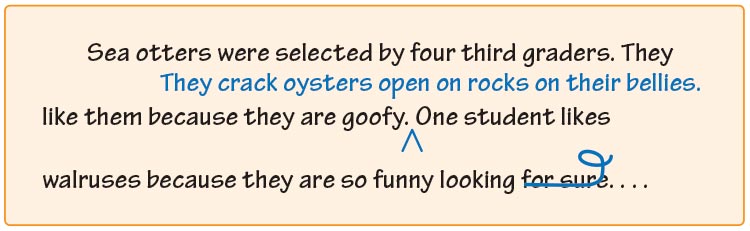
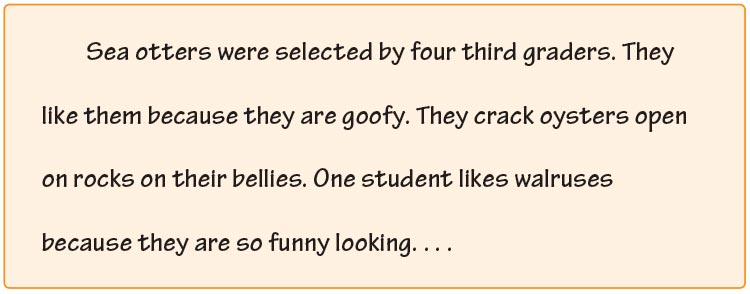
Revising is adding, cutting, and rewriting ideas to improve your writing. Here are revisions in one part of “Mammals in the Deep Ocean.”
Paragraph Before Revisions
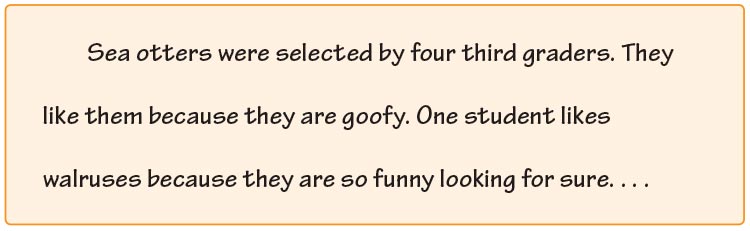
More details were added and a deletion was made.
Paragraph After Revisions
Revise with a checklist.
Revise your first draft using this checklist as a guide. Make a copy of this Google doc or download a Word template.
Developing Your Ideas
- Do I name the topic of the poll question?
- Do I include the results of the answers (numbers and reasons)?
- Do I add any details that emphasize an idea (optional)?
Structuring Your Ideas
- Does the first sentence get the reader’s interest?
- Does the beginning paragraph end with the focus statement?
- Do I include separate paragraphs for the background information and different answers?
- Do I include an ending paragraph to wrap up the essay?

Editing Essays
After making big changes to improve your essay, you need to make little changes (editing) to correct any remaining errors. You'll look for problems with sentences, punctuation, capitalization, grammar, usage, and spelling. The following activities will help you edit and publish your writing.
Editing End Punctuation
Sentences end in a period, question mark, or exclamation point. These punctuation marks are like traffic signs because they signal that a sentence has come to a stop. Here are the rules for using these marks.
- Use a period at the end of a statement.
Thirty-five third graders in the school answered two questions.
- Use a question mark at the end of a question.
What is your favorite ocean mammal?
- Use an exclamation point to show strong emotion.
They crack oysters open on rocks on their bellies!
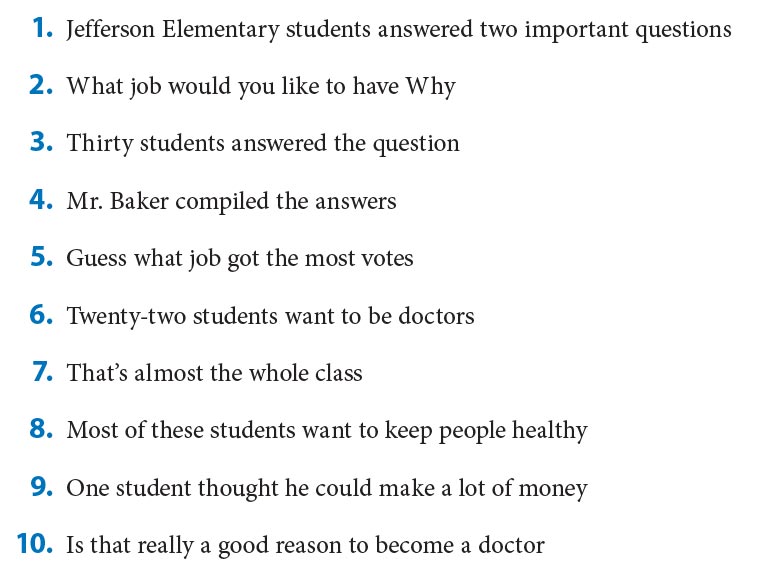
Punctuate sentences.
Add the correct end punctuation to each one of these sentences. Make a copy of this Google doc or download a Word template.
Edit for end punctuation.
Be sure the sentences in your essay end with the correct punctuation mark.
Editing to Use Numbers
To explain poll results, you must use a lot of numbers. Follow these rules when writing about numbers.
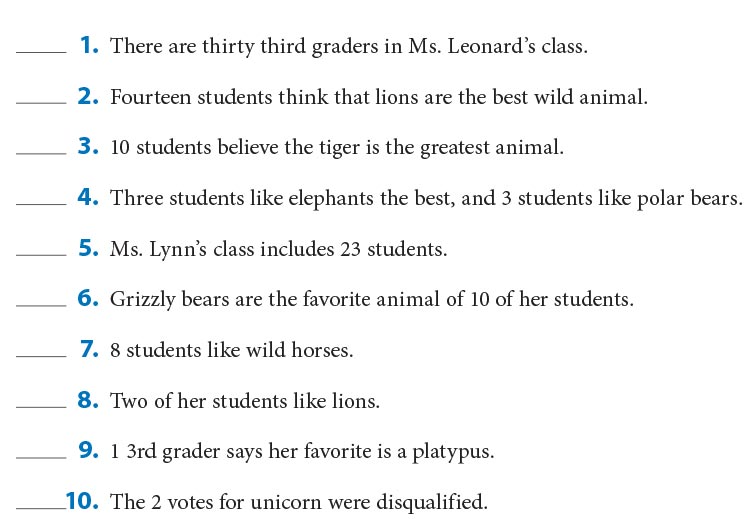
- Write out the numbers one to nine as words (one, four) and the numbers 10 and over as numerals (10, 21).
- But use words, not numerals, to begin a sentence.
Fifteen students picked Abraham Lincoln.
Check sentences for numbers.
Put a C in the blank if numbers are used correctly in a sentence. If a sentence includes numbers used incorrectly, correct them. Make a copy of this Google doc or download a Word template.
Edit for numbers.
Check the sentences in your essay for the correct use of numbers.
Editing in Action
When you edit, you check your essay to make sure it does not contain errors.
Paragraph Before Edits
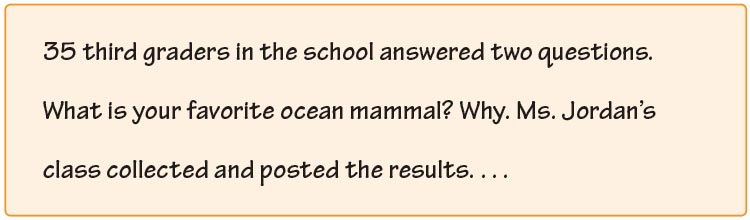
A number was fixed and a period was changed to a question mark.
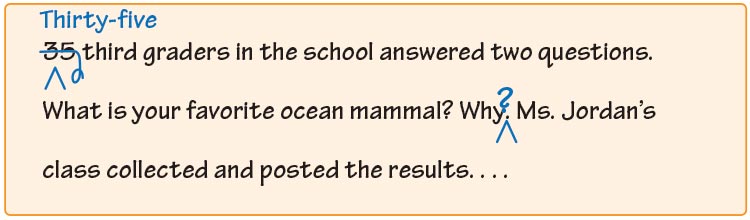
Paragraph After Edits
Edit with a checklist.
Use this checklist as a guide when you edit your writing for errors. Make a copy of this Google doc or download a Word template.
Checking Grammar and Usage
- Are the sentences complete (no fragments or run-ons)?
- Are numbers used correctly?
- Are words used correctly (your, you’re; its, it’s; their, they’re)?
Checking Capitalization, Punctuation, and Spelling
- Are first words in sentences capitalized?
- Are names of people and places capitalized?
- Do sentences end with the correct punctuation?
- Are words spelled correctly?

Publishing Essays
When you publish your essay, you make it public, sharing it with others. First, you need to make a clean final copy of your work. Then you should find ways to share what you have written with classmates, your teacher, your family, and your friends.
Publishing a Final Copy
Create a final copy.
When you write your final copy, include all of your revising and editing changes. Then check your final copy one last time for errors before sharing it. (If you are using a computer, spell check your work.) Make a copy of this Google doc or download a Word template.
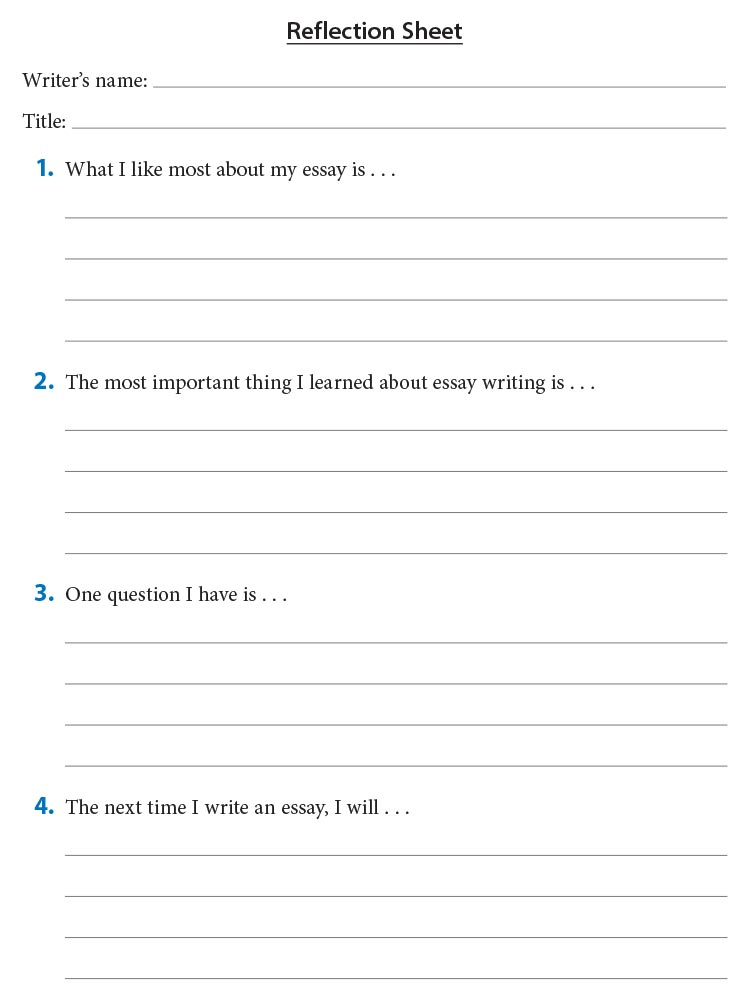
Reflecting on Your Writing
Think about your writing.
Complete each of these sentences to help you review your writing. Make a copy of this Google doc or download a Word template.
Comments
Post a Comment