Writing Class 3-5 Writing Classroom Reports
Warm-Up for Classroom Reports

Reporters go to the scene of the action. They discover what's going on and investigate the situation. Once they have gathered enough information, they write a report. This unit asks you to play the role of a reporter in your classroom. You'll learn all about a special topic and write a classroom report about it.
What Is a Report?
Listen to "What Is a Classroom Report?"
A report shares important information about a topic. To learn the best information about your report topic, you'll need to investigate books, Web sites, and videos. You may even gather information from first-hand experiences. Then you'll organize your information and write a report about it. By sharing your report with classmates, you'll help them discover what's so special about the topic too!
In this unit, you’ll read classroom reports about amazing geological places, such as the Great Salt Lake and the Grand Canyon. Then you’ll write a report about another amazing place from our natural world.
Thinking About What You Know
To write a report, you need to learn about your topic. You can look for information in books, on Web sites, and in other sources.
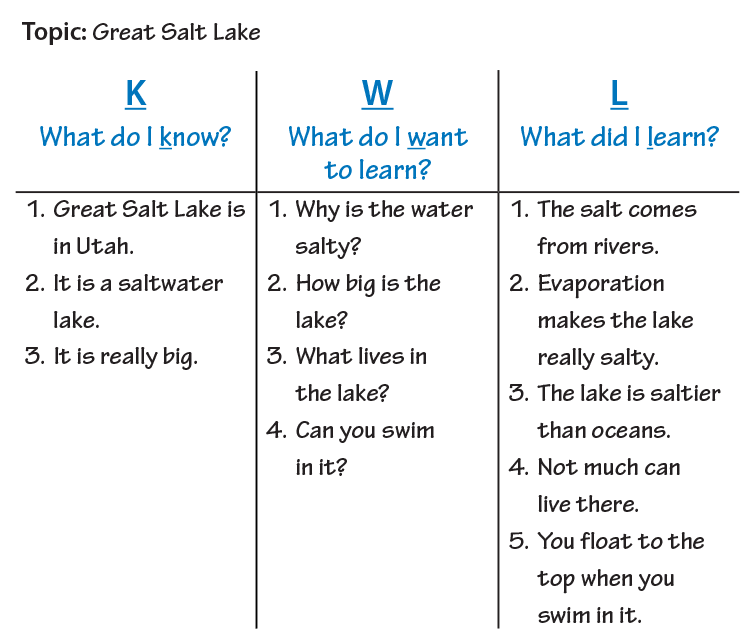
A KWL chart is a strategy for taking good notes as you read about your writing topic. Here’s how it works.
- The “K” column shows what you know. Work on this part before you read.
- The “W” column shows what you want to know. Work on this part before you read, too.
- The “L” column shows what you learned from a reading. Work on this part after you read.
The sample KWL chart shows how the parts fit together.
KWL Chart
Fill in a KWL chart.
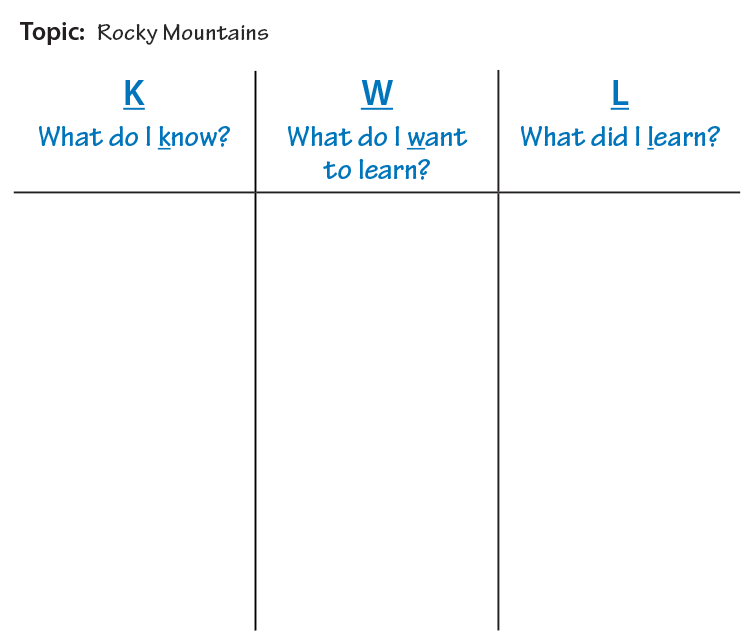
In the “K” column, write what you already know about the Rocky Mountains. In the “W” column, write what you want to learn. Then read the article and fill in the “L” column with what you learned. Make a copy of this Google doc or download a Word template.
The Amazing Rocky Mountains
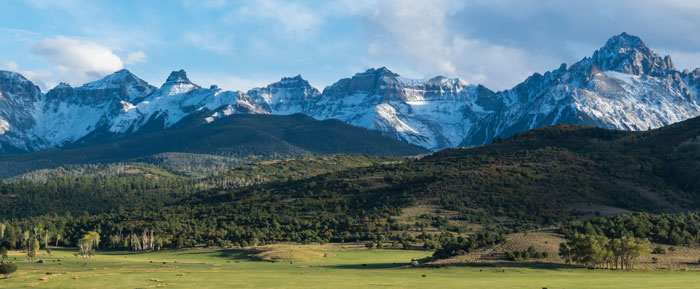
The Rocky Mountains stretch from central New Mexico to northwest Alaska. These snowcapped wonders are the “purple mountain majesties” in “America the Beautiful.” Check out these amazing Rocky Mountain facts!
- The Rockies are more than 76 million years old—young for mountains.
- They stretch for 3,000 miles through seven states and two Canadian provinces.
- With a peak of 14,440 feet, Mount Elbert in Colorado is the highest Rocky Mountain.
- The Rockies form the Continental Divide: They separate which way rivers flow—west to the Pacific Ocean, south to the Gulf of Mexico, or north to the Arctic Ocean.
- They are home to diverse wildlife, including elk, sheep, deer, moose, bear, bison, otter, and many more mammals, fish, and birds.
Reading Classroom Reports
Before you write your own report, you should read other students' reports and note the types of details they include. Consider how you might share similar types of details in your own report. Also, listen to the audio recording of each sample to get a sense of how a report should sound.
Before you write your own report, you should read other students' reports and note the types of details they include. Consider how you might share similar types of details in your own report. Also, listen to the audio recording of each sample to get a sense of how a report should sound.
Reading a Paragraph Report
A paragraph report is a quick summary of a topic. The topic sentence introduces the topic and shows what makes it special. The body sentences give important facts and details about the topic. The ending sentence gives a final thought about the topic.
A paragraph report is a quick summary of a topic. The topic sentence introduces the topic and shows what makes it special. The body sentences give important facts and details about the topic. The ending sentence gives a final thought about the topic.
Sample Paragraph
Listen to "The Great Salt Lake"
Listen to "The Great Salt Lake"
The Great Salt Lake
Topic SentenceAlmost all lakes are made up of fresh water, but not Great Salt Lake in Utah. This lake's water is saltier than ocean water. When you swim in it, the salt makes you float. The lake is so salty that not much can survive in it. Body SentencesAnother thing that makes Great Salt Lake special is its size. It is the biggest inland lake west of the Mississippi River. It is also one of the biggest saltwater lakes in the world. The lake is so special that the capital city of Utah is named after it. Ending SentenceAs you can see, the Great Salt Lake has earned its name.
Topic SentenceAlmost all lakes are made up of fresh water, but not Great Salt Lake in Utah. This lake's water is saltier than ocean water. When you swim in it, the salt makes you float. The lake is so salty that not much can survive in it. Body SentencesAnother thing that makes Great Salt Lake special is its size. It is the biggest inland lake west of the Mississippi River. It is also one of the biggest saltwater lakes in the world. The lake is so special that the capital city of Utah is named after it. Ending SentenceAs you can see, the Great Salt Lake has earned its name.
Respond to the paragraph.
Answer the questions about the paragraph. Make a copy of this Google doc or download a Word template.
- What is the topic of the paragraph?
- What is special about the topic?
- What fact from the report most surprised you?
Answer the questions about the paragraph. Make a copy of this Google doc or download a Word template.
- What is the topic of the paragraph?
- What is special about the topic?
- What fact from the report most surprised you?
Reading a Full Classroom Report
A classroom report has three main parts. The beginning paragraph hooks the reader’s interest and gives a focus statement. The middle paragraphs give interesting facts and details about the topic. The ending paragraph offers a final thought about what makes the topic special.
A classroom report has three main parts. The beginning paragraph hooks the reader’s interest and gives a focus statement. The middle paragraphs give interesting facts and details about the topic. The ending paragraph offers a final thought about what makes the topic special.
Sample Classroom Report
Listen to "Strange Salt Lake"
Listen to "Strange Salt Lake"
Strange Salt Lake
Beginning ParagraphGreat Salt Lake is one of the strangest places on earth. It is a huge lake located in the middle of Utah. In fact, it is the biggest lake in the United States west of the Mississippi River. Focus StatementBut Great Salt Lake’s size is not the only thing that makes it special.
Unlike most lakes, Great Salt Lake is made up of salt water. How can that be? River water that flows into Great Salt Lake carries salt from the surrounding land. The sun evaporates the lake water but not the salt. Over time, the water gets more salty. Today, Great Salt Lake is saltier than any ocean!
Middle ParagraphsToo much salt does strange things. Great Salt Lake is too salty for most marine life to survive. Birds and bugs buzz around the lake, but not much is living under the water. Brine shrimp are among the only creatures in the lake.
Most people don't swim in Great Salt Lake because the water is smelly and attracts bugs. But if you jump in, the salt would push you back up. That's right, salt water helps you float.
Ending ParagraphWater that helps you float is one of many things that makes Great Salt Lake strange but also great. Utah’s capital city was named after the lake, so people must respect it. Someday I want to visit this strange and salty lake.
Beginning ParagraphGreat Salt Lake is one of the strangest places on earth. It is a huge lake located in the middle of Utah. In fact, it is the biggest lake in the United States west of the Mississippi River. Focus StatementBut Great Salt Lake’s size is not the only thing that makes it special.
Unlike most lakes, Great Salt Lake is made up of salt water. How can that be? River water that flows into Great Salt Lake carries salt from the surrounding land. The sun evaporates the lake water but not the salt. Over time, the water gets more salty. Today, Great Salt Lake is saltier than any ocean!
Middle ParagraphsToo much salt does strange things. Great Salt Lake is too salty for most marine life to survive. Birds and bugs buzz around the lake, but not much is living under the water. Brine shrimp are among the only creatures in the lake.
Most people don't swim in Great Salt Lake because the water is smelly and attracts bugs. But if you jump in, the salt would push you back up. That's right, salt water helps you float.
Ending ParagraphWater that helps you float is one of many things that makes Great Salt Lake strange but also great. Utah’s capital city was named after the lake, so people must respect it. Someday I want to visit this strange and salty lake.
React to the classroom report.
Work with a partner to answer these questions. Make a copy of this Google doc or download a Word template.
- How does the report get your attention in the lead sentence?
- What sentence gives the report a focus?
- What does the first middle paragraph focus on? Does the second middle paragraph focus on something different? If so, what?
- Does the writer share any surprising facts? Give an example.
- What final thought does the report leave you with?
Work with a partner to answer these questions. Make a copy of this Google doc or download a Word template.
- How does the report get your attention in the lead sentence?
- What sentence gives the report a focus?
- What does the first middle paragraph focus on? Does the second middle paragraph focus on something different? If so, what?
- Does the writer share any surprising facts? Give an example.
- What final thought does the report leave you with?

Prewriting for Classroom Reports
To write a good report, you need to choose a topic that interests you and spend some time researching facts about it. These prewriting activities will prepare you to write a first draft.
Prewriting to Choose a Topic
Your first prewriting step is to choose a topic for your report. Make sure the topic is something you want to learn more about.
Your first prewriting step is to choose a topic for your report. Make sure the topic is something you want to learn more about.
Explore writing topics.
In this unit, you will be writing a report about a specific landform. Explore the list of landforms below. Choose the three landforms that you find most interesting.
mountains
rivers
lakes
oceans
reefs
plateaus
islands
canyons
caves
deserts
forests
plains
In this unit, you will be writing a report about a specific landform. Explore the list of landforms below. Choose the three landforms that you find most interesting.
mountains
rivers
lakes
oceans
reefs
plateaus
islands
canyons
caves
deserts
forests
plains
Narrow your topic.
List the three landforms that you chose from the last activity. These subjects are too general for a classroom report. Write specific examples of each landform. Then choose your favorite example for the topic of your report. Make a copy of this Google doc or download a Word template.
Landform 1:
Example:
Landform 2:
Example:
Landform 3:
Example:
List the three landforms that you chose from the last activity. These subjects are too general for a classroom report. Write specific examples of each landform. Then choose your favorite example for the topic of your report. Make a copy of this Google doc or download a Word template.
Landform 1:
Example:
Landform 2:
Example:
Landform 3:
Example:
Prewriting to Gather Details
It's impossible to write a good classroom report without good information. But how can you find it? Try two or more of these approaches to finding information:
- Look for books and magazines in the library.
- Search the Internet for articles and videos.
- Interview people who know a lot about your topic.
- Visit the landform!
It's impossible to write a good classroom report without good information. But how can you find it? Try two or more of these approaches to finding information:
- Look for books and magazines in the library.
- Search the Internet for articles and videos.
- Interview people who know a lot about your topic.
- Visit the landform!
Fill in a gathering grid.
Research your writing topic using books, Web sites, online videos, and encyclopedias. Fill in the gathering grid to track what you learn. Make a copy of this Google doc or download a Word template.
- Write your topic in the left corner.
- Write the name of your two best sources in the top row.
- In the blank boxes, write answers to the questions in the first column. Leave the box blank if the source does not provide an answer.
Research your writing topic using books, Web sites, online videos, and encyclopedias. Fill in the gathering grid to track what you learn. Make a copy of this Google doc or download a Word template.
- Write your topic in the left corner.
- Write the name of your two best sources in the top row.
- In the blank boxes, write answers to the questions in the first column. Leave the box blank if the source does not provide an answer.
Topic
Lesson Plan Resources:

Writing a Classroom Report
Once you finish your planning and research, you are ready to write your first draft. These activities will help you hook the reader's interest at the beginning, explain important information in the middle, and end with a strong final point.
Writing the Beginning Paragraph
The first sentence in your report should grab your reader’s attention. It is called a lead. The following activity will help you write an effective lead sentence.
Write a lead.
Read each lead-writing strategy and example. Then write your own example of each strategy. Make a copy of this Google doc or download a Word template.
- Ask a question about the topic.
- Start with a surprising fact or detail about the topic.
Did you know that New York is home to a mountain range that is bigger than the state of Connecticut?
Almost 100 mountains make up the Catskill Mountain range.
Write your focus statement.
Read about writing focus statements. Then use a formula to write your own focus statement. Make a copy of this Google doc or download a Word template.
Your opening paragraph should end with a focus statement. The focus names the topic and gives a specific thought about what makes it special.
The Catskills (the topic) are home to many natural wonders (a feeling or belief about it).
Write your focus statement:
Write your beginning paragraph.
Write your lead, introduce your topic, give background, and end the paragraph with your focus statement.
Writing the Body Paragraphs
Write topic sentences.
For each body paragraph, write a topic sentence that supports the focus statement in a different way. Each topic sentence should include a topic and a specific thought. Make a copy of this Google doc or download a Word template.
- Write a topic sentence about the landform’s size, location, or appearance.
- Write a topic sentence about the landform’s plant or animal life.
- Write a topic sentence about something special about the landform.
- Write topic sentences for any other body paragraphs. (optional)
The Catskill Mountains are not as high or jagged as the Rocky Mountains.
All kinds of wildlife call the Catskills home.
People like to vacation in the Catskills.
Write body paragraphs.
Develop each body paragraph by starting with a topic sentence and then supporting it with a variety of the details you found.
Writing the Ending Paragraph
Write your ending paragraph.
Try these closing strategies. Then combine them and other details into an ending paragraph. Make a copy of this Google doc or download a Word template.
- Sum up what makes the topic special.
- Offer a final detail about the topic.
- Give a last thought.
The Catskill Mountains are the perfect place to enjoy nature.
They rise and fall as far as the eyes can see.
Everyone should have a chance to explore them.
Ending Paragraph
Reading a Classroom Report Draft
Read a sample classroom report.
As you read this draft, note how the writer put the parts together.
Listen to "Catskill Mountains"
Catskill Mountains
LeadDid you know that New York is home to a mountain range that is bigger than the state of Connecticut? The mountain range is called the Catskill Mountains. Focus StatementThe Catskills are full of natural wonders.
The Catskill Mountains are not as high or jagged as the Rocky Mountains. The mountain range’s 100 peaks are smooth and rounded. Middle ParagraphsThe highest peak is Slide Mountain. It rises 4,180 feet. Many streams, lakes, waterfalls, and caves are a part of the mountain range too.
Topic SentencesPeople like to vacation in the Catskills. There's so much to do. You can ski and snowboard in the winter. You can hike, swim, and camp in the summer. You can also explore deep and dark caves. But you better be careful! About 2,000 black bears live in the Catskills.
TransitionsIn fact, all kinds of wildlife call the Catskills home. Some examples are bobcats, white-tailed deer, and raccoons. Bald eagles live there too. They fly from peak to peak and set up nests in the many evergreen trees.
Ending ParagraphThe Catskill Mountains of Upstate New York are the perfect place to enjoy nature. They rise and fall as far as the eyes can see. Everyone should have a chance to explore them.

Revising Classroom Reports
Great job finishing your first draft! Now it's time to improve your writing through a series of revisions. When you revise, you think about the “big picture,” including the overall structure of your writing (beginning, middle, and ending) and the focus and supporting details you use. These activities will help you revise.
Revising to Add Specific Details
You can strengthen your report by replacing general ideas with specific details. Specific details include facts, statistics, and examples. These details help support your writing ideas.
General idea: The Catskill Mountains are big. (This doesn’t tell you much.)
Specific fact: The Catskills range covers an area the size of Connecticut.
Specific example and statistic: Slide Mountain rises 4,180 feet above the ground.
Add specific details.
Review the first draft of your report. Pick out two general ideas. Replace the ideas with specific facts, statistics, or examples. Note: This activity may require you to do additional research about your topic. Make a copy of this Google doc or download a Word template.
- Write down one general idea from your report.
- Write a specific fact, statistic, or example you could use to replace or support the general idea.
- Write down another general idea from your report.
- Write a specific fact, statistic, or example you could use to replace or support the general idea.
Review the first draft of your report. Pick out two general ideas. Replace the ideas with specific facts, statistics, or examples. Note: This activity may require you to do additional research about your topic. Make a copy of this Google doc or download a Word template.
Revising to Connect Ideas
You can make your writing easier to read and understand by adding transition words or phrases between paragraphs and sentences.
Transitions to Add Information
These transitions help signal new information or ideas.
again
also
another
for example
next
for instance
as well
in addition
Transitions to Emphasize a Point
These transitions signal that something is true and important.
again
for this reason
in fact
so
certainly
to be sure
Add transitions.
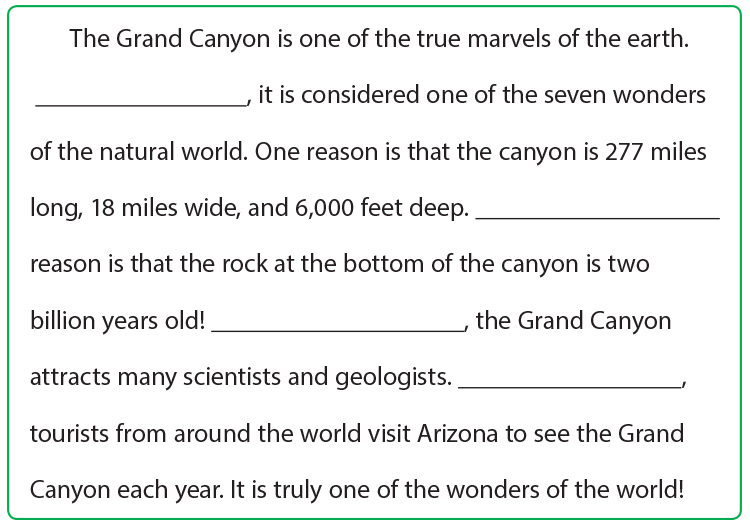
Transitions are missing from the paragraph below. Fill in the blank spaces by choosing an effective transition from the list. Read the paragraph. Do the transitions help connect ideas and improve the flow? Consider adding similar transitions to your report. Make a copy of this Google doc or download a Word template.
in addition
another
in fact
for this reason
Transitions are missing from the paragraph below. Fill in the blank spaces by choosing an effective transition from the list. Read the paragraph. Do the transitions help connect ideas and improve the flow? Consider adding similar transitions to your report. Make a copy of this Google doc or download a Word template.
in addition
another
in fact
for this reason
Revising with a Peer Response
Share your writing.
Have a classmate read your classroom report and complete the form. Make a copy of this Google doc or download a Word template.
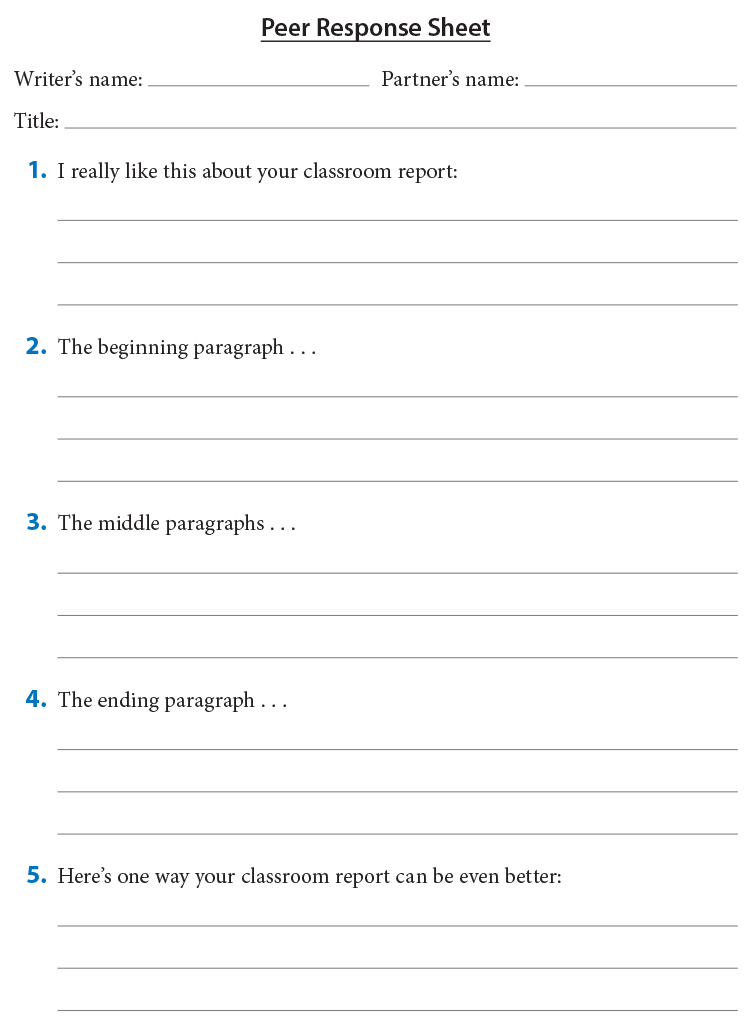
Have a classmate read your classroom report and complete the form. Make a copy of this Google doc or download a Word template.
Revising in Action
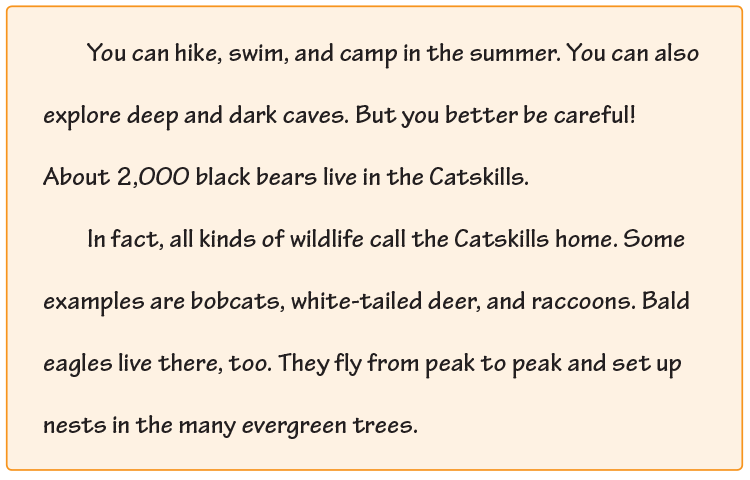
When you revise, you add, delete, rewrite, and rearrange your writing to make it clearer. Here are some revisions to “Catskill Mountains.”
Paragraph Before Revisions
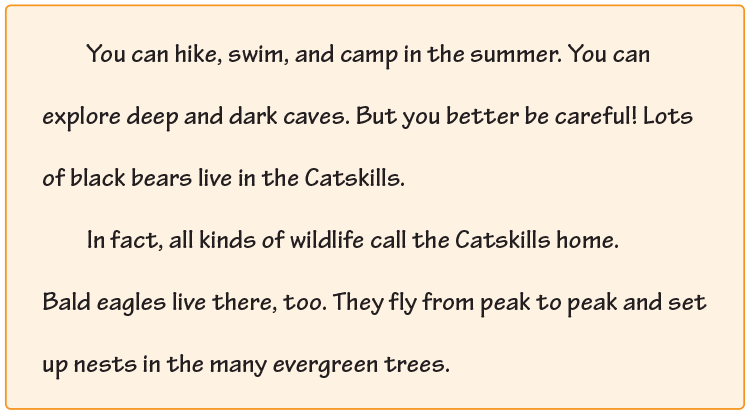
General details replaced with specific ones and transitions added.
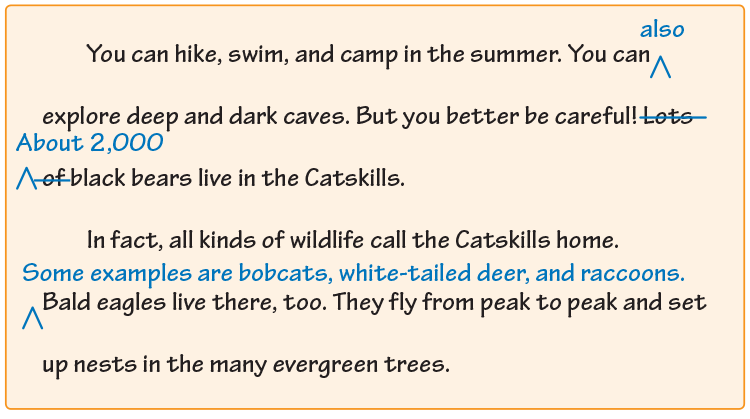
Paragraph After Revisions
Revise with a checklist.
Read each line. When you can answer each question with a yes, check it off. Make a copy of this Google doc or download a Word template.
Developing Your Ideas
- Is my topic interesting and specific?
- Does my focus statement include a topic and a specific thought?
- Did I gather interesting details about my topic?
- Did I replace general ideas with facts, statistics, or examples?
Structuring Your Ideas
- Do I start with an interesting lead and provide a clear focus statement?
- Do details support my focus and topic sentences?
- Does the ending remind readers what makes the topic special?
- Do I use transitions to connect ideas?

Editing Classroom Reports
After revising your report, you need to edit it to correct any remaining errors. You'll look closely at sentences, punctuation, capitalization, grammar, usage, and spelling. The following activities will help you edit your classroom report.
Editing Apostrophes
An apostrophe is a punctuation mark that takes the place of missing letters or shows ownership.
Apostrophes in Contractions
Use an apostrophe to form a contraction. The apostrophe takes the place of one or more letters.
don't (do not)
it's (it is / it has)
they're (they are)
I'll (I will)
isn't (is not)
wasn't (was not)
Add apostrophes in contractions.
Add apostrophes to the contractions in the sample sentences. Some sentences will require more than one correction. Make a copy of this Google doc or download a Word template.
- The Mississippi River isnt the longest river in the United States.
- Ill bring an extra coat so I dont get cold.
- Its important to respect the land, especially in national parks.
- Wasnt it cool to see the herd of buffalo? Theyre amazing animals.
- I dont ever want to leave.
Apostrophes to Show Ownership
To show ownership, add an apostrophe plus an s to a singular noun.
A mountain’s summit is its topmost point.
For a plural noun, add an apostrophe after the s. For plural nouns not ending in s, add an apostrophe and an s.
The trees’ leaves turned red and orange. (The leaves of more than one tree are turning red and orange.)
The mice’s cage is messy. (Mice is a plural noun.)
Add apostrophes to show ownership.
Add apostrophes where needed in the sample sentences. Make a copy of this Google doc or download a Word template.
- We looked closely at the one canyons walls.
- The Fox Rivers current is slow and steady.
- The girls row team practices in the river.
- Jasons dad took us canoeing.
- The rivers current carried Jasons canoe downtown.
Editing Capitalization
Your classroom report probably names specific places. These names are proper nouns, so you should capitalize them, using these rules:
- Always capitalize specific geographical names. Geographical names include streets, cities, states, important regions of a country, countries, continents, islands, land formations, and bodies of water.
- Always capitalize the names of people and their nationalities or ethnic groups.
Idaho
Victoria Falls
Gulf of Mexico
Everglades
Chicago
the Midwest
Erie Canal
Australia
Mount Everest
Australia
Stanford Avenue
Vancouver Island
Theodore Roosevelt
Canadian
South African
Malala Yousafzai
Capitalize proper nouns.
Correct the capitalization errors in the sentences below. Make a copy of this Google doc or download a Word template.
- The appalachian mountains extend 2,000 miles between alabama and newfoundland, canada.
- The longest river in the united states is the missouri river.
- However, the longest river in the world is the amazon river.
- The amazon river is located in south america.
- Mount kilimanjaro is a volcanic mountain in tanzania, africa.
- Lincoln, nebraska, is named after abraham lincoln.
- The capital of france is paris.
- Lake michigan, lake superior, lake huron, lake erie, and lake ontario are known as the great lakes.
Editing in Action
When you edit, you check to make sure your report is correct.
Paragraph Before Edits
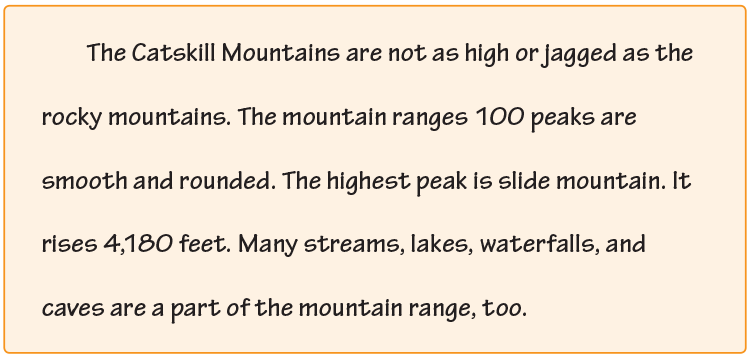
Capitalization errors are fixed and a missing apostrophe is added.
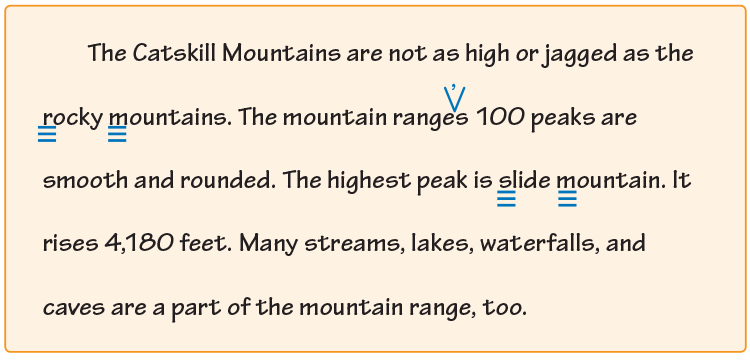
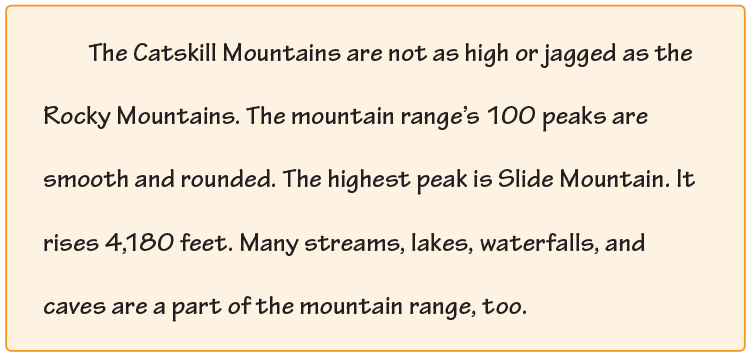
Paragraph After Edits
Edit with a checklist.
Read each line. When you can answer each question with a “yes,” check it off. Make a copy of this Google doc or download a Word template.
Checking Grammar and Usage
- Have I used correct end punctuation after all of my sentences?
- Do I use active verbs in place of passive verbs?
- Do my subjects and verbs agree in number? (Bears eat, not bears eats.)
- Are sentences complete (no fragments or run-ons)?
Checking Capitalization, Punctuation, and Spelling
- Are first words in sentences capitalized?
- Are all proper nouns capitalized?
- Do I use apostrophes correctly to show possession?
- Do I use apostrophes correctly in contractions?
- Are words correctly spelled?

Publishing Classroom Reports
When you publish your classroom report, you make it public, sharing it with others. First, you need to make a clean final copy of your work. Then you should find ways to share what you have written with your classmates, teacher, family, and friends.
Publishing a Final Copy
Create a final copy of your writing.
Include your editing changes and read over your work a final time. (If you are working on a computer, spell check your work.)
Reflecting on Your Writing
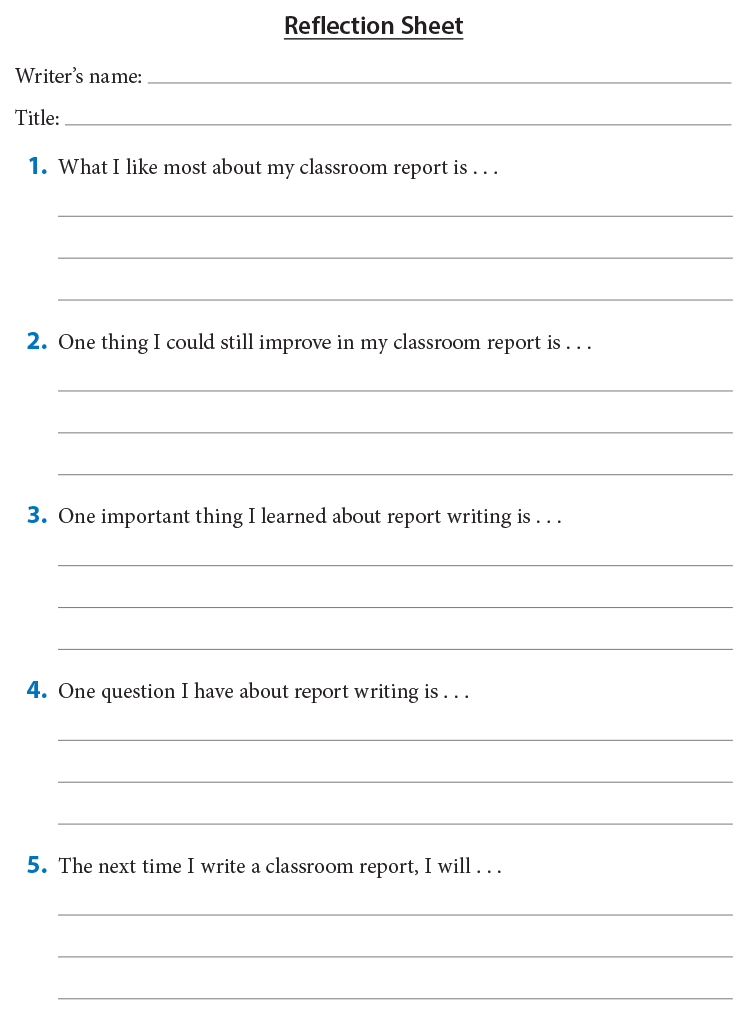
Reflect on your writing.
Complete the following form to think about what you learned. Make a copy of this Google doc or download a Word template.
Comments
Post a Comment