Writing Class 3-5 Summarizing, Paraphrasing, and Quoting
Warm-Up for Summarizing, Paraphrasing, and Quoting
Summarizing, paraphrasing, and quoting all involve using key details from other sources in your own writing. This lesson will help you get a feel for summarizing.
What Is Summarizing?
Listen to "What Is Summarizing?"
Summarizing means identifying the key information in a text, condensing it, and putting it in your own words. In this unit, you will learn the steps to writing an effective summary. You will also learn about two other research skills called paraphrasing and quoting.
All three skills will help you decide what ideas from other sources are most important. These skills will allow you to write about information from other sources and use the information fairly.
Thinking by Summarizing
Read the comic strip below called Black Ducks. Study the pictures, read the speech bubbles, and think about the key information. Then read the summary that explains the comic strip.
Episode 74

Sample Summary
A duck receives an exotic plant as a surprise birthday present. He researches how to take care of it and learns that it eats waterfowl—such as ducks.
Summarize a comic strip.
This “Black Ducks” comic strip follows the one you have just read. Read it carefully, noting the pictures and speech bubbles. Then write a brief summary of what happens in the comic strip. Make a copy of this Google doc or download a Word template.
Episode 75

Your Sample Summary
Reading Summaries
Before you write your own summary of an article, you'll want to see how others did so. In this lesson, you'll read a sample article and summary. As you read them, think about what parts of the original article are included in the summary.
Reading a Sample Article and Summary
A summary identifies the key information in a text, condenses it, and states it using the writer’s own words. Read this article about a popular type of music and think about the main idea and key information.
Listen to "K-Pop Goes Global"
Sample Article
K-Pop Goes Global
Authorby Frances Blake
Korean pop music, or ‘K-pop’ as it’s more commonly called, has already taken over Asia’s music scene and is gaining more fans in the West all the time. BeginningBut what is it about K-pop that is attracting so many listeners? It’s K-pop’s unique blend of sound and technology.
To begin with, the music of these young Korean pop stars is unique and captivating with its energetic mix of musical styles, including hip-hop, techno, R&B, and even dubstep.Middle
Where American or British pop groups rarely have more than four or five members, it’s common for K-pop groups like Girls' Generation to include nine or ten singers. Members of the groups are recruited at an early age by Korean record companies, and the young musicians must train for two years singing and dancing before they can join a group. “Every time they perform a song, it’s got to be perfect,” says record company owner Yi Yuen.
EndingIt’s not just the music that attracts fans to the genre. K-pop groups produce larger-than-life music videos complete with multicolored light shows, impressive choreography, and several outfit changes. Listeners keep track of their favorite K-pop groups on the Internet and follow group members on social media Web sites like Twitter. One music video by the group 2NE1 has over 100 million views on YouTube. K-pop’s international influence shows no signs of slowing down soon.
Respond to the article.
Answer the following questions about the article. Make a copy of this Google doc or download a Word template.
- What is the main idea of this article?
- Name two types of music that have influenced K-pop's musical style.
- Where does the topic take place?
- How are K-pop groups different than pop groups in America or Great Britain?
- How do K-pop fans follow their favorite groups?
Listen to "Summary of 'K-Pop Goes Global' "
Sample Summary
Summary of “K-Pop Goes Global”
Topic SentenceIn the article “K-Pop Goes Global,” Frances Blake writes that Korean pop music is gaining a worldwide following through a mix of sound and technology. K-pop differs from Western pop music because of its blend of musical styles and many group members. Body SentencesAlso, members must train for two years before joining groups. Much of K-pop’s success can be attributed to its music videos and Internet presence. Social media sites allow fans to follow K-pop stars more closely. Ending SentenceFor all these reasons, K-pop is making a big impact.
Respond to the summary.
Answer the following questions about the summary paragraph. Make a copy of this Google doc or download a Word template.
- What is the main idea of this summary?
- How is the summary organized?
- How is the wording in the summary different from the wording in the original text? Which is simpler?

Prewriting is your first step in writing a summary. These prewriting activities will help you read closely and pick out the important details for your summary.
Prewriting to Read Closely
Before you can write a great summary, you need to read closely. To do so, use a close-reading strategy called SQ3R—Survey, Question, Read, Recite, Review.
Survey, question, and read.
Follow these instructions before you read the article below. Make a copy of this Google doc or download a Word template.
- Survey the article: Place a check mark by the title and author.
- Question the topic and purpose: Write notes on the document.
- Read the text: Underline the focus statement and topic sentences.
Listen to "The Modern Day Magellan' "
The Modern Day Magellan
By Lizbeth Mitchell
You may have read in history books about European explorers, like Ferdinand Magellan, who sailed around the world by ship. But your history books probably have not taught you about the man who traveled around the world by motorcycle. In 2008, a British man named Jonathan Yates rode his motorcycle across six continents and 35 countries in just one year.
Yates was inspired to make the journey after reading a magazine article about a motorcycle trip in Australia. After getting his motorcycle license, he left his comfortable job in England and hit the road on his newly bought Yamaha Tenere motorcycle.
Starting in Europe, he drove east all the way through Asia until he arrived in Beijing, China. From China, Yates made his way through Southeast Asia and down to Australia. From Australia, he flew to Argentina and headed south to the tip of South America. Then he traveled north along the Pacific coast through Central America and Mexico, before finishing his journey in North America.
Along the way, Yates stored his essential belongings in containers hanging from the sides of his bike. At night, he mostly camped in his tent. On rare occasions, he slept in hostels or hotels.
While riding, Yates encountered every type of weather condition, from scorching tropical heat in Indonesia to strong winds and freezing rain in Patagonia. He experienced passport trouble at national borders, suffered mechanical difficulties, and dealt with multiple language barriers. But Yates also saw many of the planet’s most beautiful places and met amazing people during his trip around the world.
Prewriting to Gather Details
Recite and review.
Answer the following questions to gather important information from the article. Reread the article as necessary. Make a copy of this Google doc or download a Word template.
- What is the title and author of the article?
- What topic does the article describe?
- What main idea does the article address about the topic?
- What are the most important details that support the main idea?

Writing a Summary
Once you finish prewriting, you are ready to create the first draft of your summary. These writing activities will help you create a strong beginning, middle, and ending for your summary.
Writing the Topic Sentence
The topic sentence is the first sentence of a summary. It states the focus (overall point or thought) of the text in your own words. To write an effective topic sentence, follow this formula.
Write your topic sentence.
Answer the questions below to help you form a topic sentence for your summary of the article. Make a copy of this Google doc or download a Word template.
- What is the topic of “The Modern Day Magellan”?
- What main point does the selection make about the topic?
- Create a topic sentence by combining your answers from questions 1 and 2 in a logical way.
Writing the Body and Ending
Write your body sentences.
The body sentences summarize other important details from the reading. These sentences should support the idea stated in the topic sentence. Arrange the ideas in the same order as they occurred in the original text. Make a copy of this Google doc or download a Word template.
Write your ending sentence.
Write an ending sentence if one seems needed. If the final body sentence works well as an ending, no additional sentence is needed. Make a copy of this Google doc or download a Word template.
Sample ending:
For all these reasons, K-pop is making a big impact.

Revising Summaries
Once you draft your summary, take a quick break and come back to it to see it freshly. When you revise, you make sure the source is cited and all the key ideas are in order. These activities will help you revise.
Revising to Cite Sources
In your topic sentence, you should add the title and author of the text you are summarizing. By doing so, you cite the source of the ideas. Try these strategies:
- Add an introductory part:
According to “K-Pop Goes Global” by Frances Blake, Korean pop music is gaining a worldwide following through a mix of sound and technology.
- Make the title the subject:
Frances Blake’s article “K-Pop Goes Global” describes how Korean pop music is gaining a worldwide following through a mix of sound and technology.
- Add an introductory part and make the author the subject:
In the article “K-Pop Goes Global,” Frances Blake writes that Korean pop music is gaining a worldwide following through a mix of sound and technology.
Cite the source.
Use some of the strategies above to add the title and author to the following topic sentences. Then add the title and author of “The Modern Day Magellan” to the topic sentence of your summary. Make a copy of this Google doc or download a Word template.
Topic sentence: Medieval clothes offered clues about wealth and status.
Title: “A Fashionable History”
Author: Leanna Jones
Topic sentence: Zoos rely on animal mothers to raise their babies.
Title: “Zoo Mothers”
Author: Roy Pierce
Revised Topic Sentence
Revising with a Peer Response
Share your writing.
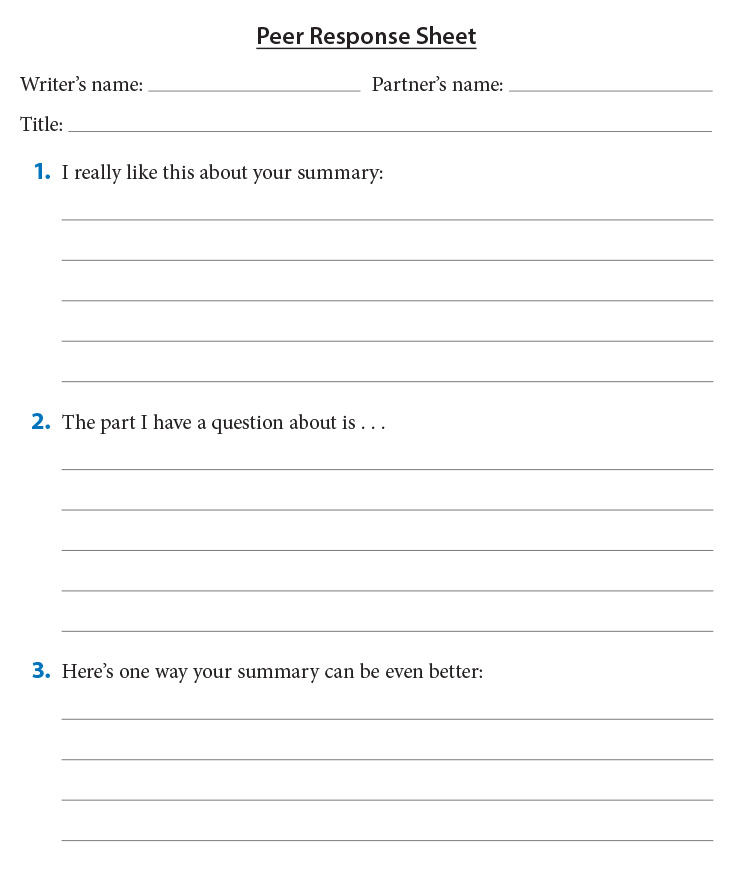
Have a trusted classmate read your summary and complete the form. Make a copy of this Google doc or download a Word template.
Revising in Action
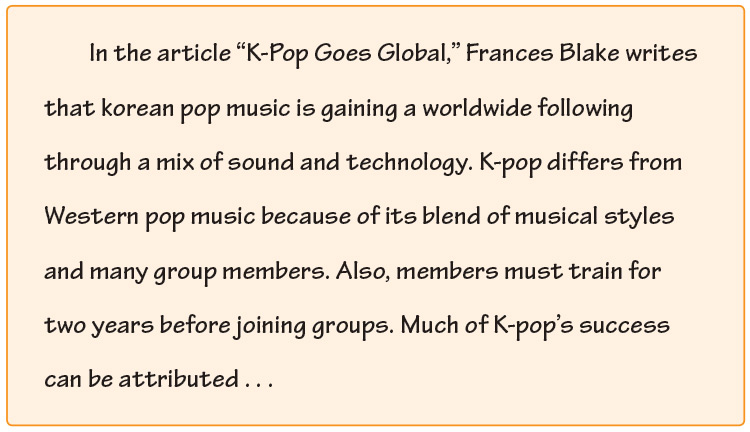
When you revise, you add, delete, rewrite, and rearrange your writing to make it clearer. Here are revisions to a summary of “K-Pop Goes Global.”
Paragraph Before Revisions
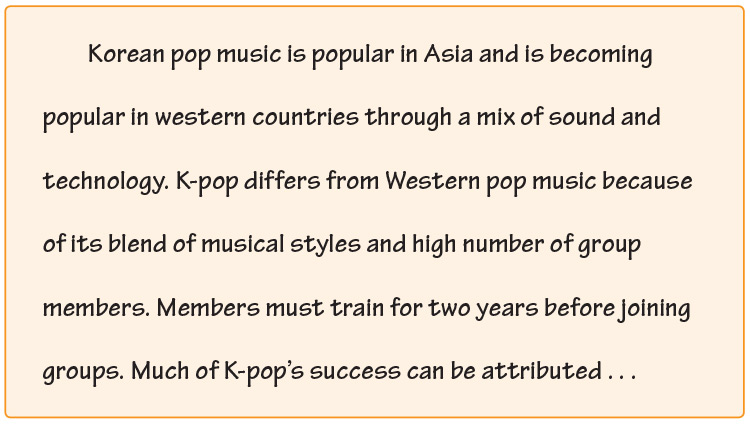
A source was cited, simplified wording used, and some transitions were added.
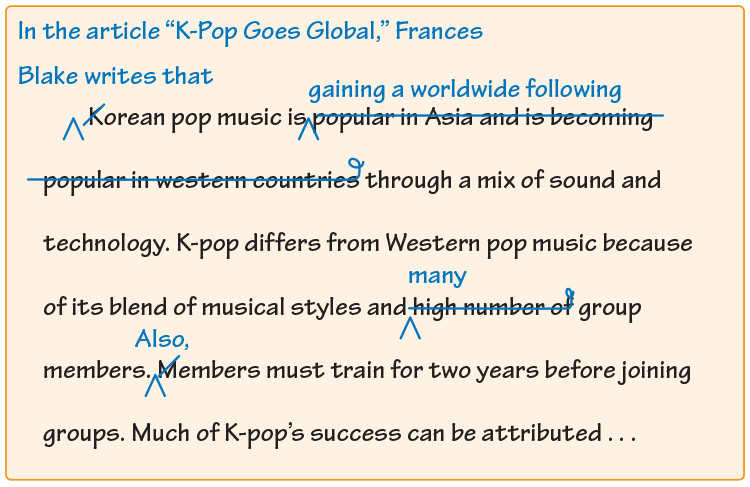
Paragraph After Revisions
Revise with a checklist.
Read each line. When you can answer each question with a yes, check it off. Make a copy of this Google doc or download a Word template.
Developing Your Ideas
- Does my topic sentence give the title, name the author, and state the main idea of the article?
- Do the body sentences include important details about the main idea?
- Does the summary contain my own words for the most part?
Structuring Your Ideas
- Does the information generally follow the same order as the article?
- Does my summary contain a topic sentence, body sentences, and an ending sentence?
- Do I use transitions to connect ideas?

Editing Summaries
After revising your summary, you need to make little changes (editing) to correct any remaining errors. You'll look for problems with sentences, punctuation, capitalization, grammar, usage, and spelling. The following instructions will help you edit and publish your writing.
Editing in Action
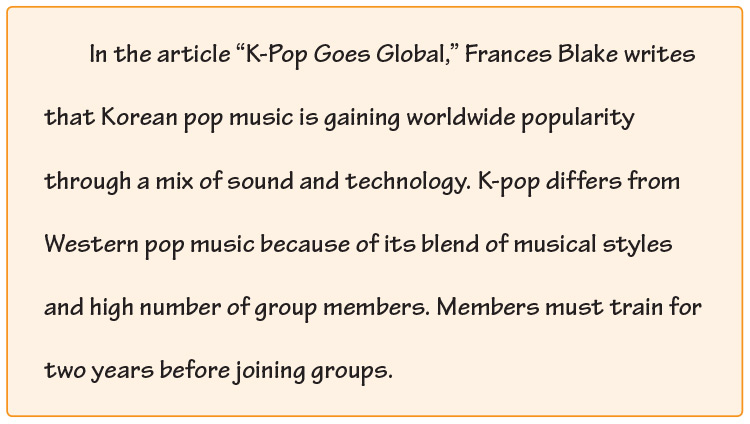
When you edit, you check to make sure your paragraph is correct.
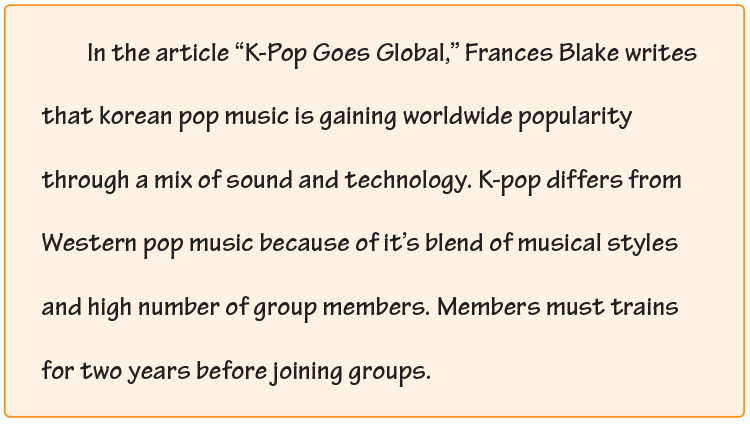
A proper noun was capitalized and a usage and agreement error was fixed.
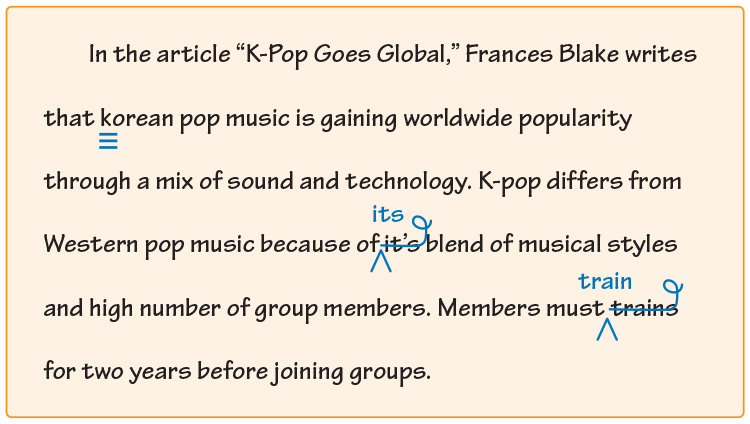
Paragraph After Edits
Edit with a checklist.
Read each line. When you can answer each question with a yes, check it off. Make a copy of this Google doc or download a Word template.
Checking Grammar and Usage
- Do my subjects and verbs agree (he takes, not he take)?
- Are words used correctly (your/you’re, their/they’re, its/it’s)?
- Are prepositional phrases used well?
- Are sentences complete (no fragments or run-ons)?
Checking Capitalization, Punctuation, and Spelling
- Are first words in sentences capitalized?
- Are proper names of people, places, and things capitalized?
- Do compound sentences have commas before and, but, or or?
- Are words correctly spelled?

Publishing Summaries
When you publish your summary, you make it public, sharing it with others. First, you need to make a clean final copy of your work. Then you should find ways to share what you have written with classmates, your teacher, your family, and your friends.
Publishing a Final Copy
Create a final copy of your summary.
Include your revising and editing changes and read over your work a final time. (If you are working on a computer, spell-check your work.) Make a copy of this Google doc or download a Word template.
Paraphrasing and Quoting
When you write, you can use ideas from sources, but you must avoid plagiarism—presenting others’ words as your own. Use one of these strategies:
- Paraphrasing is using your own words to express the ideas from a text.
- Quoting is using a text’s exact words in quotation marks and naming the source.
Listen to "Flying Fish, Ocean Acrobats"
Flying Fish, Ocean Acrobats
Flying fish are called the dragonflies of the deep, but flying fish don’t have wings like dragonflies or birds. They use two sets of pectoral fins as wings to fly. Their front fins lift them out of the water, and their back fins help them soar over the surface.
Paraphrase: Flying fish use sets of fins to glide above water.
Quote: The article “Flying Fish, Ocean Acrobats” points out that “flying fish are called the dragonflies of the deep.”
Paraphrase and quote.
Read the passage and follow the instructions below. Make a copy of this Google doc or download a Word template.
Listen to "Strange Salt Lake"
Strange Salt Lake
Unlike most lakes, Great Salt Lake is made up of salt water. How can that be? River water that flows into Great Salt Lake carries salt from the surrounding land. The sun evaporates the water in the lake but not the salt. Over time the water gets saltier. Today, Great Salt Lake is saltier than any ocean!
- Paraphrase the passage in a sentence or two:
- Quote an interesting line from the passage:
Closely read.
Use the SQ3R strategy to closely read the following article. Make a copy of this Google doc or download a Word template.
Listen to "The Plight of Pluto"
The Plight of Pluto
By Olivia Ramirez
For 76 years, nine planets made up our solar system. That all changed in 2006, when Pluto was downgraded to a dwarf planet. Now we’re left with eight full-sized planets. So what happened to Pluto? How does a planet become less of a planet?
History of Pluto
Pluto was discovered by Clyde Tombaugh in 1930, becoming the ninth planet in the solar system. Astronomers and students celebrated the icy celestial body for being the smallest and farthest planet from Earth.
In the next 75 years astronomers discovered other icy objects similar to Pluto in size. One was even inside Pluto’s orbit. Then in 2005, astronomers discovered Eris, which is 27 percent larger than Pluto.
New Definition of “Planet”
Influenced by the discovery of Eris, the International Astronomical Union (IAU) met in 2006 to establish new rules for defining full-sized planets. They decided on a set of three criteria.
- The object must orbit around the Sun.
- The object must be big enough to be nearly round.
- The object must have “cleared the neighborhood” around its orbit.
Pluto met the first two criteria but failed the third. In all the billions of years it has orbited there, Pluto didn’t have enough gravitational power to clear objects of similar size out of its vicinity. Thus, the IAU downgraded Pluto. Pluto and four other celestial bodies became known as dwarf planets.
To be clear, Pluto still exists. It didn’t change size or orbit or undergo any sort of physical transformation. Only the criteria for defining planets changed. Pluto, the full-sized planet, lost out on a technicality.
Paraphrase, quote, and summarize.
Follow the instructions to paraphrase, quote, and summarize what you’ve read. Make a copy of this Google doc or download a Word template.
- Paraphrase the second to last paragraph, which begins with "Pluto met the first two criteria. . . ."
- Quote an interesting line from the article.
- Summarize the article.
Reflecting on Your Writing
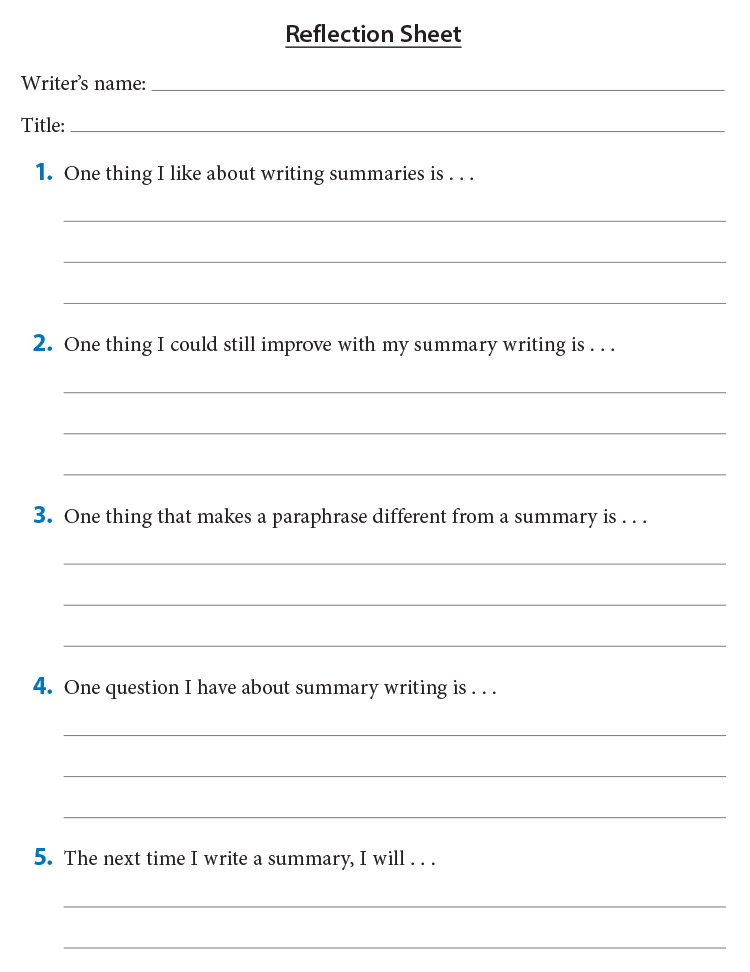
Reflect on your writing.
Complete the following form to think about what you learned. Make a copy of this Google doc or download a Word template.
Comments
Post a Comment