Writing Class 3-5 Personal Narratives
Warm-Up for Personal Narratives
All of us have important times in our lives. By thinking back to these times, we understand ourselves better. By sharing these times with those we love, we become closer. This lesson will help you think about events in your life.
What Is a Narrative?
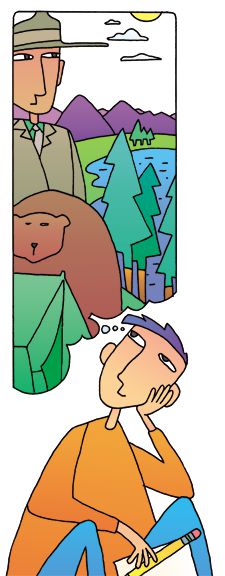
Listen to "What Is a Narrative?"
A narrative is a story. It tells something that happened, like in a book or a movie. But books and movies are not the only places to find good stories. Your experiences make great stories, too.
A personal narrative is a true story about something that happened in your life. You might share an exciting, surprising, or scary experience, like the time you went camping and saw a bear. Or you might share a moment when you learned an important lesson.
The best personal narratives include many details, helping readers feel like they are a part of the story, too. In this unit, you will write a true story from your own life in way that makes it come alive once again!
Watch the video "What Is a Personal Narrative?"
Thinking About a True Story
Before you can share a story, you need to remember all the important things that happened. Asking and answering the 5 W’s questions can activate your memory and help you record important details about your experience.
- Who was with me?
- What exactly happened?
- Where did this happen?
- When did this happen?
- Why did it happen?
You can answer a list of 5 W’s questions like the ones above to remember important details.
5 W’s Memory Chart
You can also answer the questions in a 5 W’s memory chart to help you remember your experience.
Who? | Grandpa |
What? | We went fishing. We cast our poles. Nothing happened, and I got frustrated. Grandpa told me a story about patience. We waited longer. Finally, we got a bite. Together, we reeled in my first fish! |
Where? | On a little boat in a pond outside the city |
When? | Early one summer morning |
Why? | Grandpa taught me about being patient. My patience paid off, and I finally caught a fish. |
Choose a memorable experience.
Write down an event or experience that you will never forget.
Fill in a 5 W’s memory chart.
Complete the following chart to answer the basic questions about your experience. Make a copy of this Google doc or download a Word template.
5 W’s Memory Chart
Who? | |
What? | |
Where? | |
When? | |
Why? |
Reading Personal Narratives
Before you write about your own experience, you'll want to see how other students created personal narratives. This lesson shows you a narrative paragraph and a narrative essay, explaining each part. As you read them, think about how the writers made the people, places, and events come to life through description, action, and dialogue.
Reading a Narrative Paragraph
A personal narrative paragraph has three main parts. The topic sentence introduces your story. The body sentences describe what happened to you. The ending sentence tells why the experience was important. This paragraph shares one writer’s story about a school play.
Sample Paragraph
Listen to "Frozen on Stage."
Frozen on Stage
Topic SentenceMy first school play is something I’ll never forget. I was playing Mary Todd Lincoln, the wife of Abraham Lincoln. The whole auditorium was packed with people. Body SentencesIt was hot inside, even though it was the middle of the winter. Ms. Valentine gave me the cue, so I walked on stage toward Chad, who was playing Abraham Lincoln. When I looked at the audience, I froze and forgot my line. Now I was really sweating. I looked at Chad, and he pointed to his hat. That helped me remember the line. I said, “Geez, Abe, your hat is on crooked again.” The crowd laughed, and I relaxed. We got a standing ovation when the show ended. Chad was a great teammate. Ending SentenceI knew from then on that I would be a good teammate, too.
Respond to the paragraph.
Answer the following questions about the paragraph. Make a copy of this Google doc or download a Word template.
- What is the topic of this paragraph?
- What details stand out? Name two.
Reading a Narrative Essay
A personal narrative essay has three main parts. The beginning paragraph hooks the reader’s interest and introduces the experience. The middle paragraphs tell what happened by describing actions in time order. The ending paragraph sums up the experience and shares a final thought about it.
In this personal narrative essay, the writer adds dialogue, thought details, and sensory details to expand her paragraph topic into an essay.
Listen to "Topping Stage Fright."
Sample Essay
Topping Stage Fright
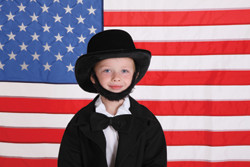
Beginning ParagraphI thought I was ready when I arrived at our school’s auditorium. Last winter my class put on a play called “Gettysburg” for a real audience. I had practiced hard, and I had all my lines memorized. During the dress rehearsal, everything went smoothly. But my first real show did not go as planned.
Middle ParagraphsI started to get nervous backstage. “I can’t believe all these people are here to see us,” I told Sofia. “And why is it so hot?” Even in the middle of the winter, the auditorium felt steamy. It didn’t help that I was wearing a big poofy gray dress in my role as Mary Todd Lincoln, the wife of Abraham Lincoln.
DialogueI wasn’t in the first scene, so I kept my eyes on Ms. Valentine. She was the director of the play and would give me a cue when it was my turn to go on stage. “You’re going to do great,” said Sofia. Before I had time to thank her, Ms. Valentine gave me two thumbs up.
Sensory DetailsStepping on stage for the first time felt like slow motion. Each step was more difficult than the last. When I caught a glimpse of the crowd, I froze. Every seat seemed like it was filled. Then a bright light hit my face, and I realized everyone could see me.
TransitionsAfter that I slowly walked toward Chad. He was playing Abraham Lincoln and was wearing a full black suit and a top hat that leaned off the side of his head. I knew it was time for my first line, but when I looked again at the crowd, my mouth got dry and my mind went blank.
Now I was really sweating, because I forgot my line. I started to feel embarrassed, but then I looked at Chad. He pointed to his hat. That’s it! I remembered what I was supposed to say.
I turned to the crowd and said, “Geez, Abe, your hat is on crooked again.” The audience laughed. I smiled and relaxed as Chad said the next line, “I was worried about my speech, Mary. Now I’m worried about my hat!”
Ending ParagraphThe rest of the play went great. My lines came out just like I practiced them. I was no longer nervous, and I even felt a surge of excitement. At the end, the crowd gave us a standing ovation. I thanked Chad backstage. “It was nothing,” he said. Reflective DetailsBut I won’t forget what he did. He acted like a good teammate. Whenever the chance comes, I’ll do the same thing for someone else.
Respond to the essay.
Work with a partner to answer these questions. Make a copy of this Google doc or download a Word template.
- How does the essay get your attention in the lead sentence?
- Does the essay answer the 5 W’s questions? If so, answer these questions: Who is involved? Where does it happen? When does it happen?
- What unexpected things happen?
- What details most make you feel like you are a part of the experience?
- What does the writer learn? Where does she share this reflection?

Prewriting for Personal Narratives
Prewriting is your first step in writing a personal narrative. These prewriting activities will help you select a topic to write about, gather important details about the topic, and organize your thoughts before you begin a first draft.
Prewriting to Focus Your Ideas
Choose your topic.
Your goal is to write a personal narrative about an unforgettable experience. Complete the following sentence starters to help you discover a writing idea. Then circle the topic you wish to write about. Make a copy of this Google doc or download a Word template.
- I’ll never forget the time when . . .
- I learned an important lesson when . . .
- I was proud of myself when . . .
Gather the basic parts.
Fill in a 5 W’s memory chart to gather all of the basic details about the experience. Make a copy of this Google doc or download a Word template.
Who? | |
What? | |
Where? | |
When? | |
Why? |
Prewriting to Organize Details
All narratives need actions. Actions are the things that happen in the story. Usually, the actions are organized in time order, or when they happened.
Place actions in time order.
List the things that happened in your experience, from start to finish. Use a time line to organize them in time order. Make a copy of this Google doc or download a Word template.
1 | |
2 | |
3 | |
4 | |
5 |
Add dialogue and thought details.
Make your experience come alive for readers by adding dialogue and thought details. Dialogue is what the people said during your experience. Thought details are how you felt or what you were thinking while the experience was happening. Study each sample and write an example from your own experience. Make a copy of this Google doc or download a Word template.
- Dialogue: “Goodness. Look at the size of that fish,” Grandpa said.
- Thought detail: I couldn’t believe I forgot my line. I felt embarrassed.

Writing a Personal Narrative
Once you finish prewriting, you are ready to tell your story in writing. These activities will help you hook the reader's interest at the beginning, build interest through a sequence of events, and lead to a strong ending for your personal narrative. You'll also read another student's essay to see how all of the parts came together.
Writing the Beginning Paragraph
Write a lead.
Read each lead-writing strategy. Then write an example of your own. Make a copy of this Google doc or download a Word template.
The first sentence in your narrative should grab the reader’s attention. It is called a lead. The following strategies will help you write an effective lead.
- Start in the middle of the action:
I thought I was ready when I arrived at our school’s auditorium.
- Start with dialogue:
“Just wait a little longer,” said my grandpa.
- Start with an interesting fact or statement:
When Manny came to my school, I didn’t expect to become best friends.
Write your beginning paragraph.
Write your lead and give more details to introduce your experience. Make a copy of this Google doc or download a Word template.
Lead:
Introductory Details:
Writing the Middle Paragraphs
Write topic sentences.
For each middle paragraph, write a topic sentence that introduces a new action or new part of the story in the order that it happened. Make a copy of this Google doc or download a Word template.
- Write a topic sentence for your first middle paragraph:
We arrived at a pale building.
- Write a topic sentence for your second middle paragraph:
Then we walked inside, and I understood his warning.
- Write a topic sentence for your third middle paragraph:
At our table, we were served tacos and flaky pastries.
- Write topic sentences for any other middle paragraphs:
Next, everyone at our table argued about soccer players.
Manny nudged me onto the dance floor.
Write middle paragraphs.
Write your topic sentences. Add detail sentences to support them. Include dialogue and thought details. Use time-order transitions to connect your ideas. Make a copy of this Google doc or download a Word template.
Time-Order Transitions
first
next
then
afterward
to start
secondly
continue by
finally
once
later
next
by the end
before
when
during
after
Middle Paragraph 1
Topic Sentence
Detail Sentences
Middle Paragraph 2
Topic Sentence
Detail Sentences
Middle Paragraph 3
Topic Sentence
Detail Sentences
Middle Paragraph 4
Topic Sentence
Detail Sentences
Middle Paragraph 5
Topic Sentence
Detail Sentences
Writing the Ending Paragraph
Write your ending paragraph.
Try these ending strategies. Then combine some into an ending paragraph. Make a copy of this Google doc or download a Word template.
- Tell how the experience ended.
When the celebration ended, I was exhausted.
- Share your feelings.
I’m thankful for Manny. It was cool that he helped me experience something new.
- Show what you learned.
Sometimes stepping out of your comfort zone is the best thing you can do.
Ending Paragraph
Read a Sample Personal Narrative Draft
Read a sample.
Note how the writer put the parts together.
Listen to "Something New."
Something New
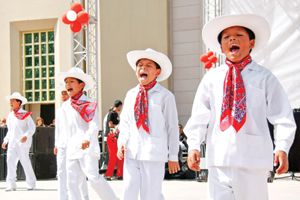
LeadWhen Manny came to my school, I didn’t expect us to become best friends. Beginning ParagraphHe moved from Texas, and his parents were born in Mexico. I had lived my entire life in Kansas City. But we both liked soccer, and we became friends. That September Manny invited me to a party with his family to celebrate Mexico’s Independence Day.
Middle ParagraphsWe arrived at a pale building. A few people in odd outfits were waiting outside, but everything else seemed normal. “You ready for this?” asked Manny. Thought DetailsI thought that was a weird question.
Then we walked inside, and I understood his warning. The entire space was filled with people, colors, sounds, and movements. I felt dizzy. Girls were dressed in bright pink, yellow, and red dresses. Guys wore big hats and suits. People were dancing to the beat of trumpets, guitars, and violins. “Welcome to the fiesta,” said Manny’s dad.
At our table, we were served delicious tacos and flaky pastries. There were also big green chilis covered in white sauce and bits of red fruit. Dialogue“Are you going to eat that or what?” asked Manny. I’d never seen or eaten anything like it. But I remembered when I made Manny eat lasagna for the first time at my house, so I took a big bite. It tasted like a soupy and spicy green pepper. “Yum,” I said. Everyone laughed because they knew I was lying. I gulped lime soda to get rid of the taste.
TransitionAfter lunch, trumpets blared, and people at our table started arguing about soccer stars. I said Messi was the best, and they gave me high fives. Just when I was feeling relaxed, Manny said, “It’s time to change into our costumes.” Before I knew it, I was wearing a sparkly black jacket, a red scarf, and a big cowboy hat. “You didn’t tell me I had to wear a costume,” I said. “I didn’t tell you about the dancing either,” said Manny. Now I felt really dizzy.
Next, Manny nudged me toward the dance floor. Everyone was moving so fast. “Just follow my lead,” he said. He bounced into the dance circle, while I stood still. When he made it all the way around, he pulled me in, and I had no choice but to dance. I spun and tapped my feet.
Ending ParagraphWhen the celebration ended, I was exhausted. Manny’s dad congratulated me on my moves. My mom still doesn’t believe I tried dancing. I’m glad Manny invited me. It was cool that he helped me experience something new.

Revising Personal Narratives
Once you draft your personal narrative, take a break and come back to it to see it freshly. When you revise, you make sure the people, places, and events are clearly described and the writing captures the experience in a vivid way. These activities will help you revise.
Revising to Add Sensory Details
To help your story come alive, you can add details about what you saw, heard, smelled, tasted, and touched. These are called sensory details.
Sensory details help you show readers what is happening, rather than just telling them. You can collect these details in a sensory chart.
Watch the video "Sensory Details."
Add sensory details.
Read the first draft of your personal narrative. Think of sensory details that you could add to make the writing come alive. Record the details in a sensory chart. Then add them to your personal narrative. Make a copy of this Google doc or download a Word template.
Revising Dialogue to Sound Natural
The dialogue in your narrative should sound real, the way people naturally speak. You can review your dialogue to make sure it sounds natural.
Make dialogue sound natural.
Read the tips for creating natural dialogue. Then try them out by revising some of the dialogue from your first draft. If your draft needs more dialogue, add some. Make a copy of this Google doc or download a Word template.
- Pretend you are having a conversation in real life.
“You didn’t tell me I had to wear a costume,” I said. “I didn’t tell you about the dancing either,” said Manny.
- Use casual language, unless the character needs to sound serious.
“Are you going to eat that or what?” asked Manny.
- Match the dialogue with the character’s personality.
“Just follow my lead,” said Manny.
- Use the dialogue to help tell your story.
Just when I was feeling relaxed, Manny said, “It’s time to change into our costumes.”
Revising with a Peer Response
Share your writing.
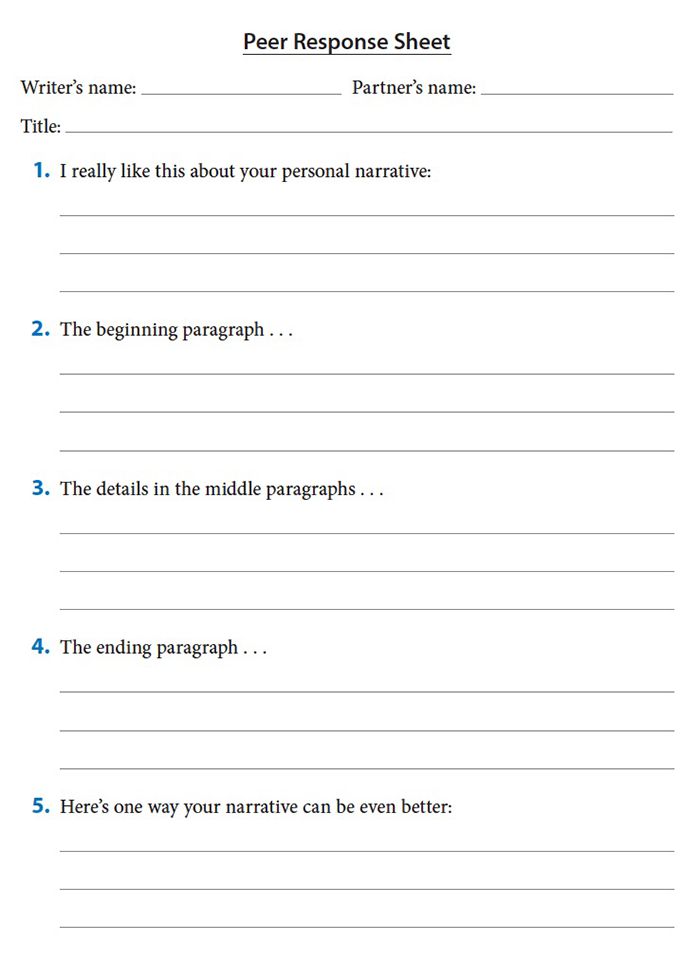
Have a trusted classmate read your essay and complete the form. Make a copy of this Google doc or download a Word template.
Revising in Action
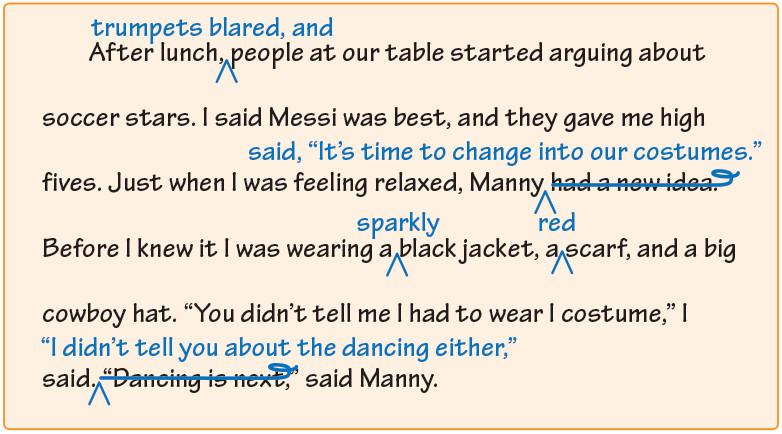
When you revise, you add, delete, rewrite, and rearrange your writing to make it clearer. Here are some revisions to the "Something New" essay.
Paragraph Before Revisions
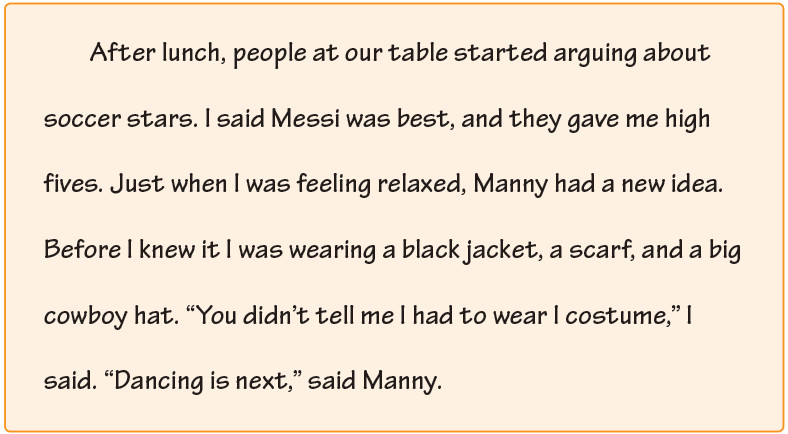
Sounds, Dialogue, and Sights are added. Dialogue is improved.
Paragraph After Revisions
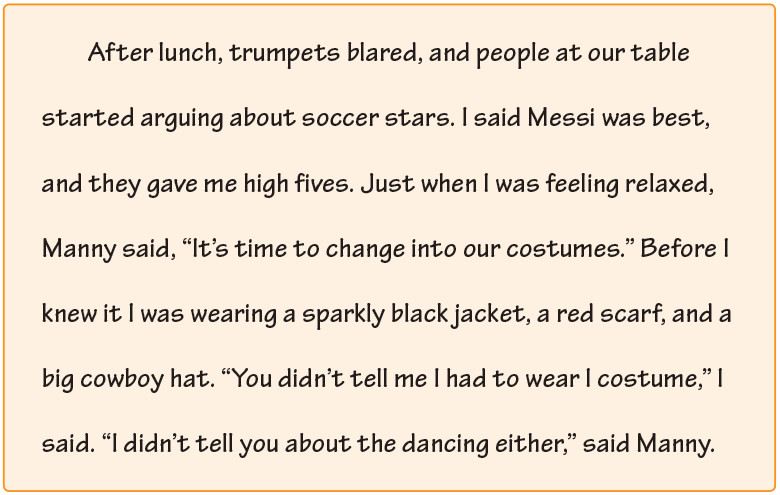
Revise with a checklist.
Read each line. When you can answer each question with a yes, check it off. Make a copy of this Google doc or download a Word template.
Developing Your Ideas
- Does the narrative tell an interesting story?
- Does it include actions, dialogue, thought details, and sensory details?
- Does the voice sound natural and interesting?
Structuring Your Ideas
- Does my lead sentence hook the reader at the beginning?
- Does the beginning paragraph introduce the experience?
- Do middle paragraphs include actions and details in time order?
- Do time-order transition words help move the action along?

Editing Personal Narratives
After making big changes to improve your personal narrative, you need to make little changes (editing) to correct any remaining errors. You'll look for problems with sentences, punctuation, capitalization, grammar, usage, and spelling. The following activities will help you edit your narrative.
Editing Dialogue for Quotation Marks
Dialogue uses quotation marks. These special marks go before and after the exact words of the speaker.
“Yum,” I said.
Manny’s dad said, “Welcome to the fiesta.”
Periods and commas that follow the speaker’s words always go inside the quotation marks.
“It’s time to change into our costumes,” said Manny. “Follow me.”
Question marks and exclamation marks go inside the quotation marks when they punctuation the dialogue.
“Are you ready for this?” asked Manny.
“Wow!” I said.
Watch the video "Punctuating Dialogue."
Insert quotation marks.
Insert quotation marks before and after the speaker’s words. Use the examples on this page for help. (Make a copy of this Google doc or download a Word template.) The first one has been done for you.
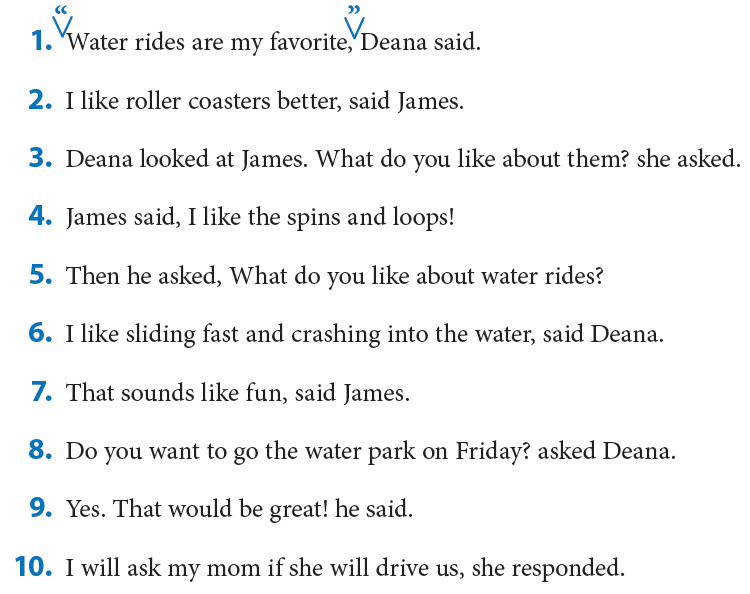
Edit your dialogue.
Read your essay, paying attention to your dialogue. Make sure you use quotation marks and that they are in the correct place.
Editing Verb Tenses
The tense of a verb tells when an action takes place. Actions in personal narratives take place in the past, so you should use the past tense of verbs most of the time. The past tense is usually formed by adding -ed to the present tense verb.
The present tense of a verb states action that is happening now.
We talk about dancing. I smile and laugh.
The past tense of a verb states an action that happened in the past.
We talked about dancing. I smiled and laughed.
The future tense of a verb states an action that will take place in the future. (It is formed by using will or shall before the verb.)
We will talk about dancing. I will smile and laugh.
Change the verb tense.
Rewrite the following sentences, changing the present and future tense verbs to the past tense. (Make a copy of this Google doc or download a Word template.) The first one has been done for you.
- I pick an outfit to wear.
- I dribble the basketball.
- Frank the dog will fetch a stick.
- We search for the nearest park.
- We will play games and race around the trees.
Check your verbs tenses.
Read your essay. Make sure any actions that happened in the past have past-tense verbs. Change the tenses as needed.
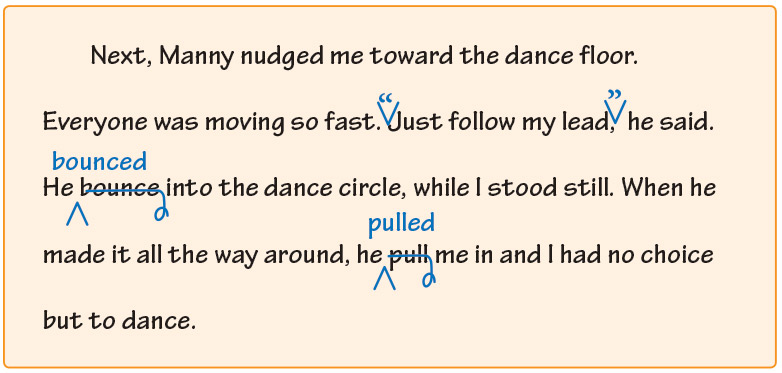
Editing in Action
When you edit, you check to make sure your essay is correct.
Paragraph Before Edits
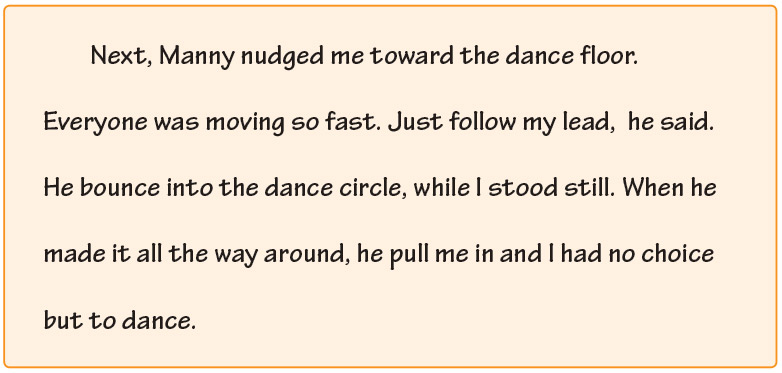
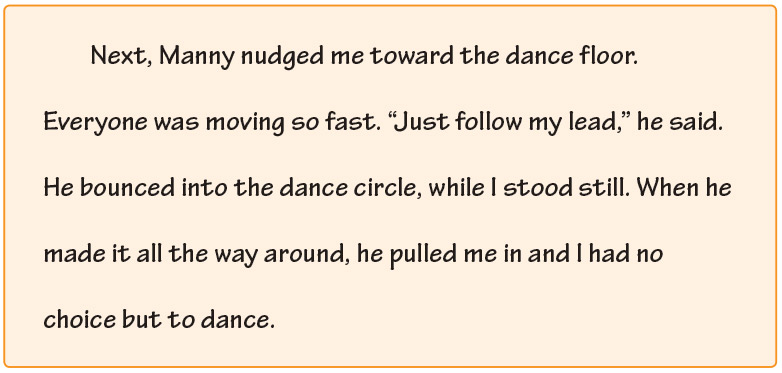
Quotation marks were added and a tense was corrected.
Paragraph After Edits
Edit with a checklist.
Read each line. When you can answer each question with a yes, check it off. Make a copy of this Google doc or download a Word template.
Checking Grammar and Usage
- Is the correct verb tense used with actions?
- Are words used correctly (your/you’re, their/they’re, its/it’s)?
- Do subjects and verbs agree in number? (Manny and I were laughing, not Manny and I was laughing.)
- Are all my sentences complete (no fragments or run-ons)?
Checking Capitalization, Punctuation, and Spelling
- Is the first word in each sentence capitalized?
- Are proper names of people, places, and things capitalized?
- Do commas and quotation marks set off dialogue?
- Are all my words spelled correctly?

Publishing Personal Narratives
When you publish your personal narrative, you make it public, sharing it with others. First, you need to make a clean final copy of your work. Then you should find ways to share what you have written with classmates, your teacher, your family, and your friends.
Publishing a Final Copy
Create a final copy of your writing.
Include your editing changes and read over your work a final time. (If you are working on a computer, spell check your work.) Make a copy of this Google doc or download a Word template.
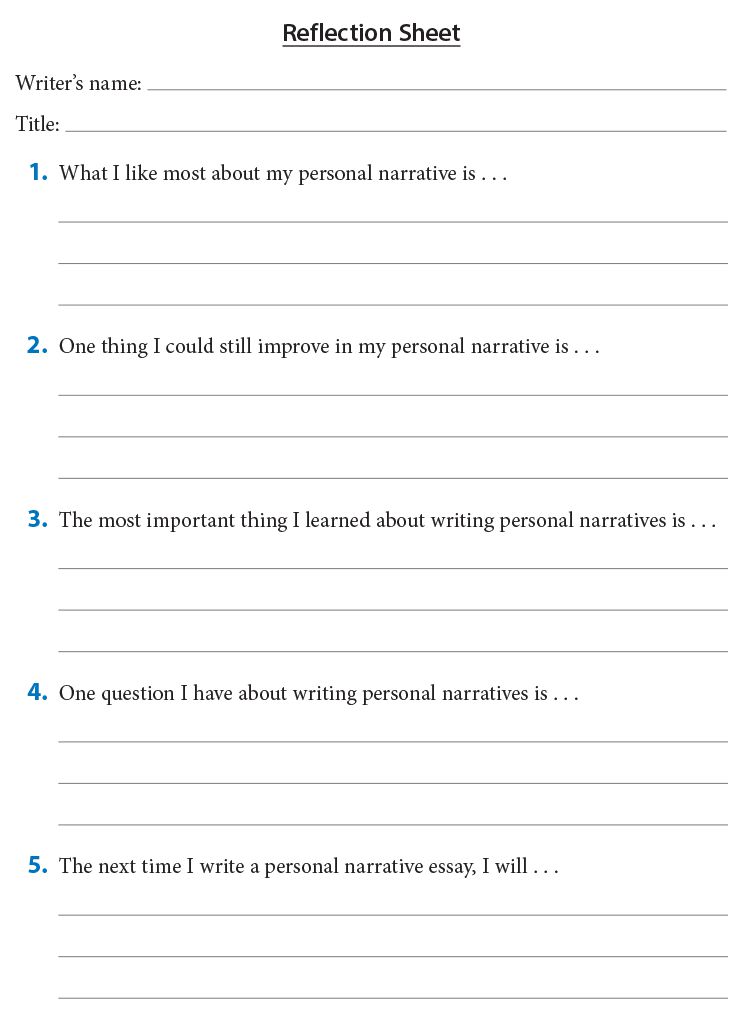
Reflecting on Your Writing
Reflect on your writing.
Complete the following form to think about what you learned. Make a copy of this Google doc or download a Word template.
Comments
Post a Comment