Writing Class 3-5 Journaling and Blogging
Warm-Up for Journaling and Blogging
Did you know that writing can be like looking in a mirror? It’s true. When you look in a mirror, you see a reflection of yourself. When you write about yourself, memories reflect back at you, both in your mind and on paper.
Why Write About Yourself?

Listen to "Why Write About Yourself?"
You finally got all the words correct on your spelling test. You nailed your dance recital. Your best friend is coming over for pizza and movie night. Days like this are so special that you want to remember each moment.
How can you be sure to remember every detail of your awesome day? Try writing about it in a journal or on a blog. Writing about yourself is one of the best ways to capture your memories, reconnect with old experiences, and deepen your learning and growth as a person in and out of school.
This unit will introduce you to journaling and blogging. You’ll learn about and practice both types of writing, and hopefully learn something new about yourself and your school subjects along the way.
Thinking by Reflecting
To reflect means to think about the things you do and see. You can make reflecting a part of your daily routine. Here’s how one student jotted down notes to reflect on different parts of her day.
My Time of Day
Morning
I learned about spiders in science class. Did you know that spiders aren’t actually insects?
Art class was fun today. I sat by Abby. Ms. Koffman had us draw portraits of each other with colored pencils. We look so goofy!
We had pork fritters for lunch. Yuck! I played kickball at recess. My team lost, but I kicked one high and far.
Afternoon
It was silent reading day in English class. I’m reading James and the Giant Peach. James is on a crazy adventure!
The bus was loud today. A fifth-grader took my seat, so I was happy to get home. I had soccer practice before dinner. I worked on my dribbling.
Night
One silly thing happened at dinner. My little sister spilled her milk all over the table. Mom and Dad didn’t giggle like me.
I finished my math assignment. Now I’m writing about my day. It’s almost bedtime.
Reflect on your day.
Jot down notes about things that happened at different times of your day. Include your thoughts and feelings about the different events. How did the events make you feel? What did you learn from them? Make a copy of this Google doc or download a Word template.
Morning
Afternoon
Night
Reading Journals and Blogs
Before you start journaling and blogging, you can read some examples from other students. The samples below will give you a sense of what personal writing looks and sounds like.
Reading a Journal
A personal journal is your own special space to write about anything and everything. You can jot down thoughts and ideas; write about things you do, see, and learn; or write about your feelings.
Sample Personal-Journal Entry
Listen to the sample.
September 10
Personal FeelingsToday proved why Sundays are the best. The sky was blue, and the sun was warm and bright. Dad turned on the sprinkler. My brother and I jumped through it. We spun, slid, and cartwheeled through the cold water. Sensory DetailsAfterward, Dad tossed us the Frisbee, and we dove to catch it. Then he taught us how to throw the Frisbee. At first, my throws wobbled. Action DetailsBut I got the hang of it before the sun went down. I wish all days were like today.
Respond to the journal entry.
Answer the following questions about the personal-journal entry. Make a copy of this Google doc or download a Word template.
- What do you like about the journal entry?
- Does the journal entry sound like a story told to a friend or like writing from a textbook? How so?
Reading a Blog
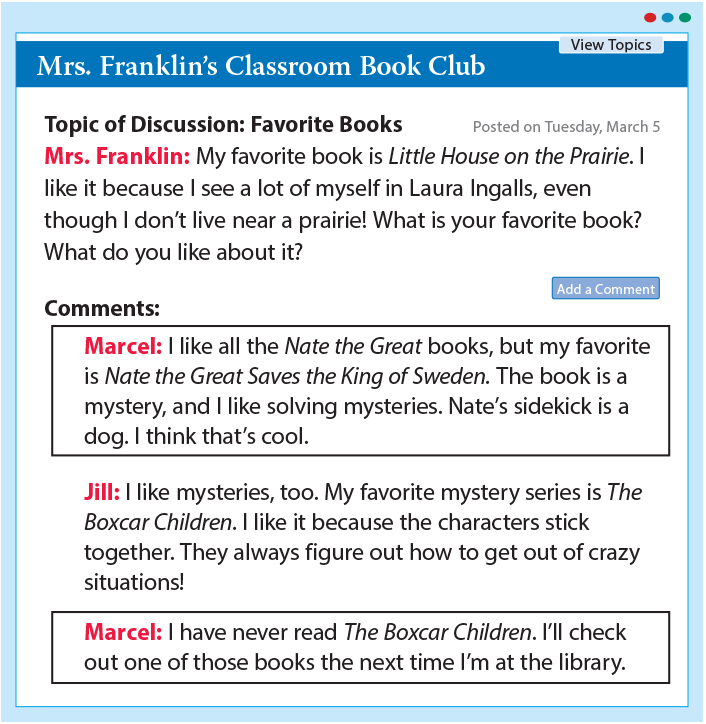
Blogs are online journals. Blog posts are more public than journal entries because other people can read and respond to them. In the sample below, Marcel becomes part of an online “conversation.” He responds to a question posed on a classroom blog. He also responds to one of his classmates. (Marcel’s blog posts are in the boxes.)
Sample Classroom Blog
Listen to the sample.
Respond to the blog.
Answer the following question about the sample blog. Make a copy of this Google doc or download a Word template.
- How is the sample blog different from the sample journal entry?

Prewriting for Personal Journals
Prewriting is your first step to writing anything. The prewriting activity in this lesson will help you choose topics for your journal entries.
Prewriting for Personal-Journal Topics
Gather topic ideas.
Finish the sentence starters to gather topic ideas for a journal entry. Draw a star next to the topic you most want to write about. Make a copy of this Google doc or download a Word template.
- The best part of my day happened when . . .
- The worst part of my day happened when . . .
- Something I feel happy about is . . .
- Something I feel confused about is . . .
- One neat thing I learned in school today was . . .

Writing in a Personal Journal
Once you pick a topic, you are ready to begin writing your journal entry. As you write, remember that you are writing for yourself, not a teacher or a mystery reader. You don't have to get every idea written down perfectly. If you get hung up on a confusing grammar rule or a complicated spelling, move on and get your thoughts down as best you can.
Writing a Personal-Journal Entry
Write a personal-journal entry.
Write a journal entry about the topic you starred in the last activity. As you write, let ideas about your topic flow freely. Don’t worry about getting everything right. If you can't think of anything else to write, answer one of the questions at the bottom of the page.
Name:
Date:
Entry:
Are you stuck? Answer one of these questions to help you get going.
What do I want to remember about my topic?
How does my topic make me feel?
What did I learn about my topic?
What else do I want to know about my topic?

Prewriting for Response Journals
Writing about the reading you do in school helps you get closer to the action, ideas, and characters in the text. These prewriting activities will introduce you to response journals and help you gather writing ideas.
Prewriting for Response-Journal Topics
A response journal is a place to write about the stories, books, and classroom materials you read. Here’s a sample entry from a response journal.
Listen to "Rogues to Riches"
Title and AuthorRogues to Riches by J. Robert King
This book is funny and strange. I like Rengie and Tooles, rogues who want to get rich. Thoughts and FeelingsThey start the book in prison, and they have a spitting contest to escape.
Rengie and Tooles pretend to be a couple of knights so that they can steal a treasure, but a cursed rose makes them have to actually become knights.
Book DetailsI'm only halfway through, but I like all the goofy jokes. Right now, they're back in prison. They've just convinced an orc guard to release them if they let him"come back at the end of the book." I wonder if he'll be back. . . .
Gather writing ideas.
Answer the questions to come up with ideas for a response journal. Make a copy of this Google doc or download a Word template.
- What am I reading in school?
- What have I learned from it?
- What do I like best about it?
- What is the most important part so far?
- What questions do I have about it?
Write about the most important thing you learned.
Write about a difficult or unfamiliar word in the reading.
Write about what you like or dislike about one of the characters.
Predict what will happen next.

Writing in a Response Journal
Writing responses to what you read in school allows you to connect with the story or information. That connection helps you understand what is happening in the reading and appreciate the text on a deep, personal level.
Writing a Response-Journal Entry
Write a response-journal entry.
Write a journal entry about something you are reading in school. Use your answers from the last activity as a starting point. If you’re stuck, consider the ideas that follow.
Name:
Title of the Reading (Book, Heading, Chapter):
Response:
Prewriting for Learning Logs
A learning log is a special journal for exploring your thoughts about your school subjects. You might write about a topic that your teacher presented in class. Or you might ask questions about an idea you don't understand.
The writing you do in a learning log is quick and ungraded, so there is no pressure to get it perfect. These activities will give you ideas for the types of writing you can do in learning logs.
Prewriting to Create Your Learning Log
Learning logs work best when you write in them regularly. Follow these steps to set up your own learning log. Then read a sample log.
- Divide a notebook into sections—create one section for each subject you will write about.
- Plan a time to write in your learning log each day. Write for a longer time about a subject that is difficult for you.
- Write freely and use your own words. Start by writing the date. Then put all your thoughts down. Write without stopping for at least 3 to 5 minutes.
Listen to the sample.
DateApril 22, 2018
I don't understand the rock cycle Mr. Ampe talked about today. Main Takeaway from the LessonAll the rocks I've ever picked up are super hard. How do they turn into sand? And then back into rocks again? Mr. A. says erosion has something to do with it. That's a key word. QuestionsWe're supposed to read about the freeze/thaw cycle, too. That's another key word. Personal Thoughts and FeelingsThe rock cycle is amazing, though. When I saw Big Thompson Canyon, I thought those rock walls would be there forever. . .
Gather writing ideas.
Answer at least two of the questions to come up with ideas for learning logs. Make a copy of this Google doc or download a Word template.
- What questions do I have about something I am learning about in school?
- What is the most important thing I learned from a recent lesson?
- What did I learn from doing a class project or experiment?
- How does something I recently learned make me feel?
- What strategies helped me understand a new topic or concept?
- How does the topic or concept relate to other things I have done or learned?
Writing in a Learning Log
The writing you do in a learning log is quick and ungraded, so there is no pressure to get it perfect. For the best results, write freely for at least 3-5 minutes for each entry and write regularly in your log.
Writing a Learning-Log Entry
Create a learning-log entry.
Write a journal entry about a recent classroom lesson. Along with writing, feel free to draw pictures, maps, and graphic organizers—anything to help you engage with your learning. If you are having trouble getting started, try answering one of the questions from the prewriting lesson.
Write a journal entry about a recent classroom lesson. Along with writing, feel free to draw pictures, maps, and graphic organizers—anything to help you engage with your learning. If you are having trouble getting started, try answering one of the questions from the prewriting lesson.
Name:
Date:
Entry:
Writing on Classroom Blogs
A classroom blog is an online space that your teacher sets up. It can host a written version of a group discussion, allowing you to share ideas with your classmates and teacher. In this lesson, you will read a sample writing prompt and response from a classroom blog. Then you will write blog posts and comment on others' posts.
Writing a Blog Post
As with journal entries, blog posts should include your personal thoughts and feelings, written in a relaxed and conversational style. However, unlike some journals, your blog posts will likely be read by other people, so make sure your responses are clear and polite.
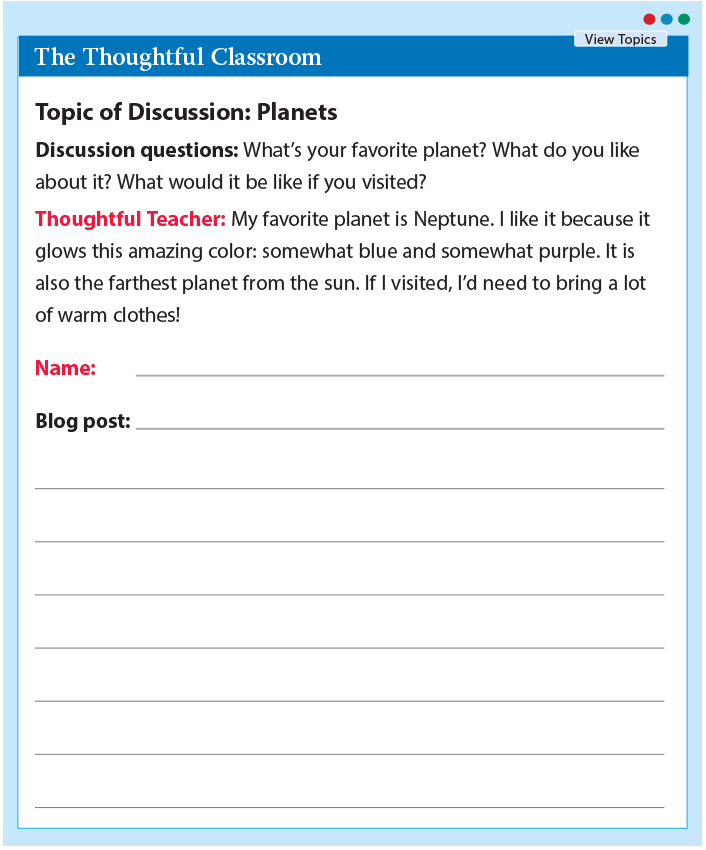
Respond to a discussion.
Read the teacher’s discussion questions and sample blog post. Then write your own blog post in response to the discussion questions. Make a copy of this Google doc or download a Word template.
Reading and Commenting on Blogs
What makes blog posts really special is that other people can read and comment on them. Just remember to respond politely. Here are some ways to comment on another person’s blog post:
- Offer your own opinion (personal thoughts or feelings) on the topic.
- Give a compliment.
- Offer advice.
- Ask a question.
Practice reading and commenting on blogs.
Pick a partner for this activity. Then follow the steps to complete the activity. Make a copy of this Google doc or download a Word template.
- Have one person be the blogger and the other person be the commenter.
- The blogger should write a short blog post that responds to this prompt:
- We all feel upset sometimes. What helps you calm down when you feel upset?
- The commenter should read and respond to the blogger’s post from step 2, offering an opinion, giving a compliment, offering advice, or asking a question.
- The blogger should read and respond to the commenter’s post from step 3.
- The commenter should now read and respond to the blogger’s post from step 4.
Blogger's name:
Commenter's name:

Revising and Editing Blog Posts
Because blogs are published on the Internet, they may be read by a wide online audience. For that reason, you should avoid sharing personal information. You should also make sure you express your ideas clearly and correctly. Revising and editing will help you do just that, and you can use a checklist to guide you.
Revising and Editing with a Checklist
Before you publish a blog post, make sure it says exactly what you want it to say. Also check for spelling and punctuation. The checklists below will help you quickly revise and edit blog posts.
Revise and edit with a checklist.
Read each line. When you can answer each question with yes, check it off. Make a copy of this Google doc or download a Word template.
Checking Your Ideas
- Does my writing answer a question, share my opinion, or tell about something I know or experienced?
- Have I read my entire post out loud?
- Have I said everything I want to say?
- Is my writing friendly, informative, and polite?
Correcting Your Ideas
- Are first words in sentences capitalized?
- Are proper names of people, places, and things capitalized?
- Did I use end punctuation after all my sentences?
- Are words spelled correctly?
Reflecting on Journals and Blogs
Throughout this unit, you have been reflecting on your life and learning through writing. In this final lesson, you'll reflect on your journal and blog writing to consider what you've learned along the way.
Reflecting on Your Writing
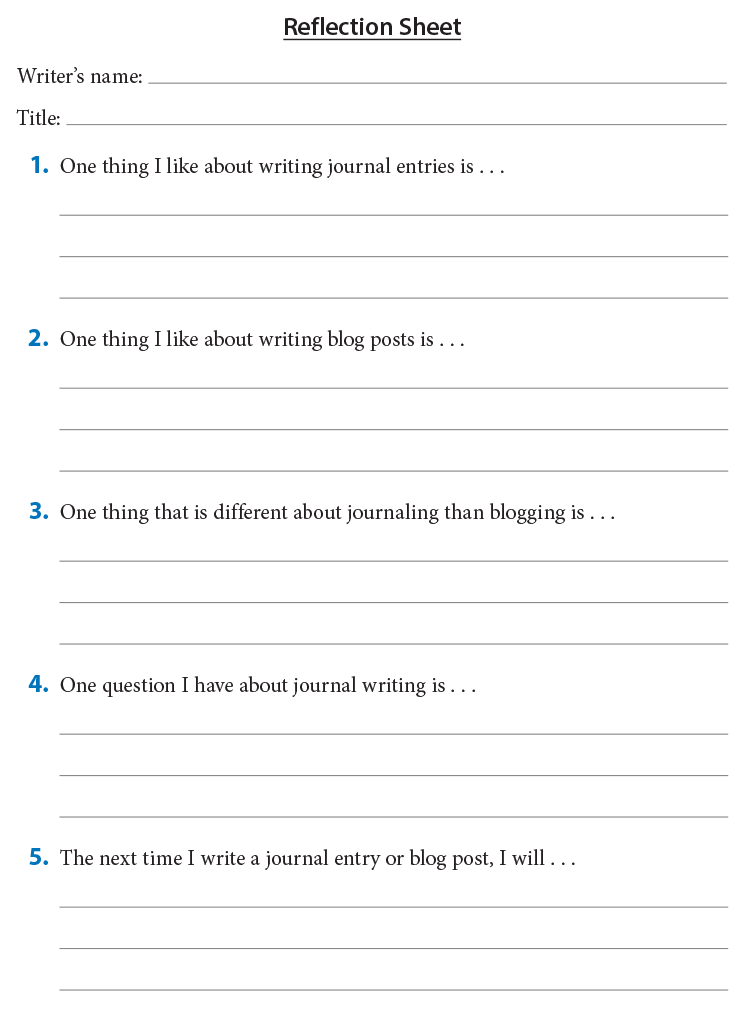
Fill out a reflection sheet.
Complete the following form to think about your experiences with journaling and blogging. Make a copy of this Google doc or download a Word template.
Comments
Post a Comment